Rain was coming down hard enough to make the Golden Spoon’s windows shake.
Sylvie Brooks stood outside with her baby brother tucked against her chest and watched strangers eat bread they had not even touched.
She was five years old, barefoot, and trying very hard not to cry because Tommy always cried harder when he heard her.
Her aunt Vanessa had shut the apartment door three weeks earlier and told her there was no room for two hungry mouths.
Since then, Sylvie had learned which church steps stayed dry, which alleys had heat vents, and which grown-ups looked through children as if they were fog.
The one thing she had kept was her mother’s old plastic nurse card.
Elena Brooks, RN.
Sylvie kept it in her coat pocket and touched it whenever she needed to remember that her mother had been brave.
That night, Tommy’s cry had faded into a thin little sound, and that was what finally made Sylvie open the restaurant door.
Warmth rolled over her face.
So did silence.
Thirty people turned toward the barefoot child dripping on the polished floor.
The manager came at her from behind the hostess stand with a napkin in one hand and disgust in his eyes.
His name tag said Tom.
“You cannot stay here,” he said.
Sylvie swallowed.
“Please, sir, just somewhere warm for my brother.”
Tom looked at the baby, then at the wet footprints, then at the customers who wanted the unpleasant thing removed from their dinner.
“Leave now, or I’ll throw you into the storm and let someone take him.”
Sylvie said nothing.
She had learned that poor children were expected to apologize for being seen.
At table twelve, Russell Morrison heard the sentence and still looked back down at his plate.
He was forty-two, rich, exhausted, and angry at a world that kept interrupting him.
He owned hotels, warehouses, offices, and more suits than he had friends.
Three years earlier, he had lost his daughter Emma to a fast infection that turned a fever into a funeral.
Since then, he had eaten alone, worked alone, slept badly, and told himself that needing no one was strength.
Then the pain struck his chest.
It was not a warning at first.
It was a fist.
His fork slipped from his hand.
His left arm went numb.
He tried to breathe and found nothing there.
The room blurred.
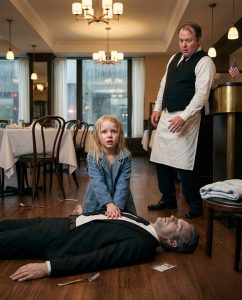
Russell hit the floor before anyone understood what was happening.
People screamed.
Chairs scraped.
Someone shouted for an ambulance.
Tom kept pointing at Sylvie as if the child and the dying man were the same problem.
Sylvie looked at Russell’s mouth and saw no breath moving.
Her mother’s voice came back to her.
Check.
Call.
Press.
She shoved her nurse card onto the floor beside Russell’s shoulder, because it made her feel less alone, then asked an old woman to hold Tommy.
The woman took the baby without speaking.
Sylvie knelt and put both hands on the center of Russell’s chest.
The first push barely moved him.
The second hurt her wrists.
By the tenth, tears had started slipping down her face.
By the twentieth, the restaurant had gone quiet.
Nobody was laughing at her feet anymore.
Sylvie counted because counting was easier than fear.
One person in the room knew what courage looked like, and she was too young to spell it.
The paramedics arrived with their bags and wires and adult hands.
The first one stopped when he saw Sylvie.
“Who started CPR?”
Nobody answered.
The old woman holding Tommy pointed.
“She did.”
The paramedic looked down at the plastic nurse card near Russell’s shoulder.
Then he looked at Sylvie as if he had seen something sacred in a place that sold steak.
“Your mama taught you well,” he said.
They took over.
The first shock lifted Russell’s body.
The second brought no answer.
On the third, the monitor found a rhythm.
Russell’s eyes opened long enough to see a small blonde girl shaking beside him.
“Thank you,” he breathed.
Sylvie wanted to say she was glad he was alive.
Tom stepped between them, his face gray now that every customer had witnessed his shame.
Sylvie took Tommy back, slipped the nurse card into her pocket, and walked out before the warm room could turn cold again.
Russell woke in the hospital before dawn with wires on his chest and a grief he did not understand pressing behind his ribs.
His assistant Harris sat in a plastic chair, looking as if he had aged ten years overnight.
The doctor said Russell had suffered a severe heart attack.
The doctor also said immediate CPR had kept him alive.
Russell closed his eyes and saw tiny hands working on his chest while full-grown adults stood frozen.
“Find her,” he told Harris.
Harris thought medication was speaking.
Russell repeated it.
“Find the girl with the baby.”
The first day brought nothing.
No shelter had a record of her.
No police report matched her.
Tom at the Golden Spoon claimed he had not seen where she went.
On the second day, Harris got the security footage.
The video showed Sylvie entering, being threatened, saving Russell, and leaving with Tommy in her arms.
It also showed a woman in booth seven watching the whole scene.
She never stood.
She never called out.
She simply lifted her coffee and smiled while the child she knew was pushed back toward the rain.
The receipt said Vanessa Brooks.
Russell stared at the last name for a long time.
He should have been resting.
Instead, he signed himself out against everyone’s advice and went back to the neighborhood around the restaurant.
He showed Sylvie’s picture to a baker, a cashier, a bus driver, and a woman sweeping hair from a salon floor.
Most people shook their heads.
One man remembered a little girl sleeping behind the laundromat with a baby wrapped in blue.
Russell found her near dusk behind a row of trash cans, searching for food with one arm while Tommy lay against her other shoulder.
She turned when he said her name.
Fear moved across her face before recognition did.
“We didn’t steal anything,” she whispered.
Russell lowered himself onto one knee in the wet alley.
His expensive coat touched the dirty ground, and for once he did not care what it cost.
“You saved my life,” he said.
Sylvie looked down at Tommy.
“My mama said you try.”
Russell took them first to a diner because trust could not be demanded from a hungry child.
He ordered soup, milk, bread, and mashed potatoes soft enough for Tommy.
Sylvie ate slowly at first, waiting for someone to snatch the bowl away.
When nobody did, hunger won.
Russell watched her feed Tommy before she took full bites for herself, and something in him shifted from gratitude to responsibility.
He had once thought love was something that arrived complete.
Now he saw that sometimes it began as a bowl placed gently in front of a child.
He asked about her mother.
Sylvie told him Elena had been a nurse, that she had gotten sick after Tommy was born, and that Vanessa had taken them in only until the sympathy cards stopped coming.
She said Vanessa had promised to find help.
Instead, she had put a grocery bag of clothes in Sylvie’s hands and shut the door.
Russell did not say what he wanted to say about Vanessa.
He only asked if Sylvie would come somewhere safe for the night.
She asked if Tommy could come too.
That was when Russell understood the size of the promise he was making.
“Both of you,” he said.
His house had been quiet for three years.
That night, it filled with bathwater running, a baby drinking warm formula, and a little girl crying into clean sheets because relief had finally found her.
Harris brought clothes, diapers, bottles, and more stuffed animals than one baby could reasonably need.
Mrs. Winslow arrived two days later, gray-haired and steady, with the kind of voice that made children believe the room would not fall apart.
Sylvie did not trust her at first.
She did not trust anyone quickly.
But Mrs. Winslow asked permission before picking up Tommy, praised Sylvie for knowing his favorite lullaby, and never once called her dramatic for being afraid.
Russell tried to return to work and failed at it.
He sat in meetings thinking about formula temperatures.
He read contracts while listening for small footsteps.
He canceled calls when Tommy coughed.
The man who used to measure days in profit began measuring them in whether Sylvie had smiled before lunch.
Then, one night, Sylvie woke with a fever and a chest that rattled when she breathed.
Russell carried her and Tommy into the emergency room wrapped in the same blanket Mrs. Winslow had warmed in the dryer.
Sylvie clutched his shirt.
“My mama went to the hospital and didn’t come back.”
Russell sat beside her bed all night.
He told her about Emma, the daughter he had lost, and how grief had turned his house into a museum of everything he could not save.
Sylvie listened with fever-bright eyes.
“Would Emma be happy you found us?” she asked.
Russell had to cover his mouth before he could answer.
“I think she would.”
Sylvie got better.
The antibiotics worked.
The fear did not vanish, but it loosened enough for hope to breathe.
On the morning she was released, Russell asked if she and Tommy would let him become their father legally.
Sylvie asked if families sent children away when they made mistakes.
Russell said no.
She asked if Tommy would always stay with her.
Russell said yes.
She asked if he was sure he wanted both of them.
Russell looked at the baby chewing his own sock and the little girl who had restarted his heart on a restaurant floor.
“I have never been more sure of anything,” he said.
The adoption process should have been simple because Vanessa had abandoned them.
It was not simple.
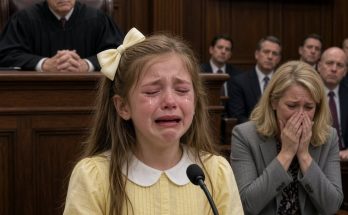
Vanessa appeared at the courthouse in a burgundy coat, smelling of perfume and outrage.
She told the judge she had been searching everywhere for her sister’s children.
She dabbed at dry eyes.
She said family belonged with blood.
Sylvie went stiff beside Russell.
Tommy started to fuss.
Harris placed a folder on the table.
Inside were bank records showing that Vanessa had collected emergency child support from a charity fund after Elena died.
Inside was the Golden Spoon receipt from booth seven.
Inside were still images of Vanessa watching Sylvie carry Tommy back into the rain.
The judge looked at the pictures longer than anyone expected.
Vanessa stopped crying.
The courtroom was so quiet that the stamp in the clerk’s hand sounded loud when it came down.
Russell became Sylvie’s father.
He became Tommy’s father.
Their last name became Morrison, but Russell kept Brooks as Sylvie’s middle name because she wanted to carry her mother somewhere safe.
Three months later, snow began falling over the city, and Russell drove the children back to the Golden Spoon.
Sylvie held his hand at the door.
She was six now, wearing a blue dress and winter boots with silver stars on them.
Tommy bounced on Russell’s hip, round-cheeked and healthy.
Tom saw them and came forward before anyone could call him.
He did not make excuses.
He knelt, which made Sylvie blink in surprise.
“I was cruel to you,” he said.
Sylvie looked at Russell, then back at Tom.
“Yes,” she said.
It was not angry.
It was true.
Tom nodded like the word had weight.
“I am sorry.”
Russell did not force her to forgive him.
Children who survive cruelty do not owe adults a clean ending.
But Sylvie took the small bowl of ice cream Tom offered, and after a minute she said thank you.
They sat at table twelve.
Russell ordered soup first because some memories deserve to be answered properly.
Halfway through dinner, Harris arrived with one more folder.
Russell frowned because he had promised no work that night.
Harris spoke softly.
“You asked me to check Elena Brooks against old hospital records.”
Russell went still.
Years earlier, when Emma was dying, a nurse had stayed past her shift because Russell was stuck in a snowstorm and could not reach the hospital in time.
That nurse had held Emma’s hand, sung to her, and written Russell a note telling him his daughter had not been alone.
Russell had kept the note but never known the nurse’s full name.
Harris slid a copy across the table.
Elena Brooks, RN.
Sylvie’s mother had held Russell’s daughter when he could not.
Sylvie had held Russell’s life when he could not hold it himself.
For a moment, the restaurant disappeared around them.
Russell looked at Sylvie, and Sylvie touched the old nurse card that now lived in a tiny frame on a chain around her neck.
“Mama helped Emma?” she whispered.
Russell nodded, crying openly now.
“She did.”
Sylvie climbed into his lap right there at table twelve.
Tommy patted Russell’s tie with sticky fingers.
Outside, snow gathered on the window ledge where rain had once run in rivers.
Russell had spent years believing his story ended in a hospital room.
He had been wrong.
Some endings wait for a barefoot child to open the door.