
I visited the hospital where my husband worked as chief surgeon and calmly told the receptionist I was his wife. She gave me an uneasy smile and said that could not be true—because his wife had signed in only minutes earlier.
I stopped by my husband’s hospital shortly after lunch, carrying a paper bag containing his favorite turkey club from Delaney’s and the blue tie he had left draped over our bedroom chair that morning.
My husband, Dr. Nathaniel Pierce, was chief surgeon at St. Catherine’s Medical Center in Boston.
People behaved differently when they heard his name.
Nurses stood straighter.
Residents lowered their voices.
Donors smiled more brightly.
I had been married to him for eleven years—long enough to understand the rhythm of his professional world and the polished version of himself he presented inside it.
A sign near the entrance read:
“Visitors must check in first.”
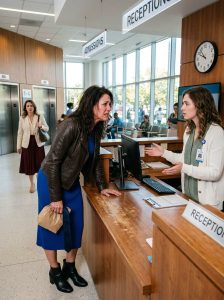
So I approached the reception desk.
The young woman seated there looked about twenty-five. She had glossy brown hair, a professional smile, and a badge identifying her as Emily Warren.
“Name of patient or staff member you’re visiting?” she asked.
“Dr. Nathaniel Pierce,” I replied. “I’m his wife.”
Her fingers stopped above the keyboard.
Then she smiled.
It was not exactly rude. It was the expression of someone who had heard an amusing mistake and was searching for the gentlest way to correct it.
“That can’t be right,” she said. “His wife was just here.”
For one second, every sound in the hospital faded.
The rolling carts.
The elevator chime.
The distant announcements.
All I could hear was my heartbeat.
I smiled and allowed her to continue.
“She left maybe ten minutes ago,” Emily explained, glancing toward the private elevator. “Blonde, tall, cream coat. She said Dr. Pierce asked her to pick up some documents from his office.”
I slowly placed the lunch bag on the counter.
“Did she sign in?”
“Of course.”
Emily turned the visitor log slightly, then hesitated.
“I probably shouldn’t—”
“It’s fine,” I said gently. “Nathan’s always telling me the hospital has tightened security.”
The compliment relaxed her.
“She signed as Mrs. Pierce,” Emily said. “First name… Vanessa.”
Vanessa.
Not a patient.
Not a colleague.
Not a name Nathan had ever mentioned.
I lowered my gaze and pretended to search through my handbag.
In reality, I watched Emily’s reflection in the glass behind her.
She had started replaying the conversation and now looked nervous.
“Did she have clearance?” I asked.
“She had his badge,” Emily whispered. “Not on a lanyard. Just in her hand.”
My smile remained steady.
Nathan had told me three days earlier that his badge had been lost.
I thanked Emily, took the elevator to the surgical administration floor, and went directly to Nathan’s office.
His assistant, Marjorie, was away at lunch.
The office door was locked.
But marriage teaches you many things.
Birthdays.
Weaknesses.
Passwords.
And where a husband keeps his spare key.
Inside, the top drawer of Nathan’s desk had been left open.
One file was missing.
The label beside the empty space read:
**Patient Incident Review — L. Monroe.**
Then my phone vibrated.
A message from Nathan appeared.
*Where are you?*
I looked at the empty file slot and typed:
*At the hospital.*
Three dots appeared.
Then disappeared.
Then returned.
Finally, his reply arrived.
*Don’t move.*
PART 2
I moved.
Not because I was unafraid.
I was frightened.
A small instinctive part of me wanted to leave the hospital, drive home, lock every door, and pretend the name Vanessa had never entered my life.
But I moved because Nathan had ordered me not to.
After eleven years of marriage, I knew the difference between his anger and his fear.
That message had come from fear.
I closed the drawer exactly as I had found it, wiped the brass handle with a tissue, and returned to the hallway.
The surgical administration floor looked perfectly ordinary.
White walls.
Framed awards.
Photographs of Nathan shaking hands with governors, donors, and hospital board members.
A man adored by the public needed walls filled with witnesses.
At the nurses’ station, an older woman in navy scrubs was organizing charts.
Her badge read:
**Denise Carter, RN.**
“Excuse me,” I said. “I’m looking for Vanessa.”
Her expression changed.
The reaction was almost invisible—a slight tightening around her mouth and a quick glance toward the elevators.
“Vanessa who?” she asked.
“That’s what I’m trying to find out.”
Denise studied me.
My wedding ring.
My coat.
My face.
“You’re Mrs. Pierce,” she said.
“The real one, apparently.”
Her eyes dropped.
Before she could respond, a door opened farther down the corridor.
Nathan emerged from Conference Room B wearing his white coat. His silver hair was perfectly arranged, and his expression remained controlled.
Hospital counsel, Gregory Hale, walked beside him, along with two board members I recognized from charity dinners.
Nathan saw me.
For the first time in years, my husband looked caught.
“Claire,” he said, walking toward me too quickly. “You shouldn’t be up here.”
“I brought lunch.”
“This is not a good time.”
“No,” I replied. “I imagine it isn’t.”
Gregory Hale looked between us.
“Dr. Pierce, we need to continue.”
Nathan kept his eyes on me.
“Go home. I’ll explain tonight.”
“You can explain now.”
His jaw tightened.
Then I saw her.
At the far end of the corridor near the stairwell, a tall blonde woman in a cream coat stood partly hidden inside a vending-machine alcove.
Beautiful.
Unfamiliar.
Yet strangely recognizable in the way strangers become recognizable once they have already damaged your life.
Our eyes met.
She turned and ran.
I went after her.
Nathan shouted my name, but I had already entered the stairwell.
My heels struck the metal steps while the smell of concrete and disinfectant rose around me.
“Vanessa!” I called.
She reached the landing below, slipped, and caught the railing.
I caught up before she could open the next door.
“Who are you?” I demanded.
She looked terrified.
But not ashamed.
“My name is Vanessa Monroe,” she said.
Monroe.
The missing report.
Cold spread through me.
“L. Monroe,” I said. “From the incident review.”
Her eyes filled.
“Lily Monroe was my sister.”
The stairwell door opened above us.
Nathan’s voice echoed downward.
“Claire.”
Vanessa stepped closer and pushed something into my palm.
A small flash drive.
“He killed her career,” she whispered. “Then he let her die.”
Nathan appeared above us, breathing hard, his flawless hospital expression completely gone.
“Claire,” he said again, more softly. “Give that to me.”
I looked at my husband.
Then closed my hand around the drive.
PART 3
For several seconds, no one moved.
The fluorescent lights hummed above us.
Beyond the stairwell walls, an announcement requested a respiratory therapist in the east wing.
Ordinary hospital life continued only inches away, separated from us by concrete, fire doors, and reputation.
Nathan stood three steps above me.
Vanessa stood one step below.
And I remained between the woman who had falsely claimed to be my husband’s wife and the man who had spent eleven years convincing me he never panicked.
“Claire,” Nathan said carefully, “you don’t understand what she’s doing.”
Vanessa gave a bitter laugh.
“Of course. Start there.”
Nathan ignored her and kept looking at me.
“That drive contains confidential hospital records. If you walk out with it, you could be charged. She knows that. She’s using you.”
“What’s on it?” I asked.
“Nothing you’re qualified to interpret.”
Even cornered and visibly sweating, Nathan reached first for superiority.
I turned toward Vanessa.
“What’s on it?”
“My sister’s operative timeline,” she replied. “Internal emails. A recording. A copy of the complaint she filed before she died.”
Nathan’s expression hardened.
“Lily Monroe died from a post-operative complication. It was tragic, but it was reviewed.”
“She wasn’t supposed to be in that operating room,” Vanessa snapped. “You made sure she was assigned to your case after she reported you.”
I turned back toward Nathan.
For once, he had no immediate response.
Vanessa continued, her voice trembling.
“Lily was a surgical fellow here. She discovered that Dr. Pierce had been allowing an unapproved medical-device representative into operations. The representative wasn’t merely observing. He was advising device placement during spinal procedures because the company was funding Nathan’s research program.”
“That is not true,” Nathan said.
“It is true,” Vanessa answered. “Lily reported it. Afterward, her evaluations suddenly changed. She became unstable. Difficult. Not a team player. Then she was scheduled for a marathon emergency shift and placed into a procedure she had already objected to.”
The name returned to me.
Lily Monroe.
Two years earlier, Nathan had come home unusually quiet for three consecutive evenings.
He told me a young physician had died following complications from an appendectomy.
He described it as tragic and unavoidable—the type of loss that haunted even excellent hospitals.
I made him tea.
I sat beside him on the couch while he stared into the distance.
I had comforted him.
The memory sickened me.
“What happened to her?” I asked.
Vanessa swallowed.
“She developed sepsis after surgery. There were delays and missed warning signs. The attending physician documented that Nathan was notified twice.”
Nathan stepped down one stair.
“Enough.”
I stepped backward, away from him.
That movement affected him more deeply than anything I could have said.
“Claire,” he said, now performing hurt because anger had failed. “You know me.”
“I thought I did.”
Gregory Hale entered the stairwell behind Nathan, followed by a hospital security officer.
Gregory looked pale but determined.
“Mrs. Pierce,” he said, “please hand over the device.”
“Why?”
“It may contain protected health information.”
“Then you should be extremely concerned that a stranger entered this hospital carrying my husband’s badge and removed documents from his office.”
Gregory pressed his lips together.
Vanessa raised her chin.
“I didn’t steal anything that hadn’t already been copied and buried. Lily emailed part of the material to herself before she died. I only came for the original incident report because someone warned me the board was meeting today to destroy the remaining drafts.”
“That’s absurd,” Gregory said.
“Is it?” I asked.
No one answered.
The security officer shifted awkwardly.
He was a broad man with kind eyes who clearly regretted being assigned to a conflict involving powerful doctors and their secrets.
Nathan extended his hand toward me.
“Claire. Give me the drive. We’ll go home. We’ll discuss this privately. Whatever she has told you, whatever she believes happened, I can explain.”
His voice softened on the word *home.*
Once, that would have worked.
But I understood too much now.
His supposedly lost badge.
The false wife.
The missing report.
The attorney.
The board members gathered behind a closed door.
His first message had not asked whether I was safe or what had happened.
It had said:
*Don’t move.*
He had not been worried about me.
He had been worried about what I discovered.
I placed the flash drive inside my coat.
Nathan’s eyes followed the movement.
“Claire,” he said quietly enough that only I could hear, “think carefully. Everything you have, the house, the foundation, your place on every board in this city, came from my name.”
There he was.
Not the grieving surgeon.
Not the brilliant husband.
Not the charming man who kissed my forehead at formal events.
The owner.
I smiled at him exactly as I had smiled at Emily downstairs.
“You should have remembered something, Nathan.”
His nostrils flared.
“I had a name before yours.”
Then I faced the security officer.
“Please escort me to the public lobby. I don’t want to be alone with my husband.”
The officer looked toward Gregory.
Gregory looked at Nathan.
Nathan said nothing.
That silence became the first visible crack in his kingdom.
When we entered the lobby, Emily looked up from the reception desk.
Her eyes widened when she saw Nathan following at a distance with his white coat open and his face stripped of warmth.
“Mrs. Pierce?” she asked softly.
“Yes,” I replied. “The real one.”
I stepped outside into the cold Boston afternoon and called my older brother, Daniel Whitaker.
Daniel was not a surgeon.
He did not charm donors or enjoy formal galas.
He disliked tuxedos, hospital fundraisers, and men like Nathan who concealed threats behind controlled voices.
He was, however, a federal prosecutor.
He answered on the second ring.
“Claire?”
“I need you.”
His tone changed instantly.
“Where are you?”
“St. Catherine’s. I have a flash drive. It may involve medical fraud, retaliation, and a patient death.”
He paused.
Then said, “Do not give it to anyone. Do not go home. I’m sending someone to you now.”
Forty minutes later, I sat inside the back room of a coffee shop two blocks from the hospital with Daniel, Vanessa, and an investigator named Mara Singh.
Vanessa’s cream coat rested folded across her lap.
Without the confidence of her disguise, she appeared younger.