My parents and sister locked my six-year-old daughter inside my SUV during a heatwave and went to lunch with the other kids.
At the ER, Rachel laughed, “She’s not family today—she’s your burden.”
They blamed me because the SUV was registered in my name—until Officer Grant played the call that exposed what really happened.
Rachel’s voice came first.
“Mom, she keeps crying and pulling at the handle. Are you sure we should leave her?”
My mother froze before the second voice even began.
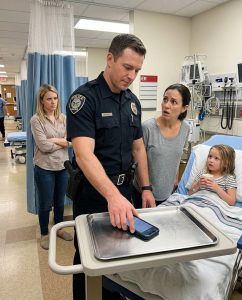
Officer Grant had placed his phone on the metal tray beside him, and the recording kept playing beneath the steady hum of the ER vents.
Every word carried through the small space outside the curtain where my daughter was lying.
She had damp hair pressed against her forehead and a paper cup held between both hands as if letting go of it might make everything around her less stable.
I could see only part of her from where I stood, but that was enough.
She was six years old.
Six.
And the adults who were supposed to protect her were already trying to decide whose name should be attached to what had happened.
Rachel’s recorded voice did not sound panicked.
It sounded irritated, like my daughter’s fear had become an inconvenience she wanted somebody else to solve.
“Turn that off,” my mother snapped.
Her eyes went straight to Officer Grant’s phone.
“You have no right to play a private family conversation.”
Officer Grant didn’t reach for it.
He didn’t argue with her, either.
“Please sit down.”
My mother remained standing for another second, her shoulders rigid, before lowering herself into the chair.
The recording continued.
Then we heard her voice.
“Lock it and come inside. We won’t be long.”
I stared at her.
She stared toward the exit.
Her recorded voice continued without hesitation.
“If anyone asks questions, the SUV is registered to her mother. Let her explain why her child was in there.”
That sentence changed the entire room for me.
Until then, part of me had still been trying to understand how three adults could make one reckless decision together.
I had been looking for the point where common sense had failed them.
Maybe someone thought another person had taken my daughter inside.
Maybe somebody misunderstood who had the key.
Maybe they had realized too late that she was still in the SUV.
The recording removed those possibilities one by one.
They knew she was there.
They knew she was crying.
They knew she was pulling at the handle.
And before they even knew whether she would be okay, my mother was already thinking about how to put the responsibility on me because my name was attached to the vehicle.
She had not simply made a terrible choice.
She had prepared an explanation for it.
Behind the curtain, I heard my daughter’s small voice.
“Mom?”
Nothing else mattered for that moment.
I went to her immediately.
Her fingers closed around my wrist as soon as I reached the bed.
She looked tired, confused, and far too serious for a child who should never have had to understand what the adults outside that curtain were arguing about.
Then she asked me the question I still couldn’t hear without feeling something inside me harden.
“Did I do something bad?”
I bent closer to her.
“No.”
She kept looking at me, waiting.
Children know when adults are giving them half an answer.
So I told her again.
“You did nothing wrong. The adults made a terrible choice. None of this belongs to you.”
Her grip stayed around my wrist.
For years, I had thought family loyalty meant finding the most generous explanation for people you loved.
That afternoon, loyalty had a different job.
It meant making sure my daughter never mistook somebody else’s cruelty for her own failure.
I stayed beside her until her fingers loosened slightly.
Then I walked back through the curtain.
My mother was still sitting near Officer Grant.
Rachel stood off to one side, arms tight against herself.
My father had gone unusually quiet.
I held out my hand toward my mother.
“Give me the SUV key.”
She looked at my palm and then at me.
That spare key had been in her possession because I had trusted her with it that morning.
Now her fingers closed tighter around it.
“How are we supposed to get home?” she asked.
The question stunned me almost as much as the recording had.
My daughter was behind a curtain in an emergency room after being locked in a hot vehicle, and my mother’s immediate concern was transportation.
“Call a ride.”
Rachel looked up sharply.
“You’re punishing everyone because one kid got overheated.”
Officer Grant’s expression changed.
I saw it happen, but I answered before he could say anything.
“You left a six-year-old locked in a vehicle during a heatwave, went inside to eat, and planned to blame me before you even knew whether she was safe.”
Rachel’s mouth tightened.
My mother lowered her voice, as if speaking softly could make what she said more reasonable.
“Families forgive mistakes.”
I looked at all three of them.
My mother had ordered the door locked.
Rachel had heard my daughter crying.
My father had been there with them.
Three adults.
One child.
“This wasn’t one mistake,” I said. “It was three adults making the same choice.”
I held out my hand again.
This time my mother finally released the key.
The little piece of metal dropped into my palm with almost no weight at all, but it felt different from the spare key I had handed her that morning.
That morning it had meant trust.
Now it meant access I was taking back.
I placed it on the metal tray beside Officer Grant’s phone.
Then I told them exactly what would change from that moment forward.
None of them had permission to use my SUV again.
None of them were allowed to take my daughter anywhere without me.
I wasn’t negotiating those boundaries, and I wasn’t asking whether they thought I was being too harsh.
My mother looked at the key as if I had done something dramatic to her.
Rachel shook her head.
My father kept his eyes down.
The argument could have stayed there, with all three of them trying to turn my decision into the real problem.
Officer Grant didn’t let it.
He looked from one face to another and asked a simple question.
“Whose decision was it to leave her in the vehicle?”
Rachel pointed at my mother immediately.
My mother turned toward Rachel almost at the same time.
“It was her idea,” Rachel said.
“That is not what happened,” my mother shot back.
They started talking over each other.
Rachel insisted my mother had made the final call.
My mother insisted Rachel had been involved from the beginning.
Each of them suddenly remembered the situation in whatever way left the smallest piece of responsibility in her own hands.
I stood there listening and realized something ugly.
When my daughter had been trapped in the SUV, they had been willing to present themselves as one family unit against her.
Now that someone was asking who had decided to leave her there, that unity disappeared instantly.
Then my father pushed his chair backward.
The sound cut through both of their voices.
He moved away from my mother.
Not far.
Just enough that the distance between their chairs became visible.
“I knew she was still in the SUV,” he said.
My mother turned toward him.
Rachel stopped speaking.
My father didn’t look at either of them for long.
He looked toward Officer Grant.
“I knew she was still in there.”
That admission hurt differently.
The recording had already told me my mother and Rachel knew my daughter was crying and pulling at the handle.