The first thing I heard when I got out of the rideshare was music.
Not a television left too loud.
Not one of Sarah’s cleaning playlists running while she folded laundry.
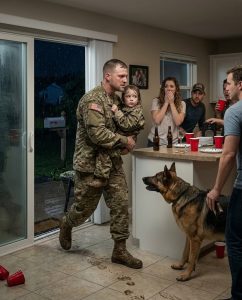
Real party music, heavy bass and bright voices, spilling through the walls of my house after midnight.
I stood at the curb with my duffel over one shoulder and my return papers in my coat, staring at the windows I had pictured for eleven months.
In my mind, that house had been quiet.
In my mind, Sarah had been asleep on the couch, Lily had been tucked under her purple blanket, and Buster had been sprawled across the hallway like the old guard he believed himself to be.
I had imagined turning my key slowly because I wanted to see their faces before they heard my voice.
I had imagined Lily waking up and running down the hall barefoot, yelling Daddy so loudly the neighbors would forgive us by morning.
That was the home I carried through every dry mile overseas.
The real one smelled like beer from the sidewalk.
The porch light was off.
The kitchen glowed like a bar.
Then Buster growled from the backyard.
That sound went straight through me because Buster did not growl at nothing.
He barked at delivery drivers, sneezed at squirrels, and whined like a puppy when Lily wore her rain boots in the house.
A growl meant danger.
I dropped my duffel near the side gate and moved toward him.
The rain had turned the ground soft, and my boots sank into the mud as I crossed the yard.
Buster stood by the shed with his head low and his body angled over something I could not see.
When he recognized me, his ears lifted, and for one second I thought he would run into my arms.
He did not.
He looked down instead.
That was when I saw Lily.
My daughter was curled in the mud in pink pajamas, one sock gone, her knees tucked up, her fingers knotted in Buster’s fur.
Her hair was wet against her face.
Her lips had lost their color.
She was five years old and small enough that my jacket could still swallow her whole.
I said her name once.
Her eyes opened like she had been waiting for something terrible to find her.
She pushed backward against the shed wall.
“You’re a ghost,” she whispered.
I have heard grown men break under fear.
I have heard radios go silent in places where silence meant someone was not coming back.
Nothing I had heard in uniform prepared me for my little girl looking at me like love had come back wearing death’s face.
I dropped to my knees so fast mud soaked through my pants.
“No, baby,” I said. “It’s Daddy. I’m here.”
She stared at my mouth like words could lie too.
Then she said the sentence that split the night in half.
“Mommy said you died in the sand.”
Behind us, the house laughed.
The music jumped.
Someone shouted Brad’s name, and a woman squealed like the night was funny.
Lily kept going in pieces.
Sarah had told her bad men made me disappear.
Sarah had told her ghosts came for children who cried too much.
Brad had told her to sleep outside with the dog until she learned to be quiet.
He had called himself Uncle Brad.
He was not her uncle.
He was the man I had told Sarah not to let into my house before I shipped out.
He was the man who borrowed my tools and never returned them.
He was the man who called Lily dramatic because she asked when her father was coming home.
I took three photos before I picked Lily up.
That choice still hurts to admit.
A father wants to grab his child first and let the world sort itself out later.
A soldier learns that proof disappears when angry people get time to clean.
I photographed the mud on her pajamas.
I photographed her bare foot.
I photographed the back door glowing behind her while the party kept going inside.
Then I wrapped her in my jacket.
She clung to me with both arms and asked if I was leaving again.
I told her no.
It was the first promise that night I knew I could keep.
Through the kitchen window, I saw Sarah with a wineglass in her hand.
She was laughing with her head tilted back.
Brad stood behind her with his arms around her waist like he belonged in the space I had paid for, repaired, prayed over, and missed.
There were red cups on the counter.
There was mud on the tile.
My deployment photo was facedown on the wall shelf.
That little detail almost broke my control.
Not the party.
Not Brad’s hands.
The photo.
It meant someone had looked at my face and decided even cardboard was too much of a witness.
I wanted to do something loud.
I wanted the whole room to feel what Lily had felt outside in the cold.
Instead, I held my daughter higher and walked to the door.
Buster came with me.
When I kicked the back door open, the kitchen went silent as if someone had cut the power to every lie at once.
Sarah’s face went empty.
Brad stepped back.
A bottle rolled off the counter and hit the floor.
The music played three more seconds before a man by the speaker finally shut it off.
Nobody asked why my daughter was covered in mud.
That told me more than any confession could have.
I looked at Sarah and said, “Nobody touches my daughter.”
My voice did not shake.
That frightened her more than shouting would have.
Brad tried to smile.
He said I was overreacting.
He said Lily liked playing with the dog.
He said kids make things up when they want attention.
Buster moved before I could.
He stepped between Brad and Lily, shoulders raised, and the brave man with my beer in his hand stopped cold.
That was the first honest thing Brad did all night.
He showed the room exactly what he was when something smaller was no longer alone.
Sarah finally found her voice.
She said I should have called.
She said she thought I was coming next week.
She said the party was just friends.
She said Lily had been having nightmares.
She said so many things so quickly that every sentence shoved the last one aside.
Then Megan, one of Sarah’s friends, started crying by the sink.
“You told us he was dead,” she said.
The room shifted toward Sarah.
Megan wiped her face with both hands and looked at me like I was the one who needed the apology.
“She told us the Army mailed a flag,” Megan said. “She said Lily was making herself sick because she wouldn’t accept it.”
Sarah snapped Megan’s name, sharp and warning.
Megan flinched, and that flinch told me Sarah had been practicing control on more than one person.
A knock hit the front door.
Two patrol officers stood on the porch with rain on their shoulders.
The neighbor behind us had called after hearing Lily cry near the fence.
One officer looked at my uniform, then at Lily’s muddy pajamas, then at Sarah’s party dress.
His face changed slowly.
Not dramatically.
Professionally.
That was worse for Sarah.
Professional anger has paperwork behind it.
The officer asked who had been outside.
Lily lifted one hand from my jacket.
Sarah whispered, “Baby, don’t.”
Lily hid her face in my neck.
I felt her shaking through the fabric.
That was when Buster started growling at the pantry door.
At first, I thought he heard another guest hiding.
Then he scratched once near the bottom shelf.
The officer opened the pantry and moved a bag of dog food.
Behind it sat a shoebox.
My name was on the top in Lily’s crayon handwriting.
Inside were letters.
Not Sarah’s letters.
Mine.
Every envelope I had mailed from deployment was stacked inside, unopened, bent at the corners, still carrying dust from places Lily had been told swallowed me whole.
The room went so quiet I could hear rain ticking against the open door.
I picked up the first one.
A dinosaur sticker was sealed under the flap because Lily had loved dinosaurs that month.
I picked up another.
A crooked little drawing of our house was visible through the paper.
I had drawn smoke from the chimney even though our house did not have one, because Lily thought every happy house should.
Sarah said my name like a person stepping toward a cliff.
I did not answer.
Under the letters was one folded note in Sarah’s handwriting.
It was not addressed to me.
It was addressed to Brad.
The officer read it first.
His jaw tightened.
Then he handed it to me.
Sarah had written that Lily was “getting harder to manage” because she kept asking when I would call.
She wrote that the death story was working, but the letters had to stay hidden until Lily stopped waiting.
The last line was worse than the rest.
If he walks back in, I will say he abandoned us first.
That was the final twist Sarah had built for me.
She had not only buried me in my daughter’s mind.
She had prepared a grave for my name too.
Cruelty borrows darkness, but it always forgets that someone may come home carrying a light.
I had not come back from the desert to haunt Sarah.
I had come back to end the ghost story she wrote for our child.
The officers separated everyone after that.
Megan gave a statement.
The neighbor gave a statement.
The man in the baseball cap admitted Brad had joked earlier that Lily was “outside learning respect.”
Brad called it a misunderstanding until the officer asked why a child had one sock and blue lips in the rain.
Then he stopped talking.
Sarah cried only when the officers asked for her phone.
Not when Lily shook.
Not when the shoebox came out.
Not when Buster sat in front of my daughter like a wall.
Only when the screen lit up and she realized messages could outlive lies.
By sunrise, Lily was asleep in my arms at the hospital while a nurse warmed her with blankets and spoke to her like every word was a soft place to land.
She was not seriously hurt.
That sentence is the only reason I can tell this story without losing myself.
Cold, frightened, neglected, yes.
But alive.
Alive because Buster stayed with her.
Alive because a neighbor heard crying.
Alive because I came home early.
People like to say timing is luck.
Sometimes timing is mercy wearing a watch.
The emergency order came the next afternoon.
Sarah was not allowed near Lily without supervision.
Brad was barred from the property.
The house became quiet in a way that felt strange at first, like the walls were holding their breath after months of being forced to listen.
I turned my deployment photo faceup again.
Then I took it down.
I did not want Lily to learn love from pictures on shelves.
I wanted her to learn it from breakfast, bedtime, clean socks, and the sound of a door opening when she called.
For a while, she asked me every night if ghosts could lie.
I told her ghosts were not our problem.
People who lied were.
We made a new rule after that.
Every letter in the house was opened together.
Every scary story had to be checked in daylight.
Every time I left a room, I told her where I was going and when I would be back, even if I was only taking out the trash.
Healing a child is not one dramatic speech.
It is repetition.
It is proof arriving on schedule.
It is showing up so often that fear gets bored waiting for you to disappear.
Buster slept outside Lily’s door for three months.
If I walked past at night, he opened one eye, judged me worthy, and went back to sleep.
Lily started kindergarten with two socks, a purple backpack, and a laminated picture of me tucked inside the front pocket because her counselor said small anchors help.
One Friday, she came home with a drawing.
It showed a house, a dog, a little girl, and a man in green standing in the doorway.
Above us, she had written, Daddy came back from the sand.
I kept that drawing.
I kept the unopened letters too.
Not because I wanted to live inside the night Sarah made.
Because one day Lily may ask how hard I tried to reach her, and I want the answer to be something she can hold.
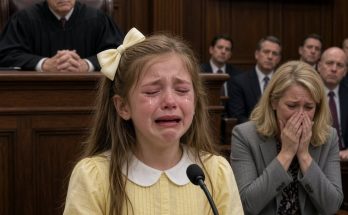
Sarah eventually tried to apologize in court.
She said she had been lonely.
She said deployment changed people.
She said Brad pressured her.
The judge listened without moving much.
Then he asked why loneliness made her put a child in the mud.
Sarah had no answer for that.
There are questions lies cannot survive.
Brad disappeared from our town after his own hearing, though men like him never think of it as running.
They call it starting over.
They call it getting away from drama.
They never call it what it is.
Leaving because the room finally saw them clearly.
The house is ours now in the only way that matters.
The locks are changed.
The pantry holds cereal, dog treats, and art supplies instead of hidden letters.
The back door still sticks where my boot cracked the frame.
I could fix it.
I have the tools.
I leave the mark there.
Not for anger.
For memory.
That door is where Lily learned her father was not a ghost.
That door is where Sarah learned a lie can fill a room until the truth kicks it open.
And every time Buster walks past it, he pauses like an old soldier checking his post.
Lily laughs now when he does it.
She tells him, “Good boy, Buster. Daddy’s home.”
Then she looks at me just to make sure.
I always answer before she has to ask.
“I’m home, baby.”
And this time, everyone in that house knows it is true.