
At midnight, my newborn daughter wouldn’t stop crying. Without warning, my mother-in-law slapped me so hard that my baby fell from my arms and lost consciousness. Then she said, “Shut her up, or get out of the house.” I rushed to the hospital, where the doctor quietly told me, “Your daughter is already…” That was when I called the police.
The slap happened so quickly that I never saw my mother-in-law raise her hand.
One second, I was standing in the dim hallway of our Columbus, Ohio, home, rocking my three-week-old daughter, Lily, while she screamed against my shoulder.
The next, Patricia Miller’s palm hit my cheek hard enough to make my ears ring.
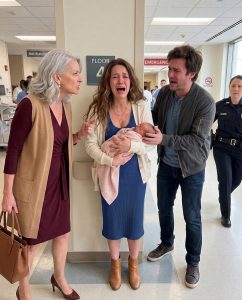
“Shut her up, or get out of the house!” she shouted.
I stumbled sideways.
Lily slipped from my arms.
Her tiny body struck the hardwood floor.
The crying stopped.
For half a second, the silence was worse than the screaming.
“Lily!”
I dropped to my knees.
My daughter lay motionless, eyes closed, one tiny fist curled beside her face.
My husband, Daniel, ran from the bedroom.
“What happened?”
“Call 911!”
Patricia stood behind me, pale but strangely rigid.
“She dropped the baby,” she said.
I stared at her.
“You hit me!”
“I barely touched you.”
Daniel froze.
“Mom?”
“She’s exhausted. She doesn’t know what she’s saying.”
I did not wait for either of them.
The nearest emergency department was less than ten minutes away.
I grabbed Lily, rushed to my car, and drove while calling 911 on speaker.
The dispatcher offered to send an ambulance to meet me, but I was already only two blocks from Riverside Methodist Hospital.
Doctors took Lily immediately.
I stood shaking in the hallway, still wearing pajama pants and a formula-stained shirt.
Twenty minutes later, a physician named Dr. Aaron Blake approached.
The look on his face made my stomach drop.
“Mrs. Miller?”
“Yes.”
“Your daughter is already in cardiac arrest.”
I stopped breathing.
“What?”
“She had no detectable pulse when you arrived. We’re performing CPR now.”
My knees weakened.
A nurse caught my arm.
Dr. Blake continued carefully.
“There are signs of significant head trauma. We need to know exactly what happened.”
Before I could answer, Daniel and Patricia appeared at the end of the hallway.
Patricia hurried toward me.
“Emily, tell them it was an accident.”
I stared at her.
Something inside me shifted.
Not grief.
Not fear.
Clarity.
I pulled out my phone and called the Columbus Division of Police.
“My name is Emily Miller,” I said when the dispatcher answered. “My newborn daughter was injured tonight. My mother-in-law assaulted me, and my baby fell because of it.”
Patricia’s face turned white.
Daniel whispered,
“Emily, what are you doing?”
I looked directly at him.
“Something I should have done a long time ago.”
Behind the emergency-room doors, an alarm began sounding.
Then Dr. Blake turned and ran back inside.
Two police officers arrived within fifteen minutes.
Officer Rachel Torres separated me from Daniel and Patricia before questioning me.
She immediately noticed the swelling on my cheek.
“Did she strike you with an open hand or a closed fist?”
“Open hand.”
“And you were holding the baby?”
“Yes.”
Patricia shouted from across the waiting area.
“She’s lying!”
Officer Torres turned toward her.
“Ma’am, stay where you are.”
Daniel looked miserable.
“Emily, maybe we should just focus on Lily right now.”
I stared at him.
“Our daughter might die because your mother hit me.”
“My mom didn’t mean—”
“Stop.”
That single word silenced him.
For two years, Patricia had controlled nearly everything in our marriage.
She owned the house.
Daniel and I had moved in after he lost his construction job.
Patricia constantly reminded us that we lived “under her roof.”
She criticized my cooking, my clothes, my parenting, even how long I breastfed Lily.
Daniel always gave the same response.
“She doesn’t mean anything by it.”
But that night, intention no longer mattered.
Dr. Blake eventually came through the doors.
I stood immediately.
“Lily?”
“We restored her heartbeat.”
I covered my mouth.
“But she’s critically ill,” he continued. “A CT scan shows bleeding around the brain. She has a skull fracture. We’re transferring her to pediatric intensive care.”
“Will she survive?”
“I can’t promise that.”
I started crying.
Dr. Blake lowered his voice.
“There’s something else. The pattern of injury is consistent with a significant impact. Because she’s an infant, hospital policy requires us to notify child protective services and law enforcement.”
Officer Torres stepped closer.
“I’m already investigating.”
Patricia stood suddenly.
“This is insane. Babies fall.”
Officer Torres looked at her.
“Mrs. Miller, you need to stop talking.”
Patricia crossed her arms.
“I know my rights.”
“Then you know you don’t have to answer questions.”
Another officer approached Daniel.
“Sir, were you present when this happened?”
Daniel hesitated.
I watched his face.
That pause told me everything.
He had heard Patricia yelling before entering the hallway.
Maybe he had not seen the slap.
But he knew his mother.
He knew what she was capable of.
Finally, he said,
“I was in the bedroom.”
Officer Torres asked,
“Did your mother ever threaten your wife before tonight?”
Daniel looked at Patricia.
She stared back at him.
“No,” he said.
Something colder than anger settled inside me.
I opened my phone.
For months, I had saved messages.
Patricia calling me an unfit mother.
Threatening to throw me out.
Saying Lily belonged more to the Miller family than to me.
One message from three days earlier read:
If that baby keeps screaming all night, both of you can sleep on the street.
I handed my phone to Officer Torres.
Her expression changed as she scrolled.
Then I remembered something else.
The camera.
Daniel had installed a small security camera in the living room after packages disappeared from our porch.
It pointed toward the front door, but part of the hallway was visible.
Including where Patricia had slapped me.
I looked at Daniel.
“The camera.”
His eyes widened.
Patricia turned toward him.
“What camera?”
Officer Torres immediately asked,
“Where is the recording stored?”
Daniel swallowed.
“Cloud storage.”
Patricia’s expression collapsed.
For the first time that night, she looked afraid.
Officer Torres did not allow Daniel to touch his phone again.
Another officer, Marcus Reed, photographed the swelling on my cheek while Torres contacted a detective and requested access to the footage.
Patricia stopped shouting.
That silence told me she understood exactly what the camera might show.
Daniel sat several chairs away with his elbows on his knees.
“Emily,” he whispered, “whatever happens, remember she’s my mother.”
I stared at him.
“And Lily is your daughter.”
He looked down.
For years, Daniel’s weakness had disguised itself as kindness.
He hated confrontation.
Avoided arguments.
Called himself a peacemaker.
But peace built on someone else’s silence was not peace.
It was permission.
Around 3:10 a.m., Lily was transferred to pediatric intensive care.
She looked impossibly small beneath the equipment.
Tubes surrounded her.
A ventilator breathed for her.
A monitor displayed numbers I could not understand but could not stop watching.
Dr. Blake introduced me to Dr. Karen Patel, a pediatric neurologist.
Dr. Patel explained that the bleeding had created dangerous pressure inside Lily’s skull.
“We’re monitoring her closely. If the pressure increases, neurosurgery may be necessary.”
I held Lily’s tiny foot between my fingers.
“Can she hear me?”
“We don’t know.”
I leaned toward my daughter anyway.
“Mommy’s here.”
My voice broke.
“I’m right here.”
Behind me, Daniel began crying.
I did not turn around.
At 4:00 a.m., Detective Samuel Brooks arrived.
He was calm, methodical, and in his late forties.
He asked me to describe everything from the beginning.
I told him about Lily crying.
Patricia coming from her bedroom.
Her complaining that I had spoiled the baby.
The slap.
My loss of balance.
Lily falling.
Patricia telling me to call it an accident.
Brooks barely wrote while I spoke.
When I finished, he asked,
“Has Patricia ever hit you before?”
I hesitated.
“Once.”
Daniel looked up.
“When?”
“Five months ago.”
He stared at me.
I continued.
“I was pregnant. We argued because she wanted to use the nursery as storage. She shoved me into a wall.”
Daniel stood.
“You never told me that.”
“I did.”
“No, you didn’t.”
“I called you at work.”
His face changed.
I remembered his response exactly.
Daniel had sighed and said,
“You two need to stop provoking each other.”
He slowly sat down.
Detective Brooks asked,
“Any other incidents?”
“Mostly threats. Insults. She blocked doorways during arguments. Once she took my car keys so I couldn’t leave.”
Brooks nodded.
“That matters.”
An officer entered and spoke quietly to him.
Brooks listened, then looked toward Patricia, who sat under supervision near the elevators.
“We have the video.”
My heart began pounding.
They watched it in a private consultation room.
I was allowed inside.
Daniel came too.
The angle was imperfect, but the footage was clear enough.
At 12:17 a.m., I appeared in the hallway holding Lily.
Patricia stepped into frame.
There was no audio at first because sound activated only after motion detection.
Then her voice became clear.
“Take that screaming child somewhere else.”
I replied,
“I’m trying to calm her.”
Patricia moved closer.
“You’ve been trying for an hour.”
“She’s three weeks old.”
“Then learn how to control her.”
The recording showed me turning away.
Patricia grabbed my shoulder.
I turned back.
Then her arm swung.
The slap was unmistakable.
My head snapped sideways.
My arms opened instinctively as I lost my balance.
Lily fell.
The sound of her hitting the floor made me turn away from the screen.
Daniel whispered,
“Oh God.”
The recording continued.
I knelt beside Lily.
Patricia looked down and said something none of us had clearly remembered.
The microphone caught every word.
“Don’t you dare blame me for this.”
Daniel covered his face.
Detective Brooks stopped the recording.
Nobody spoke.
Then he said,
“That establishes probable cause.”
Patricia was arrested before sunrise.
She was initially booked on suspicion of domestic violence and felony child endangerment.
As doctors determined Lily’s condition, prosecutors would decide the final charges.
When officers placed Patricia in handcuffs, she finally lost control.
“This family is mine!” she screamed.
She turned toward Daniel.
“Tell them!”
He stood frozen.
“Tell them she’s lying!”
Daniel said nothing.
Patricia looked at me.
“You destroyed my son’s life.”
I was too exhausted to feel anger anymore.
“No,” I said. “You nearly destroyed your granddaughter’s.”
The elevator doors closed between us.
Daniel sat in the hospital chapel for almost an hour afterward.
When he returned, his eyes were red.
“I should’ve stopped her years ago.”
I said nothing.
“I kept thinking if I stayed out of it, things would calm down.”
“They didn’t.”
“I know.”
“No. You knew before tonight.”
He flinched.
That was the first time I saw him understand the difference.
Knowing after a disaster was easy.
Acting before one was harder.
At 7:30 that morning, Lily’s intracranial pressure suddenly rose.
Doctors rushed her into surgery.
The neurosurgeon, Dr. Michael Chen, explained that they needed to relieve the pressure and control the bleeding.
I signed the consent forms with shaking hands.
Daniel reached for my shoulder.
I moved away.
“Please,” he said.