
I did not tell him everything would be fine.
Children know when adults use those words because they are afraid to tell the truth.
Instead, I rested one hand beside my radio and said, “I can promise I will listen. I can promise I will not leave you alone while we figure out what keeps you safe.”
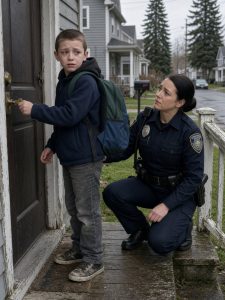
The boy searched my face for a loophole.
“Even if my dad says I’m lying?”
“Even then.”
His fingers closed around the key.
It took him three tries to guide it into the lock.
When the door opened, the first thing I noticed was the smell of bleach.
Not fresh laundry or a recently cleaned floor, but the sharp, throat-drying smell of a house scrubbed so often that nothing inside was allowed to leave a trace.
The second thing I noticed was the silence.
No television.
No refrigerator hum loud enough to cover a whisper.
No child calling from another room to ask who had come home.
The boy stepped inside and carefully placed his backpack against the wall, lining it up with two pairs of shoes already arranged beneath a narrow table.
Then he turned and raised one finger to his lips.
“He checks if things moved,” he whispered.
I stayed near the open doorway and called my supervisor, keeping my voice low while I explained that a child had invited me inside after reporting a possible safety issue.
The boy waited until I finished.
“Can I show you now?”
I nodded.
He led me past a small living room where the couch cushions sat perfectly square and every blind had been pulled to the same height.
A paper schedule was taped to the refrigerator in the kitchen.
It listed wake-up time, breakfast, school, chores, homework, quiet time, dinner, and sleep.
Nothing about the schedule looked alarming by itself.
Families used charts all the time.
Then I saw the handwritten marks beside the children’s names.
Each mark had a number beside it.
Fifteen.
Thirty.
Sixty.
The boy saw me reading.
“Those are minutes,” he said.
“Minutes for what?”
He looked toward the hallway.
“For the room.”
At the end of the hall stood a narrow door painted the same pale color as the walls.
It could have been a linen closet or a utility room.
A metal sliding latch had been screwed into the frame at an adult’s shoulder height.
The latch was on the outside.
The boy stopped several feet away.
His face had gone pale.
“She’s not supposed to answer if someone knocks,” he said. “But she knows my knock.”
He tapped twice, paused, and tapped once more.
Something shifted behind the door.
Then a little girl’s voice asked, “Is Dad back?”
The boy looked at me.
“No, Sophie. It’s me. I brought somebody.”
I moved the latch and opened the door.
The room was barely wider than the washer and dryer pushed against one wall.
A folded blanket lay on the floor beside a plastic cup and a workbook.
A little girl sat with her knees pulled against her chest, wearing a faded school sweatshirt and leggings.
She looked about six.
Her hair was tangled on one side, and the elastic around her wrist had left a deep pink line where she had twisted it over and over.
She was not bleeding.
I saw no obvious injury.
But when the door opened, she did not stand.
She looked first at her brother, then at me, and asked the question that changed the entire situation.
“Did I finish all my minutes?”
The boy dropped to his knees beside her.
“You’re done,” he said quickly. “You don’t have to do any more.”
She glanced past him at the open latch.
“Dad said you couldn’t decide that anymore.”
The boy’s shoulders folded inward.
Until that moment, I had assumed he was showing me something an adult did to him.
I had not understood that the adult had made him part of doing it to someone else.
I crouched outside the room and asked Sophie whether she wanted to come into the kitchen.
She did not move until her brother took her hand.
Even then, she stepped over the threshold like she expected an alarm to sound.
I asked how long she had been inside.
She looked at her brother because she believed he was supposed to answer for her.
He stared at the floor.
“Before school,” he said.
It was nearly four in the afternoon.
“Why wasn’t she at school today?”
“Dad called and said she was sick.”
Sophie shook her head.
“I talked after lights-out.”
The boy tightened his grip on her hand.
“I told her not to,” he said. “I was supposed to make sure she stayed quiet.”
He said it like a confession.
I told him it was not his job to punish his sister.
He looked genuinely confused.
“Then whose job is it?”
That was the belief holding the whole house together.
Not the latch.
Not the schedule.
Not even the fear of their father coming home.
The belief that somebody had to control everybody else, and that the oldest child became responsible whenever the adult was gone.
I requested another officer and a child-safety response, then kept both children in the kitchen where I could see them.
I left the front door open.
The boy watched it constantly.
Sophie drank water in tiny sips, stopping after each one as though she expected someone to tell her she had taken too much.
There were crackers in a cabinet, but the boy would not touch them.
“Those are for Thursday,” he said.
It was Tuesday.
I found no need to search drawers or tear through the house.
The open latch, the schedule, the child inside the room, and the children’s own words gave us enough to act on the immediate danger.
What we still did not understand was why their father had built a family around rules that frightened his children more than strangers did.
We heard a vehicle stop outside twelve minutes later.
The boy’s entire body changed.
His back straightened.
His hands released his sister.
He stepped between her and the hallway without being told.
A man in work pants and a faded flannel shirt came through the front door carrying a paper coffee cup and a plastic grocery bag.
He saw my uniform, then saw the open utility-room door.
The grocery bag slipped against his leg, but he caught it before it fell.
“What are you doing in my house?” he demanded.
I identified myself and told him we were checking on the safety of his children.
He looked at his son.
The anger in his face did not explode.
It narrowed.
“You brought him here?”
The boy took one step backward.
I moved enough to stay between them.
The father pointed toward the utility room.
“That is a cool-down space. She was not in danger. She had water, and the door is not locked.”
I looked at the metal latch still hanging open from the outside of the frame.
“Can she open it from inside?”
He did not answer directly.
“Kids need boundaries. People call anything abuse now because they do not know how to raise disciplined children.”
Sophie pressed herself against her brother’s back.
The father noticed and lowered his voice.
“Come on, sweetheart. Tell the officer you were fine.”
She stared at the floor.
He tried again.
“Tell him your brother checks on you.”
That sentence shifted the center of the case.
The father was not simply placing a child in a room.
He had assigned his son to monitor the punishment, count the minutes, report crying, and decide whether mistakes added more time.
The seven-year-old boy had not only been frightened of his father.
He had been terrified that asking for help would expose what he had been forced to do to his sister.
“I didn’t always add the minutes,” he blurted. “Sometimes I erased them.”
His father’s jaw tightened.
“We will discuss that later.”
“No,” I said. “You will not discuss that with him right now.”
The father turned toward me.
For a moment, I expected him to argue about authority, property, or whether I understood how difficult single parenting could be.
Instead, he said, “My father did the same thing.”
His voice had lost some of its force.
“All four of us had quiet-room time. We learned not to scream, not to talk back, and not to make the house harder than it already was. My brothers raise their kids the same way. Nobody called the police on us.”
The boy’s words on the walk returned to me.
Everyone I know believes this is what families are like.
His father had just confirmed it.
He was not inventing an excuse in that moment.
He was describing an inheritance.
That did not make the latch safer.
It did not return the hours Sophie had spent alone in that room.
It did not remove the weight he had placed on his son.
But it explained why reasoned warnings from teachers and relatives had apparently never reached him.
He did not think he was crossing a line.
He thought the line had been drawn by weak people who did not understand his family.
The second officer arrived, followed by workers responsible for evaluating the children’s immediate safety.
The father became more cooperative when he realized no one was there to stage a public confrontation.
Then he became angry again when he learned the children would not remain with him that night.
“You’re taking them because of a latch?”
The boy flinched at the word taking.
I answered before anyone could turn the argument into a debate over hardware.
“This is not only about the latch. It is about a child being confined for hours and another child being made responsible for enforcing it.”
The father looked at his son.
“I gave you the key because I trusted you.”
The boy reached into his pocket and pulled out the house key.
His hand was still shaking.
“You gave it to me because you said I was the man when you weren’t home.”
“That means I depend on you.”
The boy swallowed.
“I’m seven.”
No one in the kitchen spoke for several seconds.
The father looked down at the paper coffee cup still in his hand.
Then he set it on the counter.
He did not apologize.
Not then.
He asked where his children were going, demanded phone numbers, and argued over every limitation placed on his contact.
But he did not try to close the utility-room door again.
Before Sophie left, she asked whether she had to bring the blanket from the floor.
Her brother answered automatically.
“No.”
Then he looked at me, uncertain whether he was allowed to decide that.
I told Sophie she could leave it.
The boy placed the house key on the kitchen table.
His father immediately picked it up and held it toward him.
“You’ll need this when you come back.”
The boy did not take it.
That refusal was small enough to miss if you were watching only the adults.
It was also the first decision he had made all afternoon that did not protect someone else from his father’s reaction.
The children were placed together in temporary care while their situation was evaluated.
I saw the boy two days later at school.
He sat in the counselor’s office with his backpack at his feet and asked whether his father had been arrested.
I told him his father had not been arrested at that point, but adults were now responsible for deciding what had to change before the home could be considered safe.
The boy looked disappointed and relieved at the same time.
“I didn’t want him gone forever,” he said. “I wanted him to see it wasn’t normal.”
That was another burden he had been carrying.
He believed there were only two possible outcomes: accept everything or destroy the family.
Children in controlling homes often become experts at choosing between terrible options adults created for them.