
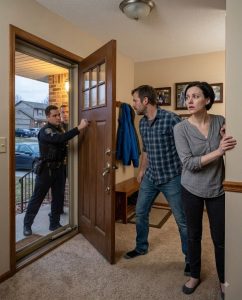
One of the officers was almost ready to leave our porch when he stopped and asked me one more question.
My thumb froze above my phone.
A few minutes earlier, I had blocked my father, my mother, and my younger sister while two police officers stood outside my house listening to the story of how a $12,000 demand had ended with a one-dollar transfer.
It sounded ridiculous when reduced to numbers.
It wasn’t.
The officer had already seen the text from my father.
We need $12,000 for your mother’s surgery.
He had already seen my transfer receipt.
Exactly $1.
He had already seen my reply.
Good luck.
There were no threats underneath it.
No insults.
No harassment.
Just three facts lined up on a phone screen: a demand, a dollar, and two words my father apparently found serious enough to involve the police.
Daniel stood beside me near the doorway, still carrying the kind of protective tension I had seen in him since the hospital.
He wasn’t shouting.
He wasn’t interfering.
He was simply there.
That difference mattered more to me than I could explain.
Because not long before those officers arrived, I had spent weeks learning exactly who showed up when my life became inconvenient.
Before all of this, I was thirty-three years old and worked as a senior payroll manager in downtown Omaha.
At work, I was the person people came to when something had gone wrong at the worst possible time.
A tax issue needed fixing before payroll closed?
They called me.
Someone’s direct deposit disappeared?
They called me.
A deadline was suddenly everybody’s emergency?
They called me.
I was good at solving problems quickly, and for a long time I was proud of that.
Then I went home and played the same role for my family.
I paid overdue bills when my parents fell behind.
I covered surprise expenses when my father said there was nowhere else to turn.
I helped my sister after one bad decision, then another, then another.
I told myself I was dependable.
My mother liked that word.
My father did too.
My sister preferred not to use any word that suggested she might eventually have to repay me.
Whenever I asked her about money she owed, she laughed as if I had made a joke neither of us needed to take seriously.
Daniel never laughed.
“They use you, Claire,” he told me more than once.
I always had an answer ready.
“They’re family.”
For years, that sentence ended every argument.
I had paid because they were family.
I had forgiven because they were family.
I had ignored my own resentment because they were family.
I had trained everyone, including myself, to believe my limits were temporary inconveniences.
Then my body gave me a limit I could not negotiate with.
I collapsed beside the copier at work with reports still in my arms.
There was no dramatic warning I could package neatly afterward.
One moment I was working.
The next thing I remember clearly was waking beneath fluorescent hospital lights with a heart monitor sounding beside me.
My throat hurt.
My body felt impossibly heavy.
Daniel was asleep in a narrow chair beside the bed, except he did not really look asleep.
He looked depleted.
His shirt was wrinkled.
His beard had grown unevenly.
His face had the exhausted, fixed expression of someone who had spent too many hours waiting for another person to wake up.
When he realized my eyes were open, he came out of that chair so quickly it scraped across the floor.
“Oh, thank God.”
His relief frightened me before it comforted me.
I asked how long I had been out.
“Nine days,” he said.
Nine days.
I had been unconscious for most of them.
A nurse named Rosa came in, checked the monitor, adjusted my blanket, and told me I had scared everybody.
Everybody.
I looked around the room.
Two visitor chairs sat in the corner.
They were empty.
There were no flowers from my mother.
There was no card from my father.
There was no note from my sister asking whether I was awake, whether I needed anything, or whether I had nearly died.
What I did have was Daniel’s jacket, a paperback Jenna from work had brought, and a grocery-store bouquet on the windowsill that had started to droop.
I remember staring at those flowers because they were ordinary.
Not expensive.
Not impressive.
They had probably been grabbed quickly on the way to the hospital.
Someone had still made the trip.
“Where are they?” I asked.
Daniel knew exactly who I meant.
He looked toward Rosa before answering, and that small hesitation told me more than I wanted to know.
I asked whether anyone had called my parents.
Rosa lowered her clipboard.
The hospital had contacted every emergency number in my file.
My mother had answered twice.
My father had returned one call.
They knew.
I asked what they had said.
Rosa told me they had things going on and would come when their schedule allowed.
Their schedule.
My parents lived about forty minutes away.
My sister lived closer.
For the next several days, I tried to build explanations generous enough to protect them from what the facts were telling me.
Maybe someone had not explained how serious it was.
Maybe they thought I was already improving.
Maybe they misunderstood which hospital I was in.
Maybe they assumed Daniel would handle everything.
Maybe.
Maybe.
Maybe.
Daniel did not argue with any of those theories.
Daniel did not call me foolish.
Daniel did not say, “I told you so.”
Daniel put a folder on my blanket and let the paperwork answer me instead.
Inside were emergency-contact logs, admission records, ambulance information, Jenna’s workplace statement, and hospital notes with timestamps.
The sequence was plain.
My family had been notified while my condition was critical.
They had not been kept in the dark.
They had not been misdirected.
They had not arrived too late.
They had chosen not to come.
That realization hurt in a way my physical recovery did not.
Pain in the hospital had rules.
You could describe it.
You could rate it.
Someone could bring medication, adjust a pillow, check a monitor, help you sit up, or tell you what needed to happen next.
There was no equivalent procedure for realizing the people you had rescued for years could not spare forty minutes when you were fighting to stay alive.
Even after I woke up, my family did not suddenly become attentive.
My sister texted me about a streaming password.
My mother sent a brief message telling me she hoped I was better.
My father forwarded a joke about hospital food.
That was their contribution.
I stopped answering.
Recovery took time.
Daniel steadied me when my legs shook.
Jenna brought clean clothes, shampoo, books, and fresh socks.
Rosa checked on me whenever her shift gave her a spare moment.
None of them made speeches about loyalty.
They just kept doing things.
That changed something in me.
For years, I had listened closely to what people called me.
Practical.
Dependable.
Responsible.
Strong.
But lying in that hospital bed, I started paying more attention to behavior than labels.
Daniel stayed.
Jenna came.
Rosa checked.
My family knew.
Those verbs told the whole story.
When I finally came home, normal life did not feel normal yet.
I moved more carefully.
I tired more easily.
Daniel hovered just enough for me to notice, then pretended he wasn’t hovering whenever I caught him.
We developed small routines around recovery.
Breakfast at the kitchen table.
Medication where I could see it.
Rest without apologizing for resting.
My phone stayed quieter because I was no longer answering every request the moment it arrived.
About a month after I came home, Daniel was making breakfast when the phone buzzed beside me.
I looked down and saw my father’s name.
For half a second, I thought he might finally be checking on me.
Maybe he was going to ask how recovery was going.
Maybe he was going to acknowledge that he had not visited.
Maybe he would say something awkward and imperfect but human.
He did none of those things.
There was no greeting.
No apology.
No question about my health.
Just a request.
We need $12,000 for your mother’s surgery.
I read it once.
Then again.
I handed the phone to Daniel.
His face tightened as he read it.
“Don’t,” he said.
One word.
He knew me too well.
The old version of me would already have been calculating.
How much was in savings?
What could be moved?
What bill could wait?
What explanation could I give Daniel this time?
How quickly could I solve the emergency so nobody would be angry with me?
I opened my banking app.
Daniel watched me.
I could feel him expecting the same pattern to repeat.
So could I.
But the hospital had broken something useful in that pattern.
I no longer believed that being needed was the same thing as being loved.
I entered one dollar.
$1.
I sent it.
Then I typed two words beneath my father’s demand.
Good luck.
I put the phone down.
There was no victory speech.
No dramatic celebration.
Daniel looked at me for a second, then went back to breakfast.
I sat there feeling something I had not expected.
Not guilt.
Space.