
By the time Emma Clarke reached the county department, the traffic stop had already become something far more serious than a roadside dispute.
Then she saw the memory card.
It was lying on Deputy Nolan’s desk, small enough to disappear beneath two fingers, but Emma recognized it immediately as the card from her personal dashcam.
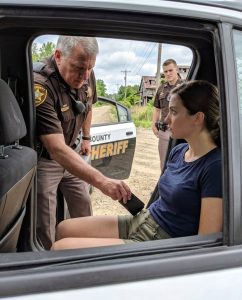
Nolan saw where she was looking.
Before Emma could say anything, he reached across the desk and lifted the card between his thumb and index finger.
That movement changed the entire situation.
Only minutes earlier, Nolan and his younger partner, Reed, had believed Emma was simply an out-of-town driver they could intimidate, restrain, transport, and document later.
They had been wrong about almost everything.
Emma was not a confused traveler.
She was not unfamiliar with procedure.
And she was not alone in the sense that mattered most.
For the previous twenty-four minutes, an active transmitter had been sending audio from the encounter to the state regional dispatch office in Columbus.
Every demand.
Every contradiction.
Every attempt to invent a justification after the detention had already begun.
All of it had been preserved.
The memory card in Nolan’s hand was something else entirely.
Emma watched his fingers close around it.
“Put that down,” she said.
Nolan looked at her, then at the card.
Reed was still standing several feet away, struggling to absorb what had happened at the dirt turnout near the abandoned timber mill.
Less than half an hour earlier, both officers had treated Emma like someone who had no leverage.
The stop had begun on Route Nine without a clear explanation.
Nolan had approached her sedan and barely looked at the registration she passed through the window before demanding her license.
His partner stayed toward the rear of the vehicle, watching instead of conducting anything that resembled a normal traffic check.
Emma had noticed the problem immediately.
Not because she was nervous.
Because she knew procedure.
She had asked them to identify themselves and explain the legal reason for stopping her.
Nolan had refused to answer.
Then he ordered her out of the car.
Reed supplied a different explanation. He said the tires appeared dangerously low and claimed they needed to inspect the vehicle.
Emma checked the dashboard.
Nothing on the tire monitoring system indicated a problem.
That alone did not prove what the officers intended, but another detail bothered her more.
Neither man had run her information through the state database.
No license verification.
No registration check.
No citation being prepared.
No clear allegation.
Emma asked whether they intended to issue a ticket.
Reed told her they were “checking everything” and ordered her toward the bumper.
Then Nolan tossed her registration and insurance papers onto the roof of the sedan.
Emma reminded him they were standing beside a state highway.
His response was immediate.
“I decide what matters in Oakhaven.”
Emma corrected him.
Route Nine was a state highway, she said, and state regulations governed the route.
Nolan did not like being challenged.
“You have a lot of opinions for someone fifty miles from home.”
Emma told him she was asking for standard procedure.
“This is standard,” Nolan said.
It was not.
Emma had spent enough time studying documented traffic encounters to recognize the pattern taking shape around her.
A legitimate stop normally created records as it unfolded.
This one seemed to be moving in the opposite direction.
The officers were escalating first and apparently planning to explain themselves later.
When Emma pointed out that they still had not verified her name, Reed’s language changed.
Suddenly she was “non-compliant.”
Suddenly transportation to the station became a possibility.
Emma reached toward the phone visible in her shirt pocket.
“I intend to record the rest of this stop,” she told them.
Nolan grabbed her wrist.
He forced her against the side of the sedan.
Emma did not struggle.
“You’re making a mistake, Officer.”
Reed told her to keep still.
“I am not resisting.”
Nolan ordered Reed to restrain her.
Plastic restraints tightened around Emma’s wrists.
Then they placed her in the back of the patrol car.
What neither officer understood was that Emma’s attempt to reach for the phone had never been the beginning of the recording.
The recording had started long before that.
Inside the pocket of her shorts were two objects that completely changed the meaning of the encounter: a gold state investigator shield and an active audio transmitter.
Emma had not revealed either one.
Not yet.
She wanted to see what Nolan and Reed would do when they believed the woman in their back seat had no protection except her own word.
As Nolan drove away from Emma’s sedan, Reed began building a reason for the stop.
He said Emma had been traveling forty-two miles per hour in a thirty-five zone.
Emma knew the number was wrong.
She had been driving thirty-four.
“A seven-mile-per-hour difference does not justify physical restraint,” she said.
Nolan answered from the front seat.
“Down here, we decide what justifies what.”
Emma studied the back of his head.
“This is an undocumented detention on a state highway.”
Nolan gave another answer he probably believed would frighten her.
“You’re a long way from Columbus, lady.”
Instead, the sentence confirmed something for Emma.
They believed distance protected them.
They believed whatever happened in their county could be rewritten before anyone outside the department saw it.
They did not seem interested in correcting the stop.
They appeared willing to carry it forward.
And if they brought her into the station, created paperwork after the fact, and held her there, the undercover state investigation Emma had been conducting could be compromised before she had gathered what she needed.
That was the point at which she made her decision.
“Officer Nolan.”
“Save it for the judge.”
“Look in my right shorts pocket.”
Reed twisted around in the passenger seat.
“She has something in her pocket.”
Nolan snapped at him that he had been told to search her.
Emma kept her voice steady.
“With my hands behind my back, I cannot do it myself.”
Nolan pulled the cruiser onto a dirt turnout near an abandoned timber mill.
The roadside around them looked empty.
“What’s in the pocket?” he asked.
“My authorization.”
Reed scoffed.
“She’s bluffing.”
Emma looked directly at Nolan.
“Reach in and pull it out.”
He opened the rear door.
Then he leaned into the patrol car, reached into Emma’s right shorts pocket, and pulled out a black leather wallet.
At first, Nolan handled it like an ordinary possession.
He flipped it open expecting identification.
Then he stopped.
A gold state investigator shield filled one side.
Beside it was the transmitter.
A small green light continued to pulse.
Nolan did not speak.
Reed leaned closer.
“This stops right now, officers,” Emma said.
Nolan stared at the credential.
“What is this?”
Emma answered plainly.
“The state regional dispatch office has been receiving this feed for the last twenty-four minutes. Every word is already on the server in Columbus.”
The significance did not require explanation.
The traffic stop they had apparently intended to keep unofficial was already documented somewhere they could not control.
Nolan stepped away from the open rear door and showed the wallet to Reed.
Reed read the identification aloud.
“State Office of Professional Standards. Senior Investigator Emma Clarke…”
The title landed differently than any warning Emma had given them on Route Nine.
Until that moment, Nolan and Reed had treated her knowledge of procedure as arrogance.
Now they understood why she had noticed every missing step.
Emma told them about the blue folder inside her sedan.
It contained copies of citizen complaints involving officers on Route Nine during the previous six months.
She had not been randomly driving through the area with no connection to what was happening.
She was the investigator assigned to examine those complaints.
And now she had personally experienced the kind of conduct she had been sent to review.
Nolan removed the restraints.
The plastic came away from Emma’s wrists, but nothing else could simply be undone.
The words from the cruiser were already preserved.
So was Nolan’s statement about deciding what mattered locally.
So was Reed’s attempt to introduce a speeding allegation after Emma had already been detained.
So was the physical restraint that followed her attempt to announce that she intended to record.
Emma did not celebrate the reversal.
She did not need to.
Her focus shifted immediately to preservation.
The blue folder remained inside her sedan.
Her equipment was still there as well.
And the stop itself had now become part of the investigation.
Nolan appeared to understand that too.
His manner changed, but Emma did not mistake a change in tone for cooperation.
People could become very careful once they learned a record existed.
The more important question was what they had done before they knew.
They eventually proceeded to the department.
Emma entered with a very different status from the restrained woman Nolan and Reed had expected to deliver.
Still, the atmosphere inside did not feel settled.
Reed remained uneasy.
Nolan seemed to be calculating.
Emma watched both of them.
She also watched the room.
That was when she noticed the small memory card on Nolan’s desk.
It should not have been there.
The card belonged to her personal dashcam.
Her sedan had been left behind when Nolan drove her away from the highway.
At some point, the card had been removed.
Emma did not need to speculate aloud about how it had reached Nolan’s desk.
Its presence was enough to create a direct question.
Nolan followed her gaze.
Then he reached for it.
The card disappeared between his fingers.
“Put that down,” Emma said again.
This time Reed looked from Emma to Nolan.
Nolan held the card for another second.
Emma’s voice remained controlled.
“That belongs to me.”
Nolan tried to answer as though the object were routine property collected during a stop.
But that explanation immediately ran into the same problem that had followed them from Route Nine.
What stop?
What documented basis?
What authorized search?
What written record showed why property had been removed from her vehicle?
Emma did not bombard him with accusations.
She asked one question.
“When did you take it out of my car?”
Nolan’s eyes moved toward Reed.
It was brief.
But Emma saw it.
Reed saw it too.