After ending the call, Peter set his phone aside and pulled the hospital chair into a new position, planting himself between Drew’s bed and the doorway.
It was a small movement.
It felt enormous.
For years, Peter had let a closed door tell him where his place was in his brother’s children’s lives.
Reena had said they were sleeping.
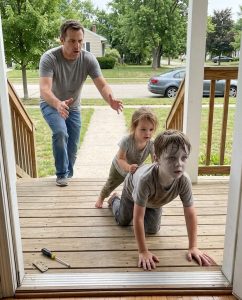
Reena had said they were sick.
Reena had said seeing Peter reminded them too much of their father.
Each time, Peter had accepted the explanation because the alternative required him to believe something he had not been ready to believe.
Now six-year-old Drew was lying under a hospital blanket with a leg that had been broken before he ever began his seven-block escape, and three-year-old Lily was resting nearby after arriving hungry enough to attack a sleeve of crackers.
The excuses no longer sounded protective.
They sounded like barriers.
Peter leaned forward, forearms on his knees, and watched Drew watch his sister.
That was what the boy kept doing.
Even hurt, Drew checked Lily first.
Even exhausted, Drew noticed whether she was eating too fast.
Even after dragging himself across block after block of pavement, he had arrived at Peter’s porch thinking less about his own pain than about the little girl gripping the back of his shirt.
Peter could not get past that.
He had spent three years thinking of Drew as Aaron’s little boy.
Somewhere along the way, Drew had been forced into acting like Lily’s protector.
At six.
Peter looked toward the hospital bed and remembered the first thing Drew had said on the porch.
“She locked us downstairs again.”
Again.
That word had been sitting in Peter’s chest ever since.
At first, the emergency had been too loud for him to understand it.
There had been Drew on the steps, pale and shaking.
There had been Lily hanging on to his shirt.
There had been the terrible angle of Drew’s leg and the dirt on both children.
There had been Peter’s screwdriver hitting the porch boards after slipping from his hand.
Then everything had become movement.
Down the steps.
Lift Lily.
Support Drew.
Get them inside.
Call for help.
Answer the dispatcher.
Give the address.
Give the ages.
Explain the injury.
Repeat what Drew had said.
Peter had not been trying to solve the story then.
He had been trying to get two children safely through the next five minutes.
The story began catching up with him only after the sirens came.
Two officers had written down Reena’s address while paramedics stabilized Drew’s leg and examined Lily.
Peter had watched strangers move around his nephew with practiced care and felt something close to shame every time he remembered how often he had been kept away.
He had called.
He had offered groceries.
He had brought birthday presents.
He had volunteered to repair things around the house.
He had believed that remaining available without becoming confrontational was the responsible choice.
After Aaron died, grief had rearranged everyone.
Peter knew that.
Aaron had been thirty-five when a heart attack killed him, leaving behind Drew, baby Lily, and a widow promising she wanted one thing for the children.
Stability.
Peter had believed that word because he wanted to.
More painfully, he had believed it because Aaron would have wanted to.
Peter could still picture his younger brother laid out in a funeral-home suit that did not look like him at all.
Aaron had never seemed like someone who belonged in stiff clothes and polished silence.
Peter’s memories of him were alive with ordinary things instead.
A brother who had children to raise.
A brother who expected there would be another birthday, another repair, another argument, another normal week.
Then there wasn’t.
After the funeral, Reena’s promise had sounded almost merciful.
She wanted stability for the children.
Peter had taken her at her word.
When she began limiting his contact, he told himself she knew Drew and Lily’s grief better because she lived with it every day.
“They’re asleep.”
Fine. He could call later.
“They’re sick.”
Fine. He could leave the groceries.
“You remind them too much of their father.”
That one had landed differently.
Peter had gone back to his truck with gifts that never reached the children and sat there longer than he cared to remember.
He had wanted to push.
He had also been afraid of making himself the problem.
A grieving household did not need another adult fighting for territory, he had decided.
So he backed away.
Not completely.
Never completely.
But enough.
Now he understood the terrible cost of that distance.
He did not know everything that had happened inside Reena’s house, and he refused to fill the gaps with guesses while Drew was lying ten feet away.
What Peter knew was already enough to change the shape of the past three years.
Drew had called the basement a place where they had been locked before.
He had referred to Reena’s punishment room.
Lily had reached Peter’s porch frighteningly light and desperately hungry.
Drew had arrived with a broken leg.
And according to the doctor, that break had happened before the escape.
Those were not Peter’s suspicions.
Those were facts already in front of him.
The doctor’s sentence kept replaying in his head.
The injury predated that morning.
Peter had initially assumed Drew had hurt himself while getting away.
Seven blocks was already difficult to imagine for a healthy six-year-old trying to guide a three-year-old.
Seven blocks while dragging an already broken leg changed the entire picture.
Drew had not been injured by the escape.
He had chosen to escape despite the injury.
Peter looked at the boy again.
Drew’s fingers rested near the edge of the blanket.
He was quiet.
Too quiet, Peter thought, though he reminded himself that the child had been through more than enough without an adult studying every breath for another clue.
So Peter did something he wished he had understood sooner.
He stopped demanding answers from the moment.
He stayed.
That was all.
He stayed where Drew could see him.
He stayed where Lily could wake and find him.
He stayed where nobody could reach either child without passing him first.
The position of the chair mattered to Peter for reasons he could not fully explain.
Maybe because doors had defined too much already.
Reena’s front door had been the place where groceries, presents, offers of help, and Peter himself kept getting turned around.
The basement door had become something much darker in Drew’s few exhausted sentences.
Now there was a hospital doorway, and Peter had put himself beside it deliberately.
Not to control Drew.
To make sure Drew did not have to control everything anymore.
Lily shifted in her sleep.
Drew’s head turned immediately.
Peter saw the reflex and felt his throat tighten.
“She’s okay,” he told him quietly.
Drew kept looking until Lily settled again.
Only then did his shoulders loosen a little against the pillow.
Peter wanted to tell him he could stop worrying.
He wanted to promise that adults had it from here.
But promises suddenly felt cheap.
Reena had made promises too.