They thought I would arrive broken.
That was why the Montgomery family sent the invitation.
They did not miss me.
They did not want closure.
They wanted a witness.
They wanted me sitting quietly in the back while Ethan Montgomery, my ex-husband, married Caroline Hastings in front of senators, CEOs, donors, and old-money friends who still believed last names were a form of currency.
The invitation came on a Wednesday afternoon.
I remember that because it was 3:42 p.m., and my assistant had just sent over the final client acquisition report for a campaign we had spent six months rebuilding.
The envelope sat on my desk like it had placed itself there.
Thick ivory paper.
Gold lettering.
A faint perfume soaked into the flap.
Outside the windows of my penthouse, Chicago looked cold and metallic, all glass towers and gray light, traffic muttering far below like an argument nobody intended to finish.
Inside my living room, my sons were building a pillow fort.
Liam was in charge of the rules because Liam believed every structure needed a plan.
Noah kept adding blankets to one side until the whole thing sagged.
Caleb was lying on his stomach, pushing a toy dinosaur through the opening and making warning noises under his breath.
They were five.
They were loud, stubborn, beautiful little boys with dark wavy hair, sharp gray eyes, and a courage nobody in the Montgomery family had earned the right to claim.
I slid one finger under the envelope flap.
The card inside announced the wedding of Ethan Montgomery and Caroline Hastings, daughter of a powerful U.S. senator.
For a moment, I only stared at his name.
Ethan.
The man I had once loved because I mistook silence for depth.
The man I had married in a chapel full of white orchids and hard smiles.
The man who had signed our divorce papers five years earlier at 9:18 a.m. without looking me in the eyes.
His mother had looked at me, though.
Eleanor Montgomery always looked directly at the person she was cutting.
That was one of her talents.
She never had to yell.
She never had to throw things.
She could destroy someone’s dignity with a seating chart, a pause before an introduction, or a smile that suggested you were lucky to be permitted inside the room at all.
The Montgomerys were old Chicago money.
Their portraits had frames thicker than some people’s doors.
Their charity events had photographers.
Their cruelty had manners.
When I first married Ethan, Eleanor called me refreshing in public and unsuitable in private.
She said I was ambitious like it was a rash.
She said my family background lacked polish.
She said women like me often confused opportunity with belonging.
Ethan heard all of it.
Sometimes he looked uncomfortable.
That was the most he ever offered.
Discomfort is not protection.
A man who watches you bleed quietly and then asks you not to embarrass his family has already chosen his side.
The divorce came after Eleanor convinced him that I wanted his name more than I wanted him.
She had no idea I was pregnant when I left.
At least, I prayed she had no idea.
By then, I had seen enough of that family to understand what would happen if she found out.
She would not have welcomed my babies.
She would have claimed them.
She would have turned them into Montgomery heirs before they learned to tie their shoes.
She would have taught them how to enter rooms like ownership was a birthright.
So I disappeared.
I changed apartments.
I changed doctors.
I changed my phone number.
I filed every document through an attorney who understood that some women do not run because they are weak.
They run because they are the only wall standing between their children and a family with money.
The first year was brutal.
I worked eighteen-hour days while pregnant, my ankles swollen under a folding desk I bought secondhand.
After the boys were born, I answered client emails at 2:13 a.m. with one baby tucked against my chest and two more sleeping in bassinets beside me.
I built a digital marketing agency from a tiny apartment where the radiator hissed all night and the elevator smelled like damp cardboard.
I kept payroll files in plastic bins under the crib.
I tracked invoices in a spreadsheet so detailed my accountant once said it looked like evidence.
Maybe it was.
By year two, I had formal client contracts, a county business registration, and a small team that believed in the company before anyone else did.
By year three, we were handling national accounts.
By year five, the agency had become one of the fastest-growing in the country.
Quietly, carefully, without ever asking a Montgomery for a dollar, my fortune became nearly three times what remained of their family empire.
The world loves a comeback only after it is profitable.
Before that, it calls survival bitterness.
I was still holding the invitation when Liam tugged my sleeve.
“Mama, who’s getting married?”
I looked down at him.
Ethan’s eyes stared back at me from a face Ethan had never kissed goodnight.
Across the room, Noah shouted that dinosaurs could absolutely fit inside elevators if the elevator was “business size.”
Caleb disagreed with his whole body.
I folded the invitation once.
Then I opened it again and found the seating card.
Table 27.
Right beside the kitchen doors.
Not near Ethan.
Not near the family.
Not even near the guests who mattered enough to be photographed.
Table 27 was where Eleanor placed reminders.
Close enough for staff to pass behind my chair with trays.
Close enough to hear the kitchen calling out courses.
Far enough for every polished guest to understand that Ethan’s first wife had been invited only as decoration for her own replacement.
I forwarded the card to my assistant at 4:37 p.m.
“Clear my Saturday schedule,” I said when she answered.
“For the wedding?” she asked.
“For a family reunion.”
There was a tiny pause.
Then I said, “I need three custom tuxedos made for my sons.”
She understood at once.
“All three?”
“All three.”
After I hung up, I called my attorney.
Not because I planned to fight in the middle of a wedding.
I had learned a long time ago that rich families love public scenes until public proof walks in behind them.
By 8:06 Saturday morning, my attorney had prepared a clean packet for my records.
Birth certificates.
Medical summaries.
A private investigator’s identity report.
A sealed paternity filing ready to move if Ethan or Eleanor tried to deny what their own faces would admit before any document did.
I printed one copy and slid it into a cream envelope.
Caleb saw it on the kitchen counter while eating cereal in his pajamas.
“Is that important?” he asked.
“Yes.”
“Can I hold it?”
“Not yet.”
He considered that like a businessman weighing terms.
“Later?”
“Later.”
Saturday arrived bright, cold, and almost insultingly beautiful.
The kind of sky Eleanor would have taken personally.
The Montgomery estate spread along the Lake Geneva shoreline like a place built to remind ordinary people where the road ended.
White roses lined the long stone path.
A string quartet played near the fountains.
Crystal chandeliers hung inside a glass tent, sparkling above tables dressed in white linen.
A small American flag moved in the wind at the gatehouse beside the security post.
Black SUVs and polished sedans rolled along the driveway one by one.
The guests looked exactly how I remembered Montgomery guests looking.
Expensive.
Relaxed.
Certain that nothing embarrassing could happen to them in public.
Caroline Hastings stood near the aisle in lace and diamonds, surrounded by bridesmaids who kept checking the way her train fell on the grass.
Her father, the senator, worked the lawn with a practiced smile.
Ethan stood beneath an arch of white roses, one hand tucked into his jacket pocket, looking handsome in a way that once would have hurt me.
It did not hurt anymore.
Some grief expires before the person who caused it notices.
From the upstairs balcony, Eleanor watched the driveway.
She wore pale silk and pearls.
Her hair was swept into a perfect twist.
Her expression was calm because she believed the scene had already been written.
I would arrive alone.
I would be shown to Table 27.
Guests would glance at me and whisper.
Ethan would not look too long.
Caroline would be gracious enough to look superior.
And Eleanor would get to enjoy the clean little pleasure of seeing me placed exactly where she thought I belonged.
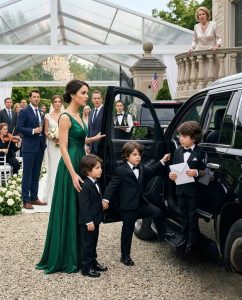
At 2:11 p.m., our convoy turned through the gate.
The first black SUV rolled past the security post.
Then the second.
Then the third.
Conversation across the lawn began to thin.
The quartet kept playing for three measures before the first violin missed a note.
A waiter froze with a tray of champagne halfway between tables.
Caroline turned with her bouquet still lifted.
Ethan frowned.
Eleanor did not move.
That was the last moment she looked certain.
The first SUV stopped beside the aisle.
The gravel made a clean crunch under the tires.
A security man stepped out and opened the rear door.
For one breath, nobody spoke.
Then I stepped into the afternoon light.
My emerald gown caught the sun.
Not loud.
Not desperate.
Just unmistakable.
I did not wave.
I did not smile at Eleanor.
I stood beside the open door while the whole estate measured me against the woman they had expected.
Across the garden, Ethan’s face changed.
Recognition came first.
Then confusion.
Then something closer to alarm.
Eleanor’s smile stayed in place for one second too long.
That was how I knew she had not prepared for this version of me.
The second SUV door opened.
Liam climbed out first.
He was careful with his shoes because he had been warned about gravel.
Noah followed, blinking at the flowers.
Caleb came last, holding the folded envelope in both hands because I had finally given him the important job.
The garden went silent.
Not quiet.
Silent.
A silence with weight.
A silence that landed on the roses, the glasses, the polished shoes, the senator’s smile, and Ethan’s chest all at once.
Liam looked at the guests and then at me.
“Mama,” he whispered, “is that our dad?”
The word dad moved through the wedding faster than any announcement.
Caroline’s bouquet lowered.
Her father turned toward Ethan.
Ethan took one step forward, then stopped as if the grass had turned to ice beneath him.
Eleanor gripped the balcony rail.
I could see her knuckles go white from where I stood.
Caleb held up the envelope.
“This is the important paper,” he said softly.
I took it from him before anyone could make him feel the weight of adult cruelty.
Then I walked down the edge of the aisle with my sons beside me.
Every guest watched.
Nobody pretended not to.
That was the funny thing about people who love spectacle.
They always forget they can become part of it.
Ethan came forward halfway.
His eyes moved from Liam to Noah to Caleb and back again, like he was trying to make the same impossible calculation three times.
“Olivia,” he said.
It was the first time he had said my name in five years.
I hated that a small, old part of me still recognized the sound.
Caroline turned on him.
“Ethan?”
He did not answer her.
He was looking at the boys.
Eleanor descended the stairs so quickly two bridesmaids stepped aside.
Her face had gone pale, but her voice was still controlled when she reached the lawn.
“What is this?” she asked.
I almost laughed.
Not because it was funny.
Because even then, even with three little boys wearing the Montgomery face standing in front of her, Eleanor still believed she could rename reality if she sounded expensive enough.
“This,” I said, “is Liam, Noah, and Caleb.”
Ethan’s mouth opened.
No sound came out.
“They are five,” I continued.
A murmur passed through the guests.
Five years.
Divorce papers signed five years earlier.
A timeline simple enough for even the most loyal Montgomery friend to understand.
Caroline took one step back.
Her father’s smile vanished completely.
Eleanor looked at the boys and then at me.
“No,” she whispered.
The word was small.
Smaller than I had ever heard from her.
Noah pointed toward the family table.
“Why is everybody staring?” he asked.
Ethan flinched like the question had touched him.
I knelt beside my sons so I could look them in the eyes.
“Because grown-ups sometimes forget how to behave,” I said.
Liam nodded as if that explained everything.
Caleb leaned into my shoulder.
I stood again.
Eleanor recovered first because women like her train their faces the way soldiers train their hands.
“You should have told us,” she said.
There it was.
The turn.
The clean shift from shock to accusation.
Not where were they.
Not are they healthy.
Not how could we have missed five years of their lives.
You should have told us.
“I was pregnant when I left,” I said.
Ethan closed his eyes.
Just once.
“Ethan knew enough to ask,” I continued. “He chose not to.”
“That is not fair,” Eleanor said.
Fair.
I thought of the apartment with the hissing radiator.
I thought of three bassinets beside my desk.
I thought of signing client contracts while one baby cried and another had a fever and the third slept only if my foot kept rocking his chair.
I thought of every birthday she missed because her pride mattered more than truth.
“Fair was not on the seating chart,” I said.
A few people looked toward Table 27.
The kitchen doors swung open behind it at that exact moment, and a staff member stepped out with a tray, saw the entire wedding frozen, and stepped back in.
Nobody laughed.
That made it better.
Caroline’s father approached Ethan slowly.
“Is this true?” he asked.
Ethan looked at me.
Then at the boys.
Then at Caroline.
“I didn’t know,” he said.
The answer was not strong enough to hold up the life he had built on top of it.
Caroline heard that too.
“You didn’t know,” she repeated.
It was not a question.
Eleanor reached for the envelope in my hand.
I pulled it back.
Her eyes flashed.
For one second, I saw the old Eleanor.
The woman who used to look me up and down in her foyer and ask whether I was comfortable in borrowed rooms.
But my sons were watching.
So I did not give her rage.
I gave her paperwork.
I opened the envelope and removed the first page.
The highlighted line was plain enough.
Biological relationship probability.
Ethan stared at it.
His face drained in stages.
First the mouth.
Then the cheeks.
Then the eyes.
Caroline covered her lips with one hand.
The senator took the document from Ethan and read the same line.
Behind us, the wedding guests shifted, restless and thrilled and horrified, all trapped in the same expensive silence Eleanor had created for me.
Eleanor whispered, “You kept them from us.”
“No,” I said. “I kept them safe.”
That was when Ethan finally looked down at Liam.
Liam looked back at him with the seriousness of a child trying to understand a stranger adults have made important.
“Are you really our dad?” Liam asked.
Ethan’s throat moved.
He crouched a little, then stopped, as if he suddenly understood he had not earned the right to close the distance.
“I am,” he said.
Noah frowned.
“Then why didn’t you come to our birthday?”
There are questions adults cannot survive because children ask them without strategy.
No accusation.
No performance.
Just the missing chair at every party.
Ethan looked at me.
I did not help him.
For five years, I had answered every hard question kindly.
Where is my dad?
Why don’t we have a grandma like other kids?
Did he not know our house?
I had softened the truth until it no longer cut them.
But I would not soften it for him.
Eleanor’s voice sharpened.
“This is not the place.”
I turned to her.
“You chose the place.”
That landed.
Everyone knew it.
Table 27 sat in full view beside the kitchen doors, ivory card waiting like a signature on her own cruelty.
I walked to it.
The boys followed.
Their small tuxedos looked impossibly formal against the grass.
I picked up the seating card and held it between two fingers.
“Eleanor sent me this invitation so I could sit here and watch your family move on,” I said.
My voice did not rise.
It did not need to.
“She wanted me close enough to be seen and far enough to be dismissed.”
Caroline looked at Eleanor then.
Really looked.
Maybe for the first time.
Ethan did too.
Eleanor’s lips pressed into a line.
“You are being dramatic.”
“I learned from the best.”
A few guests looked down.
One woman near the aisle suddenly became very interested in her champagne glass.
The senator folded the report once and slid it back into the envelope with the care of a man who understood scandal when it arrived wearing polished little shoes.
He looked at Ethan.
Then at his daughter.
“Caroline,” he said quietly, “we should talk.”
Caroline did not move.
Her eyes were wet now, but her voice stayed steady.
“Did you sign divorce papers while she was pregnant?”
Ethan said nothing.
That was answer enough.
Eleanor stepped toward Caroline.
“My dear, this is a private family matter.”
Caroline’s laugh was small and stunned.
“You invited half of Washington donors and half of Chicago money to watch it.”
For the first time that day, Eleanor had no elegant reply.
My sons stood beside me, unaware that an empire had just cracked around their names.
Caleb tugged my gown.
“Can we go home soon?”
“Yes,” I said.
Ethan looked panicked then.
“Olivia, wait.”
I turned.
He took a step closer.
“I need to talk to you.”
“No,” I said. “You needed to talk to me five years ago.”
His eyes shone.
Maybe regret had finally found him.
Maybe embarrassment had.
I no longer cared enough to sort them.
“You cannot just walk in here with my children and leave,” he said.
My children.
That was when something in me went completely still.
Not angry.
Worse than angry.
Clear.
“They are not a lost inheritance,” I said. “They are little boys.”
The wedding lawn was silent again.
This time, the silence did not belong to Eleanor.
It belonged to me.
I took Liam’s hand.
Noah took Caleb’s.
We walked back toward the SUVs.
Behind me, I heard Caroline say Ethan’s name in a voice that sounded like a door closing.
I heard the senator order his aide to cancel the media access.
I heard Eleanor call after me once.
I did not turn around.
At the car, Liam looked up.
“Did we do something wrong?”
I crouched in front of him, smoothing one hand over his lapel.
“No, sweetheart.”
“Then why did the lady look mad?” Noah asked.
“Because some people get upset when the truth arrives without asking permission.”
Caleb considered that.
“Truth is rude?”
I smiled then.
A real smile.
“Sometimes truth has better manners than people.”
We drove away before the wedding could decide what it wanted to be next.
A marriage.
A scandal.
A cancelled ceremony with too many witnesses and not enough excuses.
In the weeks that followed, my attorney filed the necessary documents.
Ethan requested visitation through proper channels.
For the first time in his life, a Montgomery man had to ask instead of assume.
Eleanor tried to send gifts.
I returned the first three unopened.
When she sent a handwritten letter, I read it once in my office while the boys were at kindergarten.
It was not an apology.
Not really.
It was a negotiation wearing perfume.
I filed it away with everything else.
Birth certificates.
Paternity report.
Seating card.
Proof that some people will try to humiliate you so publicly that they forget the whole room can watch them fail.
Months later, Liam asked if his father was going to come to his school concert.
I told him the truth.
“I don’t know. But I will be there.”
He nodded.
That was enough for him.
For now.
The night of the concert, Ethan came.
He stood in the back of the school auditorium in a plain coat, no entourage, no mother, no polished family machine around him.
A small American flag stood beside the stage.
Children shuffled in paper crowns under bright cafeteria lights.
Liam waved when he saw me.
Then, after a moment, he waved at Ethan too.
Ethan looked like that small wave had broken something open in him.
Maybe it had.
I did not forgive him that night.
Forgiveness is not a party favor handed out because someone finally feels bad in public.
But I let him stand there.
I let him clap.
I let my sons decide, slowly and safely, what kind of place he could have in their lives.
That was the only inheritance I cared about giving them.
Choice.
Safety.
A mother who never again sat at Table 27 just because someone printed her name there.
Eleanor had invited me to watch myself be replaced.
Instead, she watched three little boys step out of a black SUV and turn her perfect wedding into the first honest family gathering the Montgomerys had held in years.
They thought I would arrive broken.
They forgot broken women sometimes spend five years building doors nobody else can close.