Graduation morning should have smelled like hairspray, coffee, and the cheap roses students bought from the grocery store the night before.
For Olivia Hayes, it smelled like bleach under the sink.
She stood barefoot on the cold tile of her apartment bathroom, staring into a mirror that made the light over her head flicker every few seconds.
Her dark blue stole kept slipping crooked over her black robe.
She fixed it once.
Then she fixed it again.
The apartment was quiet except for the pipes knocking in the wall and the soft buzz of her phone charging on the counter.
There was no mother in the doorway telling her she looked beautiful.
There was no father asking whether she had eaten.
There was only Olivia, a robe she had steamed with the bathroom shower running, and a degree that had cost her far more than tuition.
She had paid for it with closing shifts at the diner just outside campus.
She had paid for it with the smell of fryer oil in her hair at midnight, coffee burns across her fingers, and bus rides where she balanced a textbook on her knees while trying not to fall asleep.
Her payroll app showed 2:18 a.m. clock-outs more often than she liked to admit.
Her registrar emails showed 7:40 a.m. class attendance anyway.
Her financial aid forms, honors notice, bookstore receipts, and scholarship letters were stacked in a plain folder on her desk because Olivia had learned to keep proof.
When no one believes how hard you work, paper becomes the only witness that does not get tired.
Her father had never asked to see any of it.
Michael Hayes loved proof when it belonged to Olivia’s younger brother, Ethan.
When Ethan turned seventeen, Michael bought him a new truck and called it practical.
When Ethan dropped out of community college, Olivia’s mother, Sarah, said he was too smart to waste his life inside classrooms.
When Ethan’s little business ideas failed, money appeared from somewhere.
There was always a little extra for Ethan.
There was always a lesson for Olivia.
The one time she asked for help during sophomore year, she stood in her parents’ kitchen holding a bookstore receipt while the refrigerator hummed behind her.
She had rehearsed the request on the bus.
She had made it small.
She had not asked for rent.
She had not asked for a car.
She had only asked whether they could help her buy the required textbook for a finance class she could not pass without it.
Michael looked at the receipt, laughed, and slid it back across the counter.
‘Maybe college just isn’t for people like us,’ he said.
Sarah wiped the same clean spot on the counter and did not look up.
Olivia remembered that more than the sentence itself.
She remembered her mother’s hand moving in circles as if a stain mattered more than her daughter’s face.
That day changed something in Olivia.
Not loudly.
No door slammed.
No big speech came.
She just stopped asking.
After that, she worked more hours.
She learned which shifts tipped better.
She learned that coffee could count as breakfast if rent was due.
She learned to buy used books from students who had underlined every other sentence in blue ink.
She learned to keep an extra sweater on her chair because winter heat in her apartment cost money she did not always have.
She also learned not to stare when other students’ families arrived for awards ceremonies with flowers, balloons, and bright proud voices.
That lesson took longer.
By senior spring, Olivia had become very good at expecting nothing.
Then the business school posted the final ranking through the campus portal.
She opened it on her cracked phone outside the diner after a lunch rush, still wearing her apron, with the smell of coffee grounds and dish soap on her sleeves.
The screen loaded slowly.
Then one line appeared.
Valedictorian, Olivia Hayes.
For a full minute, she did not move.
Cars passed on the street.
A delivery truck backed up behind the restaurant with a sharp repeating beep.
Inside, someone called her name.
Olivia kept staring at the screen until the letters blurred.
She took a screenshot.
Then she took another one because some part of her did not trust joy unless it had a backup copy.
The honors notice arrived by email that afternoon.
The registrar confirmed the ceremony order the next morning.
A faculty marshal sent instructions about where she would sit, when she would cross, and when she would speak.
Olivia printed everything.
She put each page in the folder on her desk.
She told herself it was for practical reasons.
The truth was softer and more embarrassing.
She still wanted her parents to be proud.
She imagined her mother smiling in a way that did not look apologetic.
She imagined her father hearing her name and finally understanding that the child he dismissed had built something without him.
Hope is not always reasonable.
Sometimes it is just the last bruise that still believes it can become skin again.
On graduation day, Olivia walked across campus under a gray sky that looked ready to rain.
Students moved in loose clusters around her, robes fluttering, tassels swinging, families stopping every few feet for pictures.
A father adjusted his son’s collar near the library steps.
A mother cried into a tissue beside the stadium gate.
A little girl carried flowers almost as tall as her arm.
Olivia held her speech folder against her chest and kept walking.
Behind the stage, the band warmed up in uneven bursts.
The medal ribbon felt cool against her neck when the faculty marshal placed it there.
The gold circle settled against the front of her robe.
It was heavier than she expected.
For a second, her knees softened.
Four years had become one small weight against her chest.
She found her parents near the back rows before the ceremony began.
Sarah wore oversized sunglasses even though the clouds had covered the sun.
Michael sat beside her, looking down at his phone.
Ethan was two rows behind them, slouched low, thumb moving across his screen.
Olivia almost turned around.
Then that old stubborn hope pushed her forward.
‘You made it,’ she said.
Michael looked up just long enough to shrug.
‘Wouldn’t miss your little performance.’
The words were quiet enough that people nearby probably did not hear them.
That somehow made them worse.
Olivia felt the sentence hit her ribs and settle there.
She wanted to ask why he had come at all.
She wanted to ask why a daughter’s graduation felt like an insult to him.
Instead, she smiled in the small, careful way children of angry parents learn to smile.
‘I’m glad you’re here,’ she said.
Sarah adjusted her sunglasses.
Ethan did not look up.
The ceremony began with the national anthem.
A small American flag near the stage snapped in the breeze.
The dean welcomed families, faculty, and graduates, his voice carrying across the stadium through speakers that made every breath sound official.
Names rolled across the field.
Parents screamed.
Phones rose.
Students crossed the stage laughing, crying, waving, and stumbling slightly over the uneven boards.
Olivia sat with her hands folded tightly in her lap.
She could feel the medal every time she breathed.
The dean eventually returned to the podium and said her name.
‘Valedictorian, Olivia Hayes.’
The sound from the bleachers lifted around her.
She stood.
Her legs felt unsteady, but not weak.
There was a difference.
She walked to the podium, unfolded her speech once, and looked out across the stadium.
Thousands of faces looked back.
Some were strangers.
Some were classmates.
Some were professors who had watched her drag herself into morning lectures with diner coffee and under-eye shadows.
Near the back, her parents sat almost still.
Olivia began.
Her voice shook for the first sentence.
Then it settled.
She spoke about working while studying, about the strange dignity of doing homework in break rooms, about students who built futures in the margins of their lives.
She talked about resilience without making it pretty.
She talked about wanting more without apologizing for it.
She talked about building a life even when the people who should have believed in you made doubt feel like inheritance.
She did not say Michael Hayes.
She did not say Sarah Hayes.
She did not have to.
A professor in the front section lifted a hand to her mouth.
A student near the aisle wiped his eyes with his sleeve.
Someone in the bleachers started clapping before Olivia reached the final line.
Then others joined.
By the time she stepped back from the microphone, the applause came like thunder.
For one bright, impossible second, Olivia thought the whole world had finally seen her.
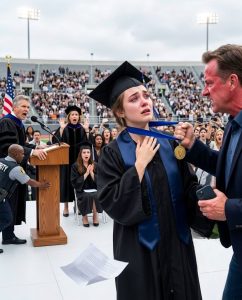
Then Michael stood up.
His voice tore through the applause.
‘You think you’re better than this family now?!’
The stadium went quiet so quickly it felt like something had been cut.
Tassels stopped moving.
A mother lowered her phone.
One graduate froze with both hands halfway through a clap.
A paper program fluttered from someone’s lap and landed near the stage steps.
Nobody moved.
Michael was already coming toward the stage.
His face was red.
His jaw was tight.
His phone was still in one hand, as if even his anger had been interrupted by Olivia’s success.
Security hesitated at first.
That hesitation would later bother Olivia more than she expected.
Nobody expects a parent to charge a graduation stage.
Nobody expects humiliation to arrive wearing a visitor wristband.
‘Dad,’ Olivia whispered.
The microphone caught it.
Her small word moved across the field through the speakers.
Michael climbed the steps.
He pointed at her in front of everyone.
‘You don’t deserve all this attention.’
For a second, Olivia saw the medal through his eyes.
Not proof.
Not pride.
An accusation.
His hand shot out.
The ribbon jerked hard against the back of her neck.
The clasp snapped with a sharp little sting.
Gasps opened across the stadium.
Her speech paper slid from her fingers and skated across the stage.
The medal dangled from Michael’s fist.
Olivia wanted to grab it back.
She wanted to scream.
She wanted to make him feel one ounce of the shame he had just poured over her in public.
Instead, she stood there shaking.
Her eyes went past him to her mother.
Sarah watched from the bleachers.
She did not stand.
She did not call Olivia’s name.
She did not even remove her sunglasses.
Cameras flashed.
Security finally rushed the steps.
The dean leaned toward the still-live microphone.
‘Mr. Hayes,’ he said.
His voice was calm enough to frighten people.
Michael turned, medal still clenched in his fist.
‘This is family business,’ he snapped.
The dean looked at Olivia’s fallen speech, then at the medal, then at the crowd.
‘No,’ he said. ‘This is a university ceremony, and that medal belongs to the student who earned it.’
The microphone carried every word.
A security guard stepped between Michael and Olivia.
Another held out a hand.
For a moment, Michael did not move.
The whole stadium seemed to wait on his fingers.
Then Ethan lowered his phone in the bleachers.
He had been recording.
Olivia saw it happen.
So did Sarah.
Her mother removed her sunglasses with both hands, and her face seemed to shrink without them.
‘Michael,’ she said, but it came out weak.
That was the first time she had spoken Olivia’s name’s enemy instead of Olivia’s name.
It was not enough.
It was also not nothing.
The faculty marshal came forward carrying the official honors folder from the registrar’s table.
Inside were copies of the final ranking notice, the award verification sheet, and the submitted speech.
The dean opened it at the podium.
‘Olivia Hayes is the verified valedictorian of this graduating class,’ he said. ‘Her award stands.’
The applause did not come all at once.
It began in one section, uncertain and angry.
Then another section joined.
Then the front rows of graduates stood.
A professor stood next.
Then another.
Within seconds, the stadium was on its feet again, but this applause sounded different.
It did not feel like celebration anymore.
It felt like protection.
Michael’s hand loosened.
The medal dropped into the security guard’s palm.
The guard passed it to the dean, and the dean turned to Olivia.
He did not put it back around her neck immediately.
He looked at her first.
‘Do you want to continue?’ he asked softly, away from the microphone.
That question nearly broke her.
Not because it was grand.
Because it gave her a choice.
Olivia nodded.
The faculty marshal replaced the medal with careful hands, fastening the broken clasp temporarily with a small pin from her own robe.
Olivia’s neck stung where the ribbon had snapped.
Her hands still trembled.
But she walked back to the microphone.
Michael was being escorted down the steps.
He kept talking, but the crowd drowned him out.
Sarah stood in the bleachers with one hand pressed to her mouth.
Ethan remained frozen behind her, phone hanging at his side.
Olivia looked at the paper on the floor.
It was dirty now.
One corner had folded under itself.
A shoe print marked the final paragraph.
She picked it up.
Then she set it on the podium without reading from it.
‘I wrote a line in this speech about building a future without waiting for the people who never believed in you to change,’ she said.
Her voice shook.
This time, she let it.
‘Apparently I needed to hear it too.’
The stadium went silent again.
Not the same silence as before.
This one listened.
Olivia took one breath.
Then she finished her speech from memory.
After the ceremony, campus security asked her to give a statement in a small office behind the stadium.
The room smelled like printer paper and old carpet.
Her hands shook so badly she had to hold the pen with both of them.
The incident statement had three lines at the top for date, time, and location.
She wrote them carefully.
Saturday.
12:43 p.m.
Graduation stage.
The dean sat across from her while a campus security officer typed notes into a report.
The officer asked whether Michael had hurt her.
Olivia touched the back of her neck and said, ‘Not badly.’
The dean said, ‘That is not the same as no.’
That sentence stayed with her.
A nurse at the first-aid table later checked the red mark where the ribbon had cut into her skin.
It did not need treatment beyond a cold pack.
Still, the nurse documented it on a campus medical form because the dean insisted.
Olivia almost laughed when she saw another piece of paper with her name on it.
For four years, paper had proved she had worked.
Now paper was proving what had been done to her.
By evening, the video was everywhere among students and families.
Ethan had not posted his copy.
Someone else had.
There were multiple angles.
One showed Michael charging the stage.
One caught Sarah sitting still.
One caught Olivia whispering ‘Dad’ into the microphone.
That was the clip people replayed the most.
Not the yank.
Not the shouting.
That one small word.
Dad.
At 8:16 p.m., Sarah called.
Olivia let it ring until it stopped.
At 8:19 p.m., Ethan texted.
I didn’t know he was going to do that.
Olivia stared at the message from her apartment couch, still wearing the robe over jeans because she had not found the energy to take it off.
The medal lay on the coffee table in front of her.
The ribbon had been fixed with the faculty marshal’s pin.
She typed back three words.
But you filmed.
Three dots appeared.
Then disappeared.
Then appeared again.
No answer came.
Michael called at 9:02 p.m.
Then again at 9:04.
Then he sent a voicemail Olivia did not play until the next morning.
When she finally listened, his voice was not sorry.
It was embarrassed.
There is a difference.
He said she had made him look bad.
He said people were blowing things out of proportion.
He said family should not let strangers get involved.
He never said he was sorry for putting his hands on the medal.
He never said he was sorry for humiliating her.
He never said he was proud.
Olivia deleted the voicemail before it ended.
On Monday, she went to the registrar’s office to request replacement documentation because the original speech copy had been damaged onstage.
The woman at the desk recognized her instantly.
Her face changed in that careful way people use when they know something awful about you and do not want to make you carry it again.
‘We can print whatever you need,’ she said.
Then she lowered her voice.
‘And for what it is worth, you handled yourself with more grace than most adults ever learn.’
Olivia nearly cried right there between the forms rack and the campus map.
Instead, she thanked her.
Two weeks later, the university mailed Olivia a new medal ribbon and an official letter acknowledging the interruption of the ceremony.
The letter was plain and formal.
It used phrases like unauthorized stage access and disruption of proceedings.
It did not capture the way Olivia’s body had gone cold when her father’s hand hit her neck.
It did not capture her mother’s sunglasses.
Documents rarely capture the soul of a thing.
They only hold its bones.
Still, Olivia kept the letter.
She put it in the folder with the payroll records, aid forms, honors notice, and receipts.
Not because she planned to show it to anyone.
Because she had finally accepted that proof was not the same as permission.
Her father had seen the proof and still tried to take it.
Her mother had watched the truth unfold and still waited too long to move.
A month after graduation, Sarah came to Olivia’s apartment.
She brought grocery bags because that was the language she knew.
Milk.
Eggs.
A rotisserie chicken.
Paper towels.
Things a mother could set on a counter when apology would require more courage.
Olivia let her in.
They stood in the small kitchen with the refrigerator humming between them and the same kind of silence that had lived in Sarah’s kitchen years earlier.
This time, Olivia did not fill it for her.
Sarah unpacked the groceries slowly.
Her hands looked older than Olivia remembered.
‘I should have stood up,’ Sarah said.
Olivia did not answer right away.
Outside, a car door shut in the parking lot.
Somebody laughed downstairs.
Life kept making ordinary noises around an extraordinary wound.
‘Yes,’ Olivia said.
Sarah flinched.
Maybe she had expected comfort.
Maybe she had expected Olivia to say it was okay.
It was not okay.
Some forgiveness is just another name for asking the injured person to keep the peace.
Olivia was tired of being peaceful at her own expense.
Sarah cried then.
Quietly.
Not dramatically.
She said Michael had been angry for years, angry about money, angry about Olivia leaving home, angry that she had done something he could not claim as his own.
‘That doesn’t explain you,’ Olivia said.
Sarah looked down at the paper grocery bag.
‘No,’ she whispered. ‘It doesn’t.’
That was the beginning of honesty.
Not healing.
Not yet.
Just honesty.
Michael did not come.
He sent messages through Sarah for a while.
Then through Ethan.
Then directly, once, with a long paragraph about respect that never mentioned what respect would have looked like on a graduation stage.
Olivia did not respond.
Ethan showed up three months later at the diner where Olivia still worked weekends while interviewing for full-time jobs.
He looked uncomfortable in a booth near the window, turning a coffee mug in both hands.
‘I deleted the video,’ he said.
Olivia set down the check presenter.
‘That doesn’t undo recording it.’
‘I know.’
He swallowed.
‘I thought it was going to be Dad saying something stupid from the stands. I didn’t think he would go up there.’
Olivia studied him.
For most of her life, Ethan had been the child the family protected.
That day, even he had looked like a boy watching the roof come off his house.
‘I’m sorry,’ he said.
It was clumsy.
It was late.
It was also the first clean apology anyone in her family had given her.
Olivia nodded once.
She did not hug him.
She did not absolve him.
But she brought him fresh coffee before she walked away.
That was enough for that day.
In September, Olivia started her first full-time job in a small office with a real desk, a badge, and health insurance that made her cry in her car after orientation.
On her first morning, she hung the medal on the wall beside her degree.
The new ribbon lay smooth against the frame.
Most people who saw it congratulated her.
A few asked about the tiny mark on the old clasp, the one that had been bent when Michael tore it away.
Olivia never gave the full story at work.
She only said, ‘It had a rough day before I did.’
Sometimes that was all the truth people needed.
The video faded from campus talk eventually.
New scandals came.
New graduations happened.
The stadium filled with other families and other flowers.
But Olivia did not forget the sound of the applause returning after the dean spoke.
She did not forget the faculty marshal’s hands fixing the ribbon.
She did not forget the security guard holding out his palm until her father finally let go.
Most of all, she did not forget the version of herself who stood there shaking and still stayed.
For years, Olivia had believed being seen would make her family love her differently.
The stage taught her something harder.
Being seen does not change people who are committed to looking away.
But it can change you.
It can show you that the shame was never yours to carry.
It can teach you that a medal is not powerful because someone gives it to you.
It is powerful because no one else has the right to take it.
The last time Michael called, Olivia was sitting in her apartment with a stack of moving boxes around her and an offer letter open on her laptop.
The job came with a better salary.
A better apartment.
A future that did not require permission from the back row of anyone’s life.
She let the call go to voicemail.
Then she picked up the medal from the table and packed it herself.
Not in the folder.
Not hidden away.
On top.
Four years had turned into one gold circle against her chest, and one terrible afternoon had shown her exactly who would clap, who would grab, and who would finally stand.
That public humiliation did change all of their lives forever.
It just did not change them the way Michael meant it to.
It changed Olivia first.
And this time, no one got to take that from her.