The first thing I heard when I drove back to the mountain house was Olivia’s wind chime.
It tapped once against the cedar post beside the front door, soft and hollow, the way it used to on evenings when she left the windows open and told me the house sounded alive.
For three years, I had avoided that sound.
My name is Ethan Brooks, and I was thirty-three years old when I finally drove up that gravel driveway again.
On paper, I was doing fine.
That was the phrase people used when they did not know what else to say to a widower who answered emails, paid his taxes, ran a company, and kept showing up to meetings in clean shirts.
Fine.
I had built an investment company from the ground up, and I had learned the useful professional talent of looking calm while everything inside me went quiet.
But grief does not care how well you can read a balance sheet.
At 4:18 p.m. on a Friday afternoon in the Blue Ridge Mountains of North Carolina, I sat in my SUV outside the cottage Olivia had loved, both hands locked around the steering wheel, unable to open the door.
The air smelled like wet leaves and cold dirt.
The gravel under the tires had made the same soft cracking sound it used to make when Olivia was alive and standing on the porch with a mug of coffee warming her hands.
The house looked almost exactly the same.
Cedar walls.
Stone chimney.
Blackberry canes at the edge of the meadow.
A porch that still leaned a little from the storm damage we had promised each other we would fix before winter.
In the passenger seat beside me was the estate folder.
Inside it were the county tax notice, the insurance papers, and the unsigned listing agreement from the realtor who had been polite enough not to say that I had waited too long.
I had come to say goodbye to the life Olivia and I had lost.
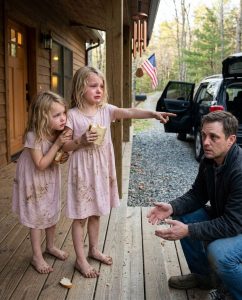
I had not come to find two little girls on the porch.
At first, my mind tried to make them into something else.
Shadows.
Laundry.
A trick of grief and mountain light.
Then one of them shifted her weight, and I saw bare feet on the porch boards.
They were twins.
Their dresses were streaked with mud.
Their pale hair was tangled around small, drawn faces.
Each one held a hard piece of stale bread in one fist, not like food, but like proof.
The engine ticked as it cooled.
Neither girl waved.
Neither ran.
They only stared at me with the exhausted silence of children who had already learned that adults could be dangerous.
I stepped out slowly and left the driver’s door open behind me.
The warning chime from the SUV sounded too loud in that quiet.
I stopped at the bottom of the porch steps and crouched.
Olivia had once told me that frightened children watched hands before faces.
She said that while we were sitting in a hospital waiting room during one of her treatment days, watching a little boy hide behind a vending machine because his parents were arguing too loudly.
I do not know why that memory came back then.
It just did.
So I kept my palms open.
“Hey,” I said. “I’m Ethan. Can you tell me your names?”
The girl on the left touched her chest.
“Emma,” she whispered.
Then she pointed at the other child.
“Ella.”
Emma and Ella.
They nodded together when I repeated it, a tiny matching movement that made my throat tighten.
They looked too young to be alone anywhere.
They looked far too young to be alone on a mountain porch with no shoes, no backpack, no adult, no car, and nothing to eat except two crusts of bread.
I looked through the front window.
I looked toward the driveway.
I looked down the road past the mailbox where Olivia’s last name had faded under mine.
There was no pickup under the trees.
No mother calling from the yard.
No sound from inside the house.
Only the chime, the tall grass, and two children trying very hard not to cry.
“Where’s your mom?” I asked.
Ella looked down at the porch boards.
Emma’s fist closed so tightly around the bread that the crust cracked.
That silence told me more than an answer would have.
There are kinds of quiet you only learn after loss.
The quiet of an empty house.
The quiet of a hospital hallway after a doctor stops using hopeful words.
The quiet of children deciding whether the truth will get them punished.
I made my voice gentler.
“Are you hungry?”
Emma lifted the bread a little.
“Yeah.”
“Then why aren’t you eating it?”
The twins looked at each other.
It was not the look children give when they are choosing whether to tell a stranger a secret.
It was the look of children who had already been told what would happen if they did.
Emma finally turned back to me.
“Because,” she said, “Mom said we have to save it.”
The words landed cold.
I looked at the bread.
I looked at their muddy feet.
I looked at the front door of the house Olivia had loved more than any place on earth.
“Save it for what?”
Neither child answered.
Instead, both girls turned toward the narrow trail behind the cottage.
I knew that trail.
Olivia used to walk it every evening before sunset, even when her body was tired and I begged her not to push herself.
She said the trees made her feel like she could breathe again.
No one else was supposed to know how much that path mattered.
Then Ella raised one dirty hand and pointed into the woods.
Her lower lip trembled.
“Mom said Olivia would keep us safe,” she whispered.
For a moment, the whole mountain seemed to stop making noise.
Olivia had been dead for three years.
These girls were saying her name like she was still somewhere inside that house.
I reached slowly for my phone.
Both children flinched.
I froze with my hand halfway to my pocket.
Emma stepped in front of Ella, barefoot on the rough boards, and tried to look brave while her knees shook.
“Please don’t call the police,” she whispered.
At 4:23 p.m., one bar appeared on my phone.
That one bar felt like a decision I was not ready to make.
I looked toward the trail again.
The trees were still.
Too still.
“Emma,” I said carefully, “is your mom in the woods?”
Emma’s eyes filled, but she did not answer.
Ella sat down suddenly on the porch, not loudly, not dramatically.
Her little body simply folded, like staying upright had cost more strength than she had left.
That was when I stopped trying to solve the moment gently.
I called 911.
My voice sounded strange to me when the dispatcher answered.
I gave the address from memory.
I told her there were two children alone on my porch.
I told her they were barefoot, hungry, and scared.
I told her their mother might be somewhere near the trail behind the house.
When the dispatcher asked whether the children were injured, I looked at Emma’s cracked lips, Ella’s gray face, and the bread crumbs on the porch.
“I don’t know,” I said. “But they need help.”
The dispatcher kept me on the line.
She told me not to go into the woods alone.
I already knew I was going to disobey that if I heard one human sound from the trees.
But first, I asked the girls if they would come inside.
Emma shook her head hard.
“Mom said porch,” she whispered.
Not house.
Porch.
That was when I understood that their mother had given instructions, and those instructions were the only thing holding the girls together.
So I did not force them inside.
I brought out the old quilt from the back of my SUV, the one I kept for road emergencies and never used.
I spread it on the porch.
I took two sealed bottles of water from the cooler behind my seat.
I set them down within reach and backed away.
Care is not always what you want to give.
Sometimes care is letting someone frightened decide how close you are allowed to stand.
Emma watched me unscrew one bottle, take a sip myself, and set it back down.
Only then did she let Ella drink.
Ella drank too fast and coughed.
Emma took the bottle from her and wiped her mouth with the edge of her own muddy dress.
It was such a small sisterly gesture that it hurt to watch.
At 4:41 p.m., the first county sheriff’s deputy pulled into the driveway.
His cruiser came slowly over the gravel, headlights flashing without the siren.
The girls pressed into each other when they saw it.
I stood where they could still see my hands and told the deputy, quietly, that the word police had frightened them.
He understood faster than I expected.
He stayed by his door.
He kept his voice low.
He asked their names from a distance and wrote them down on a small notepad instead of crowding the porch.
At 4:48 p.m., the volunteer rescue truck arrived.
A woman in a navy sweatshirt with EMT printed on the back came up the drive carrying a medical bag.
She crouched lower than I had and asked if she could look at their feet.
Emma refused at first.
Then Ella whispered, “It hurts.”
The EMT’s face changed, but only for a second.
Good people in emergencies know how to keep horror off their faces.
She checked their feet.
She checked their temperature.
She asked when they had last eaten.
Emma looked at the bread.
Nobody moved for a beat.
The stale crusts had become evidence.
By 5:07 p.m., the deputy had opened an incident report.
By 5:12 p.m., a second responder was walking the edge of the trail calling out into the woods.
By 5:19 p.m., I was standing beside my own SUV, looking at the old mountain path and hearing Olivia’s voice in my memory as clearly as if she were beside me.
She had always been the person strangers trusted.
At grocery stores, old women asked her to reach things from high shelves.
In hospital waiting rooms, children stopped crying when she smiled at them.
At roadside diners, waitresses told her things they did not tell their own families.
I used to tease her about it.
She used to shrug and say, “People know when you’re not trying to take anything from them.”
I did not understand how far that kind of goodness could travel after death.
The search team found the girls’ mother just before dusk.
She was not far down the trail.
She was alive, but barely steady, sitting against an oak with one hand pressed to her side and the other still curled around an empty plastic water bottle.
She had not abandoned them because she did not care.
She had left them on the porch because she thought it was the only place in the world where someone might not turn them away.
I did not hear the whole story that night.
The deputy would not let me crowd her.
The EMTs moved quickly.
The girls started sobbing when they saw the stretcher, and Emma tried to run down the steps before the EMT caught her gently by the shoulders.
“Is she bad?” Ella asked me.
For half a second, I thought she meant sick.
Then I understood.
She was asking whether her mother was in trouble.
I crouched again.
“I don’t know everything,” I said. “But I know she got you to the porch.”
Emma looked at me like she wanted to believe that was enough.
At the hospital intake desk that night, everything became paperwork.
Names.
Birth dates.
A temporary safety plan.
A child services contact.
A medical chart.
A police report number written in blue ink on a folded sheet the deputy handed me because I was the homeowner and the reporting party.
The girls were given socks first.
I remember that more than almost anything.
Not medicine.
Not forms.
Socks.
White hospital socks with little rubber grips on the bottom.
Ella curled her toes inside them like warmth was a surprise.
Their mother was treated down the hall.
A caseworker spoke to her after the doctor cleared the room.
I was not entitled to the details, and nobody pretended otherwise.
But later, the mother asked to speak to me.
She looked younger than I expected and older than anyone should have looked at the same time.
Her voice was cracked from thirst.
She said Olivia’s name with such care that I had to grip the arm of the chair.
Years earlier, before Olivia got really sick, she had helped her at a county family resource office after a bad night the woman could barely describe.
Olivia had not fixed her life.
Olivia had not made grand promises.
She had done what Olivia always did.
She had written down a phone number.
She had bought her coffee.
She had listened.
And before they parted, Olivia had told her that if she ever had nowhere safe to go, there was a porch in the mountains where she could sit until someone helped.
The woman had carried that sentence for years.
A porch in the mountains.
Not a plan.
Not a legal guarantee.
Just one sentence from a kind woman who had no idea she was leaving a map behind.
I went home after midnight, though home was the wrong word for the cottage then.
The porch still had bread crumbs between the boards.
The quilt was folded over the railing.
The wind chime moved in the dark.
I stood there with the estate folder in my hand and thought about the listing agreement.
The realtor had done nothing wrong.
The county tax notice was real.
The insurance bill was real.
The practical thing would have been to sell.
But practical things are not always true things.
The next morning, I called the realtor and told her I was taking the house off the market.
I did not explain it well.
I only said I needed more time.
Then I called the county office listed on the safety plan and asked what I was allowed to do.
I learned quickly that wanting to help children does not give you the right to take over their lives.
There were forms.
There were background checks.
There were rules written for reasons, even when those rules felt slow.
So I followed them.
I documented what had happened.
I gave the incident report number.
I answered questions about the property.
I spoke with the caseworker and told her the cottage could be used as a safe meeting place if the girls’ mother wanted it and the county approved it.
Nobody made me a hero.
That was not what the girls needed.
They needed adults who did not make promises faster than they could keep them.
Weeks passed before I saw Emma and Ella again.
When they came back to the cottage, it was not dramatic.
There was no movie music.
Their mother was with them.
The caseworker waited by the driveway.
Emma wore sneakers with purple laces.
Ella carried a paper cup of apple juice in both hands.
They stood on the porch and looked at the door like it might remember them.
I had replaced the loose boards.
I had repaired the broken porch rail.
I had cleaned the crumbs from the cracks, though part of me had wanted to leave them there as proof that the night had happened.
Emma noticed the wind chime first.
“Was it hers?” she asked.
“Yes,” I said.
Ella reached up, too short to touch it.
I lifted her only after she nodded.
Her fingers brushed the copper tubes, and the sound moved softly through the trees.
For the first time, it did not sound like a ghost.
It sounded like an answer.
I did not become their father.
Their story was not mine to steal.
Their mother fought for them in ways I only saw from the edges, through scheduled visits, approved plans, and quiet updates from people whose job was to protect the children, not satisfy my curiosity.
But the cottage changed.
So did I.
I stocked the pantry with food that did not expire quickly.
I kept bottled water by the door.
I put a small bench on the porch and a new mailbox flag at the road.
Not because I wanted strangers to come.
Because one woman had come once, and my wife had somehow reached her before I ever did.
People talk about legacy like it is money, property, a name on a deed, or a photograph in a frame.
Olivia’s legacy was smaller and stronger.
A sentence.
A porch.
A kindness someone remembered when there was nothing left to hold.
Months later, I found the listing agreement again in the glove compartment of my SUV.
It was creased from being carried back and forth and never signed.
I sat in the driveway with it across my lap while the wind moved through the blackberry canes.
Then I tore it once down the middle.
Not in anger.
Not in grief.
In recognition.
I had come to the mountain house to say goodbye to the life Olivia and I had lost.
Instead, two abandoned twin girls stood on my porch clutching stale bread like treasure, and they taught me that some houses are not meant to be closed just because the person you loved is gone.
Some doors stay open because love left instructions.
And sometimes the life you think you are finished with is the one still waiting for you to come home.