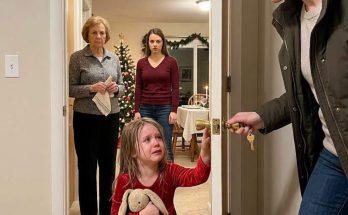
My Daughter Said My Job Was to Serve Her Mother-in-Law So I Packed My Suitcase and Left
I had just set the roast chicken on the dining table when my daughter Sarah delivered the line that would permanently alter both of our lives.

It wasn’t the volume of her voice that stopped me cold. She said it casually, without even looking up from her phone, the way you’d mention that it might rain later. That was the part that cut deepest — the casualness. Cruelty that a person has to work themselves up to is one thing. Cruelty that slides out
easy as breathing tells you something has been true in that person’s heart for a long, long time, and you’re only now being allowed to hear it out loud.
“Your job is to do the housework while my mother-in-law enjoys life,” Sarah said, thumb still scrolling. “If you don’t like it, leave.”
I paused with the serving fork still in my hand. The chicken steamed in front of me — a chicken I had brined the night before, seasoned that morning, and basted every twenty minutes for two hours while also folding three loads of laundry and taking my grandson Leo to the park so Sarah could “focus on a
deadline” that, as far as I could tell, involved forty-five minutes of typing and two hours of scrolling.
Across the table, Brenda — Sarah’s mother-in-law — leaned back in her chair with a small, satisfied smile and swirled her iced tea like a woman on the veranda of a resort. Which, in every way that mattered, she was. My son-in-law, Greg, suddenly discovered that his mashed potatoes were the most
fascinating objects in the Western Hemisphere. He did not look up. He did not say a word. Even little Leo, three years old and perceptive the way small children are, went quiet in his booster seat, his eyes moving between his mother and me.
Let me tell you how we got to that table, because the table was only the final scene of a very long play, and I was the only one in the house who had never been given a script — just stage directions.
My name is Heather. I’m sixty-two years old, widowed nine years. Two years before that dinner, when Leo was born, I moved into Sarah and Greg’s guest room to help. That’s the word we all used. Help.
It was supposed to be temporary — a few months, a grandmother doing what grandmothers have always done, carrying a young family through the sleepless newborn stretch until they found their feet.
I remember the phone call that started it. Sarah, eight months pregnant, crying on the line at ten at night. “Mom, I’m scared. Greg’s travel schedule is insane and I don’t know how to do any of this. Could you… would you come? Just for a little while?”
I had a paid-off little house forty minutes away, a garden I loved, a book club, a rhythm. I gave notice to my book club and put the garden to bed and packed two suitcases, because my daughter asked me to, and because when your child says I’m scared, everything else in your life goes quiet.
Those first months were real. Hard, holy, exhausting, real. I walked the halls at three a.m. with a colicky newborn on my shoulder so Sarah could sleep four unbroken hours.
I cooked, I cleaned, I did the endless tiny laundry of a new baby. And in those early months, Sarah would sometimes catch my hand in the kitchen and say, “I don’t know what we’d do without you,” and I would think: this is what family is for. This is the whole point of me.
But here’s what nobody warns you about. Help, if you’re not careful, hardens into a routine. A routine hardens into a job. And a job — if you’re really not careful — hardens into an identity that other people assign to you and then stop seeing altogether, the way you stop seeing the refrigerator. It’s just there. It hums. It keeps things cold. Nobody thanks it.
By the end of the first year, the thank-yous had stopped entirely. I was doing all the cooking. All the deep cleaning. All the laundry — theirs included, because one morning Sarah dropped a basket of her and Greg’s clothes outside my door with a Post-it that said “if you get a chance ,” and I did it, and after that there was never a Post-it again, just the basket. I handled the overnight wakings long past the
newborn stage. I did the grocery shopping, managed the household calendar, booked the pediatrician, remembered the trash day, scheduled the furnace maintenance, bought the birthday gifts for parties Leo was invited to — including, twice, gifts that were then presented as being “from Sarah.”
Somewhere in that second year, “Mom, you’re a lifesaver” became “Mom, the hamper’s full.” And then even that stopped, replaced by the purest form of entitlement there is: silence. The unspoken, total assumption that whatever needed doing in that house, Heather would do it, because doing it was what Heather was.
I told myself stories about it, the way we do. They’re overwhelmed. It’s a season. She doesn’t mean it. I raised her better and it’ll resurface. I want to be honest with you: I participated in my own erasure, one swallowed sentence at a time. Every time I bit my tongue to keep the peace, I taught them the peace was free.
And then, twice a year, there was Brenda.
Brenda was Greg’s mother, seventy-one, a widow like me, comfortable, and constitutionally incapable of lifting a finger inside a home that wasn’t hers — and, I suspect, inside her own. She would arrive for two or three weeks at a stretch with hard-shell luggage and soft demands that were not demands at all,
officially, just observations released into the air for someone to catch. “Oh, is there no fresh fruit cut up? At home I always have fresh fruit in the morning.” “These towels have gone a bit stiff, haven’t they?” “I do take my tea at four, but don’t trouble yourself.” And I would catch every one, because Sarah’s eyes
would find mine across the room with a silent plea — please, Mom, just handle it — and I handled it, and the handling was invisible by design.
Brenda left her wet towels on the bathroom floor daily. She never carried so much as a spoon to the sink. She referred to the guest bathroom as “my bathroom” and once rang the little bell Sarah kept on the sideboard — an ornament, a wedding gift — and when I appeared out of sheer reflex, she said, “Oh good, it works,” and asked for more ice.
And Sarah, who wanted so desperately to be admired by this woman, performed for her every visit — the gracious hostess, the accomplished wife, the effortless mother. The performance always required a supporting cast of exactly one: me, in an apron, offstage, making the effortlessness possible.
So when Sarah said it out loud that night — your job is to do the housework while my mother-in-law enjoys life — understand that she wasn’t starting an argument. She was simply reading aloud, for the first time, the org chart that had been posted in her head for two years. Brenda: guest of honor. Sarah: lady of the house. Heather: staff.
And here is the strange thing, the thing I still marvel at. Standing there with that serving fork, I did not feel rage. I felt a warmth spread through my chest that took me a moment to identify, because it had been absent so long.
It was clarity. Pure, weightless clarity — the feeling of a knot you’ve picked at for years suddenly falling open on its own.
I looked at my daughter — really looked, the way you look at a stranger — and I saw a thirty-four-year-old woman who had completely confused my maternal sacrifice with servitude. Who had watched me give and give and give, and had concluded, quite reasonably from her side of the table, that giving was
simply what I was for. And I understood, in that one clean moment, that no speech would fix this. No tears, no lecture, no family meeting. There was only one message she could still receive, and it had to be delivered in the only language the household understood: labor. Specifically, the sudden absence of it.
“All right,” I said, and my voice came out perfectly even, which surprised even me. “I’ll leave. And you can start handling everything yourself.”
Sarah rolled her eyes and stabbed a piece of chicken. “Stop being dramatic, Mom. Just clear the counter before you sit down.”
I want you to notice what she did there, because I did. In one breath, I’d announced my departure. In the next, she’d assigned me a chore. That is how invisible I had become — my exit registered as background noise, but the counter still needed clearing.
I didn’t clear the counter.
I didn’t sit down.
I set the serving fork carefully beside the roast — gently, precisely, because I refuse to be a woman who throws things — turned on my heel, and walked down the hallway to my bedroom. Behind me I heard Greg mutter something low, and Brenda’s dismissive little laugh floated after me like perfume. “She’ll be
back by dessert,” I heard her say, quite clearly. They genuinely believed I was having a moment. A flare-
up. Something that would burn itself out around the time the dishes needed doing.
They had no idea that the foundation holding up their entire comfortable world had just excused itself from the table.
Leaving a house you’ve run for two years doesn’t happen in five minutes. But it happens a great deal faster than you’d think, once you are finally, completely done making excuses for people.
I pulled my hard-shell suitcase down from the closet shelf and laid it open on the bed. I did not throw things into it in a passion. I folded. Sweaters. Slacks. Comfortable shoes.
Each item squared away with the same care I’d folded their laundry with for two years — except this time, for the first time in a long time, the care was for me. I packed my toiletries and my medications. I packed the framed photo of my late husband, Tom, from the dresser — he watched me pack, the way
he’d watched over me from that frame for nine years, and I swear his smile looked approving. I packed the picture of Leo at his first birthday with chocolate cake on his nose. I left the apron hanging on the back of the door. It belonged to the house now. It always had.
Down the hall, silverware clinked. Brenda’s braying laugh came through the wall, twice. They were still eating the meal I had spent two hours preparing. I want you to hold that image the way I’ve held it since: a family enjoying a roast chicken while the woman who cooked it packed her entire life into a suitcase forty feet away — and in the twenty-five minutes it took me, not one of them got up to knock on my door. Not my daughter. Not my son-in-law. Nobody.
That, more than anything said at the table, told me I was right to go.
I took my house key off my ring — the key I’d used to let repairmen in, to carry groceries through, to come home from Leo’s pediatrician visits — and laid it in the exact center of my neatly made bed, where it could not possibly be missed. Then I zipped the suitcase, the long metallic sound very loud in that quiet room, took one last look around at two years of my life, and rolled my bag out into the living room.
The dining table went dead silent.
Sarah froze with her fork halfway to her mouth. Greg dropped his napkin. Brenda’s smile evaporated into pure confusion — the confusion of a hotel guest watching the entire staff walk out mid-shift.
“Mom, what are you doing?” Sarah demanded, her tone sliding from arrogance to irritation — but not yet, I noted with an odd, clinical detachment, anywhere near worry.
“I’m leaving,” I said, not breaking stride. “Just like you suggested.”
“At this time of night? Don’t be ridiculous.” She actually gestured at the table, at the wreckage of the meal. “Who is going to clean up the kitchen? Brenda is a guest.”
I paused at the front door with my hand on the latch, and I turned and looked at my daughter, and I gave her the only piece of housekeeping instruction I had left in my body.
“You are a thirty-four-year-old woman, Sarah. I’m sure you can figure out how soap and water work.”
Leo said, “Bye-bye, Gamma?” in a small uncertain voice, and that — only that — nearly broke me. I blew him a kiss. “See you soon, sweet boy,” I said, and I meant it, because none of this was ever going to be about him.
I opened the door. The evening air hit my face — pine, cut grass, and underneath it something I can only describe as oxygen after a long time in a sealed room.
“If you walk out that door,” Sarah shouted from her chair — still seated, I noted; she did not rise even for this — “don’t expect me to come begging you to return!”
I smiled without turning around.
“I wouldn’t dream of it.”
And I let the heavy oak door click shut behind me on the sound of my daughter’s stunned silence and, faintly, Brenda asking if there was more gravy.
I checked into a comfortable extended-stay motel three towns over — far enough that no one could “just swing by,” close enough to Leo that my heart could stand it. The room was plain. The bed was firm. It smelled like lemon cleaner that someone else had applied, which struck me as the most luxurious scent on earth. And it was silent. Deeply, spectacularly silent.
I sat on the end of that bed for a few minutes, waiting to feel the things I assumed I was supposed to feel — guilt, panic, grief. They didn’t come.
What came instead was tiredness, two years of it, arriving all at once now that there was finally room for it. I took a long shower with nobody’s towels to pick up but my own, got into bed, and slept nine straight hours for the first time in twenty-four months.
When I woke, sunlight was coming through the curtains, and I lay there and observed my own first conscious thought the way a scientist observes a rare bird. It was not: does anyone have clean socks. It was not: is the coffee pot prepped, is Brenda’s fruit cut, is the blue jacket by the door. It was: I think I’ll have my coffee by the window.
So I did. Instant coffee in a paper cup. Best cup of coffee of my adult life.
Then I unlocked my phone. Thirty-two unread messages. Four missed calls.
The earliest texts, from around six-thirty a.m., were merely annoyed — the tone of a woman inconvenienced by an appliance malfunction:
“Mom, where is the baby’s blue jacket? We’re running late.”
“The coffee maker isn’t working. Did you unplug it?”
No. I did not unplug the coffee maker. The coffee maker required a person to put water and grounds in it, a fact that had apparently never been observed by anyone else in that house.
By seven-fifteen, the tone had shifted from inconvenience to grievance:
“Greg had to leave without breakfast. Brenda is complaining there are no fresh towels in her bathroom. Stop ignoring me.”
I read them all in order, the way a person reads the weather report for a city they’ve moved away from. Interesting. Distant. Not my forecast anymore. Then I set the phone face-down and finished my coffee while it was still hot — a small act that felt, that morning, nearly criminal in its decadence.
Around nine, Greg entered the field: “Hey Heather. Sarah is really stressed. Can you just come back and help with the morning routine? Brenda doesn’t know how to use the washing machine.”
I read that sentence three times. Brenda doesn’t know how to use the washing machine. A grown woman of seventy-one, mother of a grown man, defeated in open combat by an appliance with three buttons and pictures on them.
I typed my first reply of the day:
“Good morning, Greg. As Sarah explained last night, it is not my job. I suggest reading the manual — it’s in the drawer under the machine, where I put it two years ago. Best of luck.”
Then I got dressed, because I had errands to run — real ones, mine — and the first one was the most important errand of my new life.
Here is something nobody warns you about when you become a household’s unpaid manager: the money tangles itself up right alongside the labor, quietly, one convenience at a time.
Because I did the grocery shopping, my credit card was the one saved in the family’s grocery delivery app. Because I handled the bills — Sarah found bills “stressful,” and stressful things migrated to me the way water migrates downhill — my checking account had ended up on autopay for their internet, their