
Before the paramedic could respond, the second neighbor said he had heard something else from the barnyard before he came running.
He did not raise his voice.
He did not embellish it.
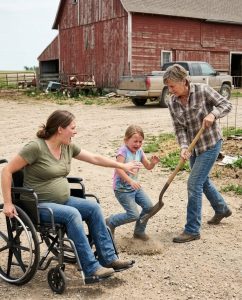
He just looked at the paramedic, then at my mother, and repeated the words he said had carried across the property moments before everyone started shouting.
According to him, Mom had yelled, “You do not walk away from me when I am talking to you.”
My daughter stopped crying for half a second.
Mom did not.
“That proves nothing,” she said immediately. “Kids get corrected. That is what parents used to do before everybody got so sensitive.”
The neighbor shook his head.
“You were not correcting her,” he said. “You sounded furious.”
Mom pointed at my daughter from several feet away.
“Because she was being disrespectful.”
One of the paramedics glanced up from my daughter’s leg.
Until that moment, Mom had been trying to maintain three different versions of the same few minutes.
First, my daughter had fallen.
Then she had supposedly kicked at Mom.
Then Mom had “barely touched” her.
Now she was admitting there had been an argument serious enough for her to be furious about being ignored.
The details were no longer drifting apart by accident.
They were colliding.
I kept my hands on the rims of my wheelchair because I could feel them shaking.
I was pregnant, frightened, and angry enough that part of me wanted to answer every accusation Mom threw at us.
But every time I started thinking about defending myself, I looked at my daughter on the ground.
Her face had gone pale beneath the tears.
Her fingers were locked around mine.
That was the only argument I needed to win right then.
The paramedic asked everyone except my daughter to stop talking.
Mom ignored him.
“Tell them you kicked at me,” she said.
My daughter stared at her.
“I didn’t.”
Mom took one step closer.
The neighbor who had removed the shovel shifted sideways and kept himself between them.
“Give her some room,” he said.
Mom looked offended.
Not frightened.
Not confused.
Offended.
She acted as though the worst thing happening on that patch of gravel was that people were no longer accepting her version automatically.
The paramedic asked my daughter where the shovel had hit.
She pointed toward the lower part of her leg and winced before her hand even reached it.
He told her not to move it again.
Then he asked whether she had fallen before or after the contact.
“After,” she whispered.
“Because of the shovel?”
She nodded.
Mom made a disgusted sound.
“She is exaggerating. She always does this when she gets caught doing something wrong.”
My daughter squeezed my hand harder.
“Stop talking about her like she isn’t here,” I said.
Mom turned toward me.
For the first time since the neighbors arrived, her voice lost that careful public softness.
“You created this,” she said. “You let her think she can ignore adults, and now you are sitting there acting helpless while everybody attacks me.”
The word helpless landed exactly where she intended it to.
My wheelchair was directly between her and my daughter.
I looked down at my hands on the rims and then back at Mom.
“I’m not helpless,” I said. “I’m keeping you away from her.”
She laughed once through her nose.
The neighbor holding the shovel lowered it farther behind his leg.
The paramedics finished stabilizing my daughter’s leg and prepared to move her.
When they lifted her onto the stretcher, she cried out despite trying not to.
That sound changed something inside me more effectively than anger ever could.
I stopped wondering whether Mom would forgive me for what came next.
I stopped wondering whether relatives would say I had gone too far.
I stopped wondering whether she would tell people I was dramatic, ungrateful, hormonal, or cruel.
My daughter was hurt.
My mother had done it.
My daughter had asked me not to let her touch her again.
Everything else came second.
One of the paramedics asked whether I was coming with them.
“Yes.”
Mom immediately said, “She cannot go alone in her condition. I’ll follow.”
My daughter heard her.
“No.”
The word was barely louder than her breathing.
But everyone nearby heard it.
Mom froze.
“What did you say?”
My daughter turned her face toward me instead of answering Grandma.
“I don’t want her there.”
I told the paramedic I would handle transportation arrangements and asked that Mom not be allowed near my daughter during the trip or once we arrived.
I did not make a speech.
I did not threaten anyone.
I simply answered the question that mattered.
“She does not have permission to be with my child.”
Mom started shouting before the stretcher had even cleared the gravel.
She said I was poisoning my daughter against her.
She said families argue.
She said children say dramatic things when they are upset.
Then she said something that made both neighbors turn toward her again.
“I was trying to scare her, not break her leg.”
Nobody had accused her, in that moment, of intending to break it.
She had supplied that distinction herself.
The neighbor holding the shovel stared at her.
“So you were trying to scare her with it?”
Mom’s mouth tightened.
“That is not what I said.”
“You just said it.”
“No, I said she needed to understand there are consequences.”
I watched the paramedic secure the straps around my daughter and kept my attention there.
Mom kept talking behind me.
Each sentence sounded like another attempt to drag the story back under her control.
She blamed my daughter for walking away.
She blamed me for not disciplining her properly.
She blamed the neighbors for interfering.
She blamed the paramedics for treating a “family misunderstanding” like something serious.
But she never once asked my daughter whether she was okay.
That absence stayed with me.
At the hospital, imaging confirmed what I already feared from the way my daughter’s leg looked and the way she reacted when anyone came near it.
It was fractured.
The staff focused on pain control, stabilization, and making sure there were no additional injuries from the fall.
My daughter answered questions quietly.
Whenever someone entered the room, she looked toward the doorway first.
At one point she asked me, “Can Grandma come in here?”
“Not unless you want her here.”
“I don’t.”
“Then she isn’t coming in.”
Her shoulders loosened slightly.
That small change hurt to see.
A child should not have to feel safer because she has been reassured that her grandmother cannot enter the room.
But that was where we were.
Later, someone came to take statements about what had happened.
I told the same story I had told the paramedics.
I did not improve it.
I did not add motives I could not prove.
Mom raised the shovel.
She struck my daughter’s leg.
My daughter went down.
Mom immediately began saying she had fallen.
Two neighbors arrived.
One heard Mom’s angry words before he reached us.
Both heard her explanations change afterward.
The shovel had been taken away because she tried to step around my wheelchair while still holding it.
Those were the facts I knew.
My daughter gave her account separately.
The neighbors gave theirs.
For once, Mom could not interrupt every version until they all sounded like hers.
That mattered more than I expected.
For years, I had thought arguments with my mother were exhausting because she always had more energy for them than anyone else.
Standing in that hospital room, I realized the deeper problem was that she treated disagreement as disobedience.
If you said no, she heard disrespect.
If you walked away, she heard defiance.
If you remembered an event differently, she treated your memory like an attack.
I had learned to survive that by explaining myself over and over.
My daughter had done something much simpler.
She had walked away.
And Mom had not tolerated it.
That realization did not excuse what happened.
It clarified it.
The conflict had not escalated because my daughter failed to communicate clearly enough.
It escalated because she made a choice Mom could not control.
When Mom was eventually allowed to communicate with me indirectly about the incident, her first concern was still the story.
She wanted me to understand that people were “making her sound dangerous.”
She wanted me to correct the neighbors.
She wanted me to explain that my daughter had been rude beforehand.
She wanted context.
I asked one question.
“Did you hit her with the shovel?”
There was a long answer waiting for me.
She said my daughter had ignored her.
She said the shovel was already in her hands because she had been working.
She said she had lost her temper for only a second.
She said she had not swung hard.
She said she had never meant for anyone to get seriously hurt.
Then she said, “You know I would never intentionally hurt my granddaughter.”
I repeated my question.
“Did you hit her with it?”
This time she paused.
“I made contact.”