The hospital room smelled like antiseptic, stale coffee, and the thin plastic wrapper from a fresh roll of bandages.
Rebecca Walker had been there long enough to know the sounds by heart.
The heart monitor beside her bed kept a steady rhythm, a small electronic beep that rose and fell through the room like it belonged to someone else.
The fluorescent light above her buzzed faintly.
A cart wheel squeaked somewhere in the hall.
Now and then, a nurse’s shoes passed by the door with that soft rubber sound all hospitals have, the sound of people moving quickly while trying not to frighten anyone.
Both of Rebecca’s legs were locked in plaster casts from her thighs down.
They were heavy, stiff, and hot beneath the thin hospital blanket.
Every small shift pulled at the bruises around her ribs.
Every breath reminded her of the cracked places the doctors had warned her not to ignore.
Three weeks earlier, at 6:42 PM, a hospital intake form had turned her life into a stack of boxes and signatures.
Patient name.
Emergency contact.
Insurance.
Accident details.
Pain level.
She remembered only pieces of the crash.
The red light.
The scream of brakes.
The sharp glitter of broken glass.
The smell of gasoline and hot rubber.
Then ambulance lights washing over the road in red and white, red and white, until everything became a blur.
When she woke up, a nurse was asking her name.
“Rebecca Walker,” she whispered.
The nurse asked if she knew where she was.
Rebecca tried to answer and cried out instead.
The doctors told her later that both legs were broken.
She had cracked ribs.
She had stitches under her hairline.
She had bruises so deep they looked painted on.
The words came gently, but the truth beneath them did not.
She would not be walking out of that hospital anytime soon.
For twenty-one days, Rebecca waited for her husband to come in like a husband.
Caleb did visit.
He came twice in the first week, once with his phone already in his hand and once with his jacket still buttoned like he had somewhere more important to be.
He asked the doctor how long recovery would take.
He asked what insurance would cover.
He asked whether all of this was really necessary.
He did not ask Rebecca if she was scared until a nurse was standing close enough to hear the answer.
“Yes,” Rebecca had said.
Caleb patted her shoulder like he was touching a stranger’s coat.
“You’ll be fine,” he said.
That had always been Caleb’s way.
He liked problems that solved themselves.
He liked emotions that came pre-folded and quiet.
He liked a house that ran smoothly, a daughter who behaved, bills paid on time, laundry handled, school forms signed, and dinner appearing as if the kitchen had done it on its own.
For eleven years, Rebecca had made that happen.
She had once worked in accounting.
She was good with numbers, patient with details, the kind of person who kept receipts in labeled envelopes and knew exactly when a bill had been paid.
When their daughter Emma was little, Caleb told her that one parent should stay home.
“It makes sense,” he said at the kitchen table, his laptop open, his coffee going cold beside him.
“Daycare costs almost as much as your paycheck anyway.”
Rebecca remembered looking down at Emma in the high chair, cheeks sticky with applesauce, one small sock missing.
She remembered thinking that maybe Caleb was right.
She remembered trusting him.
Trust can look practical at first.
It can look like one person saying, “I’ll handle the outside work,” while the other person quietly handles everything that keeps a home from falling apart.
It can look like love until the day you realize only one of you ever gave anything up.
Rebecca packed school lunches.
She answered calls from the school office.
She waited in pickup lines.
She sat through parent-teacher conferences alone while Caleb texted that work had run late again.
She paid bills from the kitchen table.
She remembered birthdays, doctor appointments, permission slips, grocery lists, dentist cleanings, field trip money, and every small family responsibility too invisible for anyone to praise.
She kept peace in the house because peace was easier than arguing.
A woman can mistake peacekeeping for love for a long time.
Then one day she stops moving, and everyone notices she was the furniture.
In the hospital, Rebecca had too much time to think.
She thought about their daughter, Emma, who had cried the first time she saw both casts.
Emma was thirteen now, old enough to understand that broken legs meant pain, but young enough to still believe her father would protect her mother because that was what fathers were supposed to do.
She had brought Rebecca a grocery-store bouquet wrapped in crinkly plastic.
The flowers drooped after three days, but Rebecca kept them on the windowsill anyway.
She liked seeing proof that someone had walked into the room thinking about her comfort instead of her cost.
By the third week, the hospital bills had started to become a constant shadow.
Rebecca heard nurses mention forms.
She saw Caleb’s face tighten whenever anyone said insurance.
She saw him glance at the clipboard outside her door like her name had become a number he resented.
On the twenty-first day, the door opened harder than usual.
Caleb walked in without knocking.
His dress shirt was pressed.
His shoes were polished.
His hair was perfect.
He looked like a man on his way to a meeting, not a husband entering a hospital room.
Rebecca lifted her head as much as she could.
For one foolish second, she hoped he had brought Emma.
He had not.
“Stop this drama, Rebecca,” he snapped from the foot of the bed.
The words were so sharp that she blinked.
“What?”
“Get up,” he said. “We’re leaving.”
Rebecca stared at him through the haze of pain medication.
“Caleb, I can’t.”
His jaw flexed.
“Don’t start.”
“My legs are broken.”
“I heard the doctors.”
He walked closer to the bed rail.
His cologne reached her before he did, clean and expensive, with mint gum underneath it.
“I also heard the hospital intake desk ask about payment again,” he said. “I’m done wasting money on this performance.”
Rebecca felt the word hit her before she understood how badly it hurt.
Performance.
She looked at her legs.
The casts were real.
The ache was real.
The stitches beneath her hairline were real.
The hospital wristband cutting into her swollen wrist was real.
The chart outside the door, with Rebecca Walker typed in black ink, was real.
But Caleb had always been talented at making her pain sound like an inconvenience.
“I gave up everything for this family,” she said.
Her voice was barely louder than the monitor.
“You’re my husband. You’re supposed to help me.”
His eyes did not soften.
They narrowed.
“Help you?” he said. “You’re a burden.”
The monitor kept beeping.
The room felt smaller.
Rebecca heard the word settle over her bed.
Not injured.
Not his wife.
Not the mother of his child.
A burden.
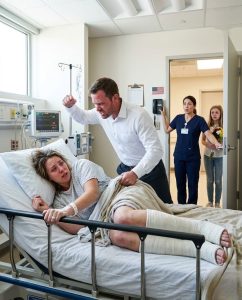
Caleb grabbed the blanket and yanked it down.
The movement exposed her casts, her hospital gown, the bruises near her ribs that the fabric had been loosely hiding.
Rebecca gasped from the cold and the pain.
“Caleb, stop.”
He reached for her upper arm.
His fingers clamped around it hard enough that she felt the pressure through the medication.
“Get out of that bed,” he hissed.
“I can’t.”
“You can when I say you can.”
He pulled.
Pain shot through Rebecca’s ribs and climbed into her throat.
Her casts scraped an inch against the sheet.
The monitor changed rhythm.
A sharper alarm began, small at first, then faster.
Rebecca tried to brace herself against the mattress.
Her hands shook.
Her wedding ring clicked against the metal bed rail.
“I’m not paying for a wife who can’t even be useful,” Caleb said.
Something inside Rebecca rose then.
It was not strength exactly.
It was not courage the way people imagine it.
It was the last small place inside her that still knew the difference between love and ownership.
She did not slap him.
She did not scream every sentence she had swallowed for eleven years.
She did not tell him that a man who counts hospital bills over his injured wife’s body has already confessed more about himself than any argument could expose.
She gripped the bed rail with both hands.
“No,” she said.
For one second, Caleb looked stunned.
It was as if the bed itself had spoken.
Then he slammed both fists down into her stomach.
The pain went white.
Rebecca’s breath vanished.
Her body folded as much as the casts would allow.
The sound that came out of her did not feel human.
It sounded far away, like someone trapped two rooms down.
The heart monitor broke into a frantic alarm.
Caleb leaned over her.
His face was red now.
One hand still twisted the blanket.
His other fist rose again.
“You don’t get to talk back to me,” he said. “Do you understand?”
Rebecca looked past him toward the door.
The hallway beyond it was bright and clean.
It seemed impossible that the world could look so normal just a few feet away.
A cart wheel squeaked.
Someone near the nurses’ station laughed softly.
Somewhere beyond that door, her daughter still believed her father was the kind of man who brought flowers.
Then the silver handle moved.
At first it turned slowly.
Almost politely.
Then the monitor shrieked again, and the door swung inward.
A nurse in navy scrubs froze in the doorway.
She held a paper coffee cup in one hand.
Her other hand was still on the door handle.
Behind her stood Emma.
Rebecca’s daughter was holding a small grocery-store bouquet wrapped in clear plastic.
The flowers were yellow and white.
Emma must have chosen them because they looked cheerful.
Her face emptied the moment she saw the bed.
Her eyes moved from Caleb’s raised fist to Rebecca’s curled body to the twisted blanket in his hand.
“Dad?” she whispered.
Caleb dropped the blanket as if it had burned him.
“This isn’t what it looks like,” he said.
The nurse stepped into the room.
She did not shout.
She did not panic.
She used the quiet voice of someone trained to make dangerous people understand that the room no longer belonged to them.
“Step away from the patient,” she said. “Now.”
Caleb turned toward her, already rearranging his face.
“She’s confused,” he said. “She’s on medication.”
Rebecca tried to speak, but her breath caught.
The nurse looked at the monitor.
Then she looked at Rebecca’s arm.
Caleb’s fingerprints were already reddening on her skin.
Emma saw them too.
The bouquet slipped from her hands.
The stems scattered across the hospital floor.
The plastic sleeve cracked softly beneath her shoe.
For a second, nobody moved.
Emma’s mouth opened, but no sound came out.
Then she looked at the nurse and said, “He did that.”
Caleb’s head snapped toward her.
“Emma.”
She flinched at her name.
That flinch did something to Rebecca that the punch had not.
It told her this moment was not as new as she wanted to believe.
The nurse reached for the wall phone.
“Security to Room 318,” she said. “Now.”
Caleb’s face changed.
Not rage.
Not contempt.
Fear.
Because witnesses change a coward’s math.
Because a hospital room has charts, logs, cameras in corridors, nurses who document, and forms that do not care how polished a man’s shoes are.
At 2:18 PM, the nurse documented Rebecca’s elevated heart rate and visible distress.
At 2:21 PM, hospital security arrived.
At 2:26 PM, the charge nurse entered the room and asked Rebecca, in front of no family members, whether she felt safe with Caleb present.
Rebecca looked at the ceiling.
She thought about eleven years.
She thought about Emma in the doorway.
She thought about the word burden.
“No,” she said.
That one word was smaller than the life it ended.
Security escorted Caleb into the hallway.
He did not fight them.
Men like Caleb often know exactly when rage stops helping them.
He argued instead.
He said Rebecca was drugged.
He said she was emotional.
He said the nurse had misunderstood.
He said Emma was a child and did not know what she saw.
Emma started crying only when he said that.
Not when he raised his voice.
Not when security arrived.
Only when her father tried to erase her own eyes.
The charge nurse guided Emma to the visitor chair.
Another nurse brought tissues.
Rebecca reached for her daughter with the hand that did not hurt as much.
Emma came to the side of the bed and held it.
Her fingers were cold.
“I’m sorry,” Emma whispered.
“No,” Rebecca said. “You don’t apologize for telling the truth.”
The next hour became paperwork.
Hospital staff photographed the reddened marks on Rebecca’s arm.
They noted her pain response.
They printed an incident report.
They reviewed the visitor log where Caleb Walker had signed in.
The nurse wrote down the time the monitor alarm changed.
Rebecca watched the world turn her suffering into evidence.
It was strange how comforting that felt.
For years, Caleb’s cruelty had lived in tones, pauses, looks, private sentences, and kitchen silences.
Now it had timestamps.
Now it had witnesses.
Now it had a room number.
A hospital social worker came in before sunset.
She wore a gray cardigan and carried a folder filled with forms.
She spoke gently, but she did not speak around the truth.
“Rebecca, do you have somewhere safe to go after discharge?”
Rebecca almost said home.
Then she pictured the driveway.
The mailbox.
The kitchen table where she had paid the bills.
The laundry room where she had folded Caleb’s shirts while apologizing in her head for things she had not done.
She pictured Emma walking through the front door with him inside.
“No,” Rebecca said.
The social worker nodded like that answer mattered.
“Then we’ll start there.”
Emma stayed until visiting hours ended.
She did not ask to leave with Caleb.
She did not defend him.
She sat beside Rebecca’s bed and picked up the dropped flowers one by one, putting them into a plastic water pitcher because the vase from the old bouquet was already full.
Some stems were bent.
Some petals had torn.
Emma arranged them anyway.
“They’re still pretty,” she said, as if she needed them to be.
Rebecca squeezed her hand.
“So are we,” she whispered.
Caleb called the room phone six times that evening.
The nurse unplugged it after the third.
He called Rebecca’s cell phone after that.
She watched his name light up again and again.
Husband.
That was how his contact was saved.
She stared at the word for a long time.
Then she changed it to Caleb.
It was not a divorce.
It was not a legal filing.
It was only a name in a phone.
But sometimes the first act of leaving is telling the truth in the smallest place you control.
The hospital helped Rebecca file a formal incident report.
A staff member explained the next steps without promising outcomes she could not guarantee.
Rebecca appreciated that.
She had heard enough promises from people who used them like curtains.
By the next morning, Emma had told her school counselor what she saw.
Rebecca did not know that until later.
She found out when the counselor called the hospital social worker and asked whether Emma had a safe adult picking her up after school.
A safe adult.
The phrase broke something open in Rebecca.
For years, Caleb had been listed as emergency contact, parent, husband, provider.
But none of those words meant safe.
The weeks after that were not clean or easy.
Rebecca still hurt.
She still needed help sitting up.
She still woke in the night with the sound of the monitor alarm in her ears.
Caleb sent messages that shifted from apology to anger to accusation and back again.
He said he had lost control.
He said she had embarrassed him.
He said Emma should not be dragged into adult problems.
Rebecca read that one twice.
Then she took a screenshot.
The old Rebecca might have argued.
The new Rebecca documented.
She saved call logs.
She kept copies of the hospital incident report.
She asked for her discharge instructions in writing.
She wrote down dates, times, names, and every sentence Caleb sent that revealed what he still believed he had a right to do.
It did not make her feel powerful.
It made her feel awake.
When she was finally discharged, she did not go home with Caleb.
A social worker helped arrange a temporary safe place with Emma.
A nurse pushed Rebecca in a wheelchair through the hospital doors into bright afternoon light.
Emma walked beside her holding the plastic bag of hospital belongings.
Inside were Rebecca’s torn clothes from the accident, her phone charger, discharge papers, and the two bouquets pressed together in one makeshift bundle.
At the curb, Emma looked small and older at the same time.
“I thought he was supposed to take care of us,” she said.
Rebecca looked at her daughter.
The answer mattered.
It had to be honest without making Emma carry the weight of it.
“He was,” Rebecca said. “And he chose not to.”
Emma nodded.
Then she pushed the wheelchair closer to the waiting car.
That was how love looked that day.
Not a speech.
Not a promise.
A thirteen-year-old girl gripping a plastic hospital bag, walking beside her mother, refusing to look back.
Months later, Rebecca would still remember the sound of that hospital door opening.
She would remember the nurse’s face.
She would remember the bouquet falling.
She would remember Caleb saying, “This isn’t what it looks like,” while the whole room was finally looking.
For eleven years, she had thought peace meant keeping the house quiet.
She had thought survival meant making herself smaller.
She had thought being useful was the same as being loved.
It was not.
Useful is what people call you when they value what you do more than who you are.
Loved is what you are when someone sees you unable to stand and moves closer to protect you.
The hospital chart had her name on it.
The visitor log had his.
The incident report had the truth.
And Emma, who had walked into that room with flowers in her hands, learned something no child should have to learn, but something that saved them both.
A person can be family and still be dangerous.
A person can share your last name and still not be safe.
And sometimes the door that opens at the worst moment becomes the door you finally walk through to get free.