The first thing I remember about the morning Silver Creek decided I deserved to die was the sound of a mule breathing. Not the rope scratching my neck. Not the deputy reading accusations from a paper nobody had allowed me to see. Not the men whispering about my body as though it were a defective cow. I remember that frightened mule beneath the wagon, snorting and shifting while I stood beside Isa and tried not to let anyone see my knees trembling.
My name is Nadine. I was twenty-four years old, although the men of Silver Creek had never bothered remembering my age. To them I was simply Harlan Boone’s Apache wife, purchased through an arrangement made after my mother died and my family scattered. For two years I cooked his food, washed his shirts, managed his garden, delivered calves during storms, and slept beside a man who never once asked whether I was happy. Then I failed to become pregnant, and suddenly every kindness I had given became worthless.
Isa stood beside me on the wagon. She was younger, barely twenty, and had been married less than eighteen months to Vernon Tate, whose father owned half the businesses along Silver Creek’s main road. Isa had spent the night crying until no tears remained. At sunrise she became frighteningly calm. When the deputy looped the rope around her neck, she whispered, “Do not let them make your last memory their faces.” I turned toward the mountains instead.
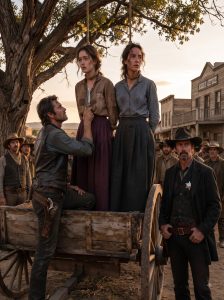
There were perhaps forty people gathered beneath the cottonwood. Some looked eager. Others looked ashamed. Most simply looked relieved that someone else was suffering. Reverend Pike stood near the general store with his Bible pressed against his chest. He had blessed both our marriages. He had also signed the paper declaring us “unfit wives.” When I looked directly at him, he lowered his eyes. That hurt more than the laughter coming from the drunken ranch hands near the watering trough.
Harlan Boone stood in the front row. He was fifty-seven, broad around the waist, gray around the beard, and dressed in the black coat he normally saved for funerals. He had buried his first wife, Margaret, three years before marrying me. I had been the one who cleaned her abandoned room after arriving at his ranch. I had found dried flowers beneath her pillow and scratches inside the bedroom door. Even then, before I understood Harlan, I wondered what kind of woman locked herself in from the inside.
“You can still stop this,” I told him.
Harlan’s face remained expressionless.
“You brought shame into my house.”
“You brought me into your house.”
“That was your good fortune.”
I almost laughed.
“My good fortune is standing on a wagon with a rope around my neck?”
His mouth tightened. “You should have given me an heir.”
I stared at the man whose first wife had also never given him a child.
The thought would matter later.
That morning, I expected it to die with me.
Deputy Corbin slapped the side of the wagon and told the driver to prepare the mule. Isa reached blindly for my hand. Our fingers found each other behind our bound backs. I could feel her shaking now. I told her in Apache that I would remain beside her wherever we went next. She whispered that she was afraid. I admitted that I was afraid too. There was strange comfort in finally telling the truth when everyone around us had spent months lying.
Then a horse stopped at the edge of the crowd.
People turned.
A man sat beneath a dust-covered hat on a chestnut gelding. He looked like the trail had carved him from old wood and left every unnecessary piece behind. His coat was faded. His jaw carried several days of beard. A pale scar ran from his temple toward his ear. He studied the wagon first, then the ropes, then Harlan and Vernon. Something changed in his face.
The deputy walked toward him.
“Keep riding.”
The stranger remained mounted.
“What did they do?”
Corbin spat into the dirt. “They failed.”
The stranger frowned.
“Failed at what?”
Vernon answered before the deputy could.
“Giving their husbands sons.”
The stranger looked at us again. His expression became so incredulous that he actually laughed once.
“You’re hanging women because they didn’t get pregnant?”
Nobody answered.
He swung down from the saddle.
“What’s your name?” Corbin demanded.
“Caleb Walker.”
I had never heard it before.
I would spend the rest of my life remembering it.
Corbin warned him that Silver Creek handled its own affairs. Caleb asked whether murder was now considered an affair. Vernon called him an ignorant drifter. Harlan demanded that the sentence proceed. Caleb walked toward the wagon anyway. Three rifles came up from the crowd. He stopped long enough to look at each man holding one. His voice was quieter than theirs, which somehow made everyone listen more carefully.
“Point those at me only if you’ve decided you’re ready to pull the trigger.”
Nobody did.
He climbed onto the wagon.
Caleb cut Isa’s wrist bindings first. When the blade touched the rope around her neck, she squeezed her eyes shut. It fell onto the boards with a dull thump. She nearly collapsed, and Caleb caught her shoulder.
“Easy.”
She whispered her name.
“Isa.”
He nodded.
Then he turned to me.
His eyes were gray, tired, and unexpectedly gentle.
“What’s your name?”
“Nadine.”
“Hold still, Nadine.”
The rope loosened.
I stepped away from death.
The moment my boots touched the ground, my legs betrayed me. I stumbled. Caleb reached toward me, but I straightened before his hand arrived. Pride was almost all Silver Creek had left me. I refused to surrender it in front of Harlan Boone. Caleb seemed to understand. He lowered his hand without embarrassment and simply positioned himself between us and the crowd.
“You walk away with those women,” Deputy Corbin said, “you’ll regret it.”
Caleb rested one hand near his revolver.
“Then come make me regret it.”
No one moved.
Isa stared at him as if she had forgotten men could speak that way without wanting something afterward.
I had forgotten too.
We left Silver Creek before noon. Caleb placed Isa behind his saddle because she was weaker than she admitted. I walked beside the gelding until he finally insisted I ride while he led the horse. I told him I was capable of walking. He said he could see that. Then he added, “Being capable doesn’t mean you have to prove it every mile.”
I did not know what to say to that.
For several miles, none of us spoke.
Silver Creek disappeared behind the red hills. Every time wind stirred the sagebrush, I looked back, expecting riders. Isa finally asked Caleb why he had interfered. He kept his eyes on the trail.
“Because no decent man could ride past.”
“You did not know us,” I said.
“Didn’t need to.”
“What if they were telling the truth about us?”
He glanced at me.
“About you not having children?”
“Yes.”
“What would that change?”
I had no answer.
It was the first crack Silver Creek’s judgment suffered inside my mind.
The riders appeared before sunset.
Three silhouettes rose behind us through dust. I knew Harlan’s heavy sorrel immediately. Isa recognized Vernon and began breathing too quickly. The third rider carried a shotgun across his saddle.
“They came,” Isa whispered.
Caleb stopped.
“Your husbands?”
“Yes.”
He looked at me.
“You want to go back?”
The question stunned me.
Not “Are you supposed to?”
Not “What do the papers say?”
What did I want?
“No.”
“Isa?”
She swallowed.
“No.”
Caleb turned toward the approaching men.
“Then that settles my part.”
Vernon arrived furious enough to shake. He wore a fine brown coat and silver spurs, the costume of a man who wanted everyone to notice that his father had money. He pointed at Isa.
“She’s coming back.”
Caleb stood beside his horse.
“No.”
“I wasn’t speaking to you.”
“Still no.”
Harlan pointed at me. “That one belongs to me.”
Caleb’s expression hardened.
“Belongs?”
“I paid a bride price.”
“You paid somebody. Doesn’t make her a saddle.”
“You don’t understand our arrangements.”
“I understand she said no.”
Harlan leaned toward me.
“Nadine, get on this horse.”
I stepped closer to Caleb instead.
Harlan’s eyes widened.
“You ungrateful woman.”
Something inside me finally broke open.
“I cooked for you. I worked your land. I carried water when your shoulder failed. I stayed beside Margaret while she was dying because you were drunk in the barn.”
The color left Harlan’s face.
Vernon turned sharply.
“What is she talking about?”
I looked directly at my husband.
“Tell them.”
“Nadine.”
“Tell them where you were when your first wife died.”
Harlan’s hands tightened around the reins.
I continued.
“She called your name for hours. You never came.”
He hissed, “Enough.”
“No.”
It was the first time I had ever spoken that word to him.
It tasted like freedom.
Vernon barked at Isa to mount his horse.
She flinched from habit.
Then she stepped beside me.
“No.”
He reached toward his pistol.
Caleb drew first.
His revolver pointed toward the ground between Vernon’s horse and mine, but the warning was unmistakable.
“Don’t.”
Vernon froze.
Caleb’s voice remained almost conversational.
“I’ve spent enough years around men who make bad decisions because they’re embarrassed. Don’t make this your last one.”
For several seconds, nobody breathed.
Vernon withdrew his hand.
“You’ll pay for this.”
“Maybe.”
Caleb holstered his revolver.
“But not today.”
They rode away promising to return.
I believed them.
We continued toward the mountains until I saw figures ahead. At first there were five riders. Then seven. Then ten. Caleb drew his revolver but kept it pointed downward.
Isa whispered, “Apache.”
My heart stopped for an entirely different reason.
The lead rider had silver threaded through his hair.
Even from a distance, I knew his posture.
I had been thirteen the last time I saw him.
“Uncle.”
The word escaped before I could stop it.
Tomas dismounted.
For years I had imagined our reunion. Sometimes I imagined anger. Sometimes joy. Sometimes nothing at all because imagining hope had become painful. Yet when he stood before me, neither of us spoke. He simply placed one hand over his heart.
I did the same.
My vision blurred.
“Nadine,” he whispered.
I became a child again.
“Uncle.”
He crossed the distance between us and held my shoulders as if confirming that I was real.
“You lived.”
“I lived.”
“We searched.”
“I know.”
“No. You do not know. We searched everywhere.”
I started crying before I could answer.
For the first time since Silver Creek tightened a rope around my neck, I let myself fall against another human being.
Tomas held me until my knees stopped shaking.
Then he looked over my shoulder at Caleb.
His face became guarded.
“Who is he?”
“The man who cut me down.”
My uncle stared at the stranger for a long moment.
Finally he spoke in English.
“You?”
Caleb nodded.
“Seemed like the thing to do.”
Tomas looked at the rope burn across my throat.
“Many men would have ridden away.”
Caleb’s eyes drifted toward the horizon.
“Maybe I got tired of being one of them.”
Tomas understood more than Caleb meant to reveal.
That night we sheltered with my relatives in a camp hidden between two sandstone ridges. I heard my language spoken around fires. Children ran between families. Women who remembered my mother touched my face and cried. My cousin Lela brought warm stew and accused me of becoming too thin. Isa sat nearby staring into the fire as though she had entered a dream from which she feared waking.
Caleb remained at the edge of everything.
I watched him more than I meant to.
He ate quietly, repaired a loose saddle strap, thanked every person who brought him food, and never once acted as though rescuing us had purchased our gratitude. When Lela asked why he had interfered, he shrugged.
“Couldn’t tolerate the view.”
Lela laughed.
“You always speak that little?”
“Usually less.”
“That must make arguments difficult.”
“I find leaving helps.”
For the first time in weeks, I laughed.
Caleb looked toward me.
The smallest smile touched his mouth.
Something warm frightened me.
By morning, my uncle asked me to remain with our family. Isa was welcome too. I should have felt nothing except relief. Instead, when I saw Caleb saddling Chester at the edge of camp, grief rose unexpectedly beneath my ribs.
He was leaving.
Of course he was.
He had saved us.
He owed us nothing more.
I walked toward him.
“You are going?”
He tightened the saddle cinch.
“Figured you’re safe here.”
“You could stay.”
His hands stopped.
“For breakfast?”
“For longer.”
He looked at me then.
I immediately wished I could swallow the words.
Before either of us could answer, hoofbeats thundered from the southern trail.
A young rider named Nantan entered the camp with his horse covered in sweat. He spoke rapidly to Tomas. Every conversation died around us.
My uncle’s face hardened.
Isa came to my side.
“What happened?” Caleb asked.
I already knew from Tomas’s expression that Silver Creek had not finished with us.
Isa translated.
“Vernon Tate is gathering men.”
“How many?”
“Twenty, maybe more.”
Nantan added something.
Isa’s voice became quieter.
“They are coming before sunrise.”
No one slept properly that night.
Tomas wanted to move the camp deeper into the mountains. Several younger men wanted to remain and fight. Caleb opposed both ideas.
“If you run,” he told my uncle, “Tate tells Silver Creek you kidnapped the women.”
Tomas’s eyes narrowed.
“And if we stay?”
“He gets the fight he wants.”
“What do you suggest?”
Caleb looked at the fire.
“Make him come somewhere witnesses can see what kind of man he is.”
I spoke before Tomas could answer.
“Silver Creek already saw.”
Caleb turned toward me.
“And they looked away.”
“Yes.”
“Then we make looking away harder.”
Tomas studied him.
“You speak like a man who has done this before.”
Caleb’s expression went distant.
“I’ve seen mobs convince themselves they were armies.”
The words carried a history none of us understood yet.
He knelt and drew lines in the dirt.
“There’s an abandoned mission on the southern road. Stone walls. Open ground. If Tate comes, we meet him there. Nobody fires first. Nobody gives him an excuse.”
“And then?” Tomas asked.
“Then we find out whether he wants his wife back or wants everyone to know he can control her.”
Isa looked sick.
“I already know.”
Caleb nodded.
“So do I.”
At dawn, we rode for the old mission.
I remember feeling strangely angry with the rising sun. How could the sky turn gold while men traveled toward us intending violence? How could birds sing from cactus flowers while Isa checked over her shoulder every few minutes?
Caleb rode beside me.
“You all right?”
“No.”
“Good answer.”
I frowned.
“That is a strange thing to say.”
“Usually people lie.”
“I am tired of lies.”
“So am I.”
We rode another hundred yards before I asked, “Why are you alone?”
His jaw shifted.
“That’s a longer answer.”
“We have twenty angry men coming. Perhaps there will not be another opportunity.”
He looked at me.
“You always this cheerful?”
“Only before battles.”
He almost smiled.
Then his face became serious.
“I had a wife.”
I was not prepared for that.
“What happened?”
“She died while I was away fighting.”
“I am sorry.”
“So was I.”
The answer sounded like an old wound.
“And your family?”
“Parents gone. Brother too.”
“So your ranch is empty?”
“Mostly.”
“Why return?”
He looked toward the land.
“Because empty is still mine.”
The words stayed with me.
I understood too well the difference between loneliness and ownership of one’s loneliness.
We reached the mission before noon. Its roof had partly collapsed, but thick adobe walls still enclosed a courtyard. Tomas positioned riders where they could be seen without appearing aggressive. Caleb made everyone repeat the same rule: no weapon unless Tate’s men fired first.
“What if they take Isa?” one young warrior demanded.
“Then I stop them.”
“And if they shoot you?”
Caleb checked his revolver.
“Then I’ll be considerably less useful.”
Even Tomas laughed.
The laughter mattered.
Fear had been swallowing us whole.
For a moment, we remembered we were people.
The Silver Creek riders appeared near sunset.
There were twenty-three.
Deputy Corbin rode in front beside Vernon and Harlan. Reverend Pike followed in a wagon with Vernon’s father, Silas Tate, a heavy-faced man whose wealth had convinced him that consequences were things poor people suffered.
Caleb walked into the road alone.
My uncle cursed.
I started after him.
Caleb raised one hand without looking back.
“Stay.”
I ignored him.
He heard my footsteps.
“Nadine.”
“I spent two years obeying men because they claimed it kept me safe.”
He sighed.
“Fine.”
I stood beside him.
Isa joined me.
Then Tomas.
Vernon stopped his horse thirty feet away.
“This is your final warning.”
I looked around.
“At which of us are you speaking?”
His nostrils flared.
“You.”
“That does not narrow it.”
Even Caleb turned to hide a smile.
Vernon’s father spoke.
“We have legal marriage contracts.”
Caleb said, “Show them.”
Silas produced folded papers.
I recognized Reverend Pike’s handwriting.
Caleb did not take them.
“You got a judge’s order?”
“This territory recognizes marriage.”
“Marriage isn’t ownership.”
“You a lawyer?”
“No.”
“Then spare us your education.”
A new voice came from behind us.
“I am.”
Everyone turned.
A rider emerged from the western trail.
She was a small woman in a dark traveling coat, perhaps forty, riding beside an older Mexican man whose silver badge glinted beneath his vest.
Caleb stared.
“Clara?”
The woman dismounted.
“Still causing trouble, Walker?”
“Trying not to.”
“You’ve always been poor at that.”
The man beside her introduced himself as Deputy United States Marshal Rafael Ortega.
For the first time, Vernon looked uncertain.
Caleb had sent Nantan the previous night to a telegraph station fifteen miles west, carrying a message to an attorney Caleb knew in Santa Fe. Clara Bennett had once helped settle the estate of Caleb’s late brother. She had been traveling nearby and brought Ortega after reading what Caleb wrote.
Silas Tate recovered first.
“This is a local matter.”
Ortega looked at the armed men.
“Twenty-three armed citizens pursuing two women into the hills stopped being local some miles back.”
Deputy Corbin protested.
“They’re fugitives.”
“From what charge?”
“Violation of marital obligations.”
Clara stared at him.
“Is that written in the territorial criminal code you invented this morning?”
Corbin’s face reddened.
Reverend Pike suddenly became interested in his Bible.
Clara took the marriage papers.
She read silently.
Then she looked at Isa.
“Did you sign this?”
“No.”
“Did Nadine?”
I shook my head.
Silas interrupted.
“They could not write English.”
Clara’s eyes sharpened.
“Then who explained the terms?”
Reverend Pike cleared his throat.
“I did.”
“In Apache?”
Silence.
“Mr. Pike?”
“No.”
“Then what exactly did they consent to?”
Nobody answered.
The first real crack opened in Silver Creek’s power.
Yet Harlan was not frightened enough.
He rode forward.
“That woman is my wife.”
I stepped toward him.
“No.”
“You cannot simply decide otherwise.”
“I decided a long time ago. You simply never cared enough to ask.”
His voice dropped.
“Come home now and I will forgive this.”
The audacity almost stole my speech.
“You will forgive me?”
“For humiliating me.”
I looked at the rope burn on Isa’s neck, then touched my own.
“Harlan, you stood beneath a tree and watched them prepare to hang me.”
“You brought it on yourself.”
Something inside Caleb snapped.
He moved, but I caught his sleeve.
“No.”
His eyes met mine.
“This is mine.”
I faced Harlan again.
“Do you remember the night Margaret died?”
His face changed.
“Do not.”
“I remember.”
“Nadine.”
“She held my wrist even after she lost the strength to lift her head. She told me something.”
Harlan went pale.
I had never repeated Margaret’s final words because I had been afraid no one would believe me.
Now the entire road seemed to wait.
I said, “She told me you blamed her too.”
Silas Tate frowned.
“For what?”
“For never giving Harlan a child.”
Harlan shouted, “She was feverish!”
“She told me the doctor said there was nothing wrong with her.”
Clara’s gaze sharpened.
“What doctor?”
“Dr. Edwin Marsh. He traveled through Silver Creek before Margaret became sick.”
Harlan’s voice shook with rage.
“Enough!”
I raised mine.
“She said he told Harlan the problem might be his.”
The silence afterward was extraordinary.
I did not say it to shame Harlan for infertility. That would have made me no better than the people who condemned us. I said it because he had known for years that his accusations against Margaret—and later me—might be false.
He had known.
And he let them put a rope around my neck anyway.
Clara understood immediately.
“You knew?”
Harlan said nothing.
I continued.
“Margaret told me he burned the doctor’s letter.”
Harlan dismounted so quickly his horse startled.
“You lying little—”
Caleb stepped between us.
“Finish that sentence carefully.”
Harlan stopped.
Clara asked me, “Is there evidence?”
I nodded.
“Margaret hid a copy.”
Every head turned toward me.
I had kept that secret for two years.
The night Margaret died, she had told me where the letter was hidden: beneath a loose floorboard in the old smokehouse, wrapped in oilcloth. I found it weeks later. I could not read English well enough then to understand every word, but I recognized Harlan’s name and Dr. Marsh’s signature.
I had left it where it was.
Fear had protected the truth better than courage could.
Clara folded her arms.
“Mr. Boone, perhaps we should visit your ranch.”
“No.”
That single word convicted him more effectively than any confession.
Vernon suddenly laughed.
“What does Boone’s problem have to do with Isa?”
Isa turned toward him.
“Everything.”
He stared.
She reached inside her dress and removed a small folded paper.
“I found this three weeks ago.”
Vernon’s face emptied.
Isa handed it to Clara.
“What is it?” I whispered.
Isa looked at her husband.
“The physician’s bill.”
Clara read.
Vernon shouted, “Give me that.”
Ortega stepped closer.
“No.”
Clara scanned the page twice.
Then she looked at Isa.
“You knew?”
“Not until recently.”
Vernon’s father demanded the paper.
Clara refused.
“What does it say?” Caleb asked.
Clara chose her words carefully.
“It records a private consultation in which Vernon Tate reported an injury several years before his marriage and was informed it could make fathering children difficult.”
Vernon looked at Isa with murder in his eyes.
She did not move.
He had known too.
Both husbands knew there were reasons they themselves might not father children.
Both blamed their wives anyway.
The men who had called us barren were exposed not because infertility belonged to them instead, but because they had deliberately built public punishment upon a lie.
Isa’s voice shook.
“You knew before you married me.”
Vernon said nothing.
“You knew.”
“I needed an heir.”
“You needed somebody to blame.”
His father snapped, “Watch yourself.”
Isa turned on him.
“No. You watch me.”
I had never heard such strength in her voice.
“For eighteen months I watched everything I said. I watched how I sat, how I walked, how much flour I used, whether I smiled at the wrong person. I watched your son blame me every month for something he knew might never happen.”
She touched the scar around her neck.
“I am finished watching.”
Silas Tate’s control vanished.
He pointed at Ortega.
“These papers are private property.”
Clara answered, “So were the women, according to you.”
“That is not what I said.”
“It is precisely what you rode twenty miles armed to enforce.”
Several Silver Creek men shifted uncomfortably.
I recognized two from the hanging crowd.
One was a blacksmith named Amos Reed.
He lowered his rifle.
Vernon noticed.
“Pick that up.”
Amos looked at him.
“No.”
Vernon blinked.
“What?”
“I said no.”
Another man lowered his weapon.
Then another.
Silas Tate turned in disbelief.
“You men came here for justice.”
Amos spat into the dust.
“No. We came because you told us Apaches kidnapped two wives.”
His eyes went to Isa.
“Looks different from here.”
Vernon exploded.
“They embarrassed this town!”
Amos stared at him.
“They embarrassed you.”
That was the moment Silver Creek’s wall began to fall.
Not all at once.
Walls rarely do.
One stone moves.
Then another realizes it was never held there by anything stronger than fear.
Deputy Corbin reached for his pistol.
Marshal Ortega saw him.
“Don’t.”
Corbin’s hand froze.
Vernon screamed, “Are we going to let savages and outsiders tell us how to live?”
The word hit the road like filth.
Caleb took one step forward.
But Tomas stopped him this time.
My uncle looked directly at Vernon.
His English was deliberate.
“You came to our land with ropes.”
He gestured toward me.
“You called my niece property.”
Then toward Isa.
“You tried to kill both because they could not make your pride bigger.”
Tomas’s eyes hardened.
“Do not speak to us of savagery.”
No one could answer him.
Silas Tate realized control was disappearing.
He leaned toward Reverend Pike.
“Tell them.”
The preacher looked ill.
“Tell them these marriages are lawful.”
Pike’s fingers tightened around his Bible.
“Reverend,” Silas warned.
Pike looked at Isa’s bruised throat.
Then at mine.
Something broke in him.
“I cannot.”
Silas stared.
“What did you say?”
“I cannot.”
Pike removed his hat.
“I signed those declarations.”
He swallowed.
“I signed them because Mr. Tate threatened to take the church property if I refused.”
A murmur spread through the men.
Vernon’s face twisted.
“Coward.”
Pike flinched.
“Yes.”
Then the preacher looked at us.
“I was a coward.”
He walked toward Isa, stopped several feet away, and did not ask her forgiveness.
That mattered.
“I knew hanging you was wrong.”
His voice cracked.
“I told myself the deputy would stop it. Then I told myself the crowd would. Then I told myself God would.”
He looked down.
“I kept waiting for someone else to become the man I should have been.”
Caleb’s expression became unreadable.
I thought of his words when my uncle thanked him.
Maybe I got tired of being one of them.
The confrontation might have ended there.
It should have.
Instead Vernon Tate reached for his gun.
Everything happened inside one heartbeat.
Isa shouted.
Caleb moved.
Ortega drew.
Vernon fired.
The bullet struck the mission wall beside my head and exploded adobe into the air.
Caleb slammed into me.
We hit the ground.
Gunfire erupted from somewhere behind Vernon.
Then Tomas’s men shouted.
Horses screamed.
Dust swallowed the road.
I could not see Isa.
“Isa!”
Caleb pinned me behind a broken stone trough.
“Stay down.”
“I cannot see her!”
“I’ll find her.”
“No!”
He grabbed my shoulders.
“Nadine, look at me.”
I did.
His eyes held mine with terrifying calm.
“You staying alive helps her more than you running into gunfire.”
A second bullet struck stone.
He ducked.
Preview
Then his expression changed.
Blood appeared along his sleeve.
“You are hit.”
“Grazed.”
“Caleb—”
“Grazed.”
He drew his revolver.
“Stay.”
This time I obeyed for three seconds.
Then I saw Isa.
She was crawling toward the mission doorway while Vernon advanced from behind an overturned wagon.
He had lost his hat.
Blood ran from his cheek.
His pistol remained in his hand.
He saw her.
“Isa!”
She froze.
Vernon pointed the gun.
I moved before thought could stop me.
I ran.
Caleb shouted my name.
Vernon turned toward the sound.
That saved Isa.
It nearly killed me.
He fired.
The shot tore through the edge of my skirt.
I stumbled behind a barrel.
Then Harlan Boone stepped from the dust directly in front of me.
For one terrible instant, husband and wife stared at each other.
He had a pistol.
I had nothing.
“Nadine.”
His voice sounded almost tender.
“Come with me.”
I laughed because terror had become too large for any other response.
“You are still asking that?”
“This has gone far enough.”
“You tried to hang me.”
“I made a mistake.”
“You stood beneath the tree.”
“I was angry.”
“The rope was already around my neck.”
His hand trembled.
“If you come home, we can forget everything.”
I stared at him.
There it was.
The life Silver Creek expected me to accept.
Return.
Cook.
Work.
Sleep beside the man who watched me nearly die.
Call survival forgiveness.
I shook my head.
“No.”
His face hardened.
“You will have nothing.”
“I would rather have nothing that belongs to me than everything that belongs to you.”
He raised the pistol.
A shot cracked.
Harlan’s weapon flew from his hand.
He collapsed, screaming and clutching his fingers.
Caleb stood twenty feet away.
Blood covered his left sleeve.
His revolver remained raised.
“I warned everybody about embarrassing decisions.”
Harlan stared at him in shock.
Caleb staggered.
My heart stopped.
I ran to him.
He leaned against the wall.
“You said grazed.”
“It became more enthusiastic.”
“You are impossible.”
“So I’ve heard.”
“Sit down.”
“That sounded like an order.”
“It was.”
He sat.
Somehow, even with bullets flying, he smiled.
Then Vernon screamed from the road.
“Isa!”
We turned.
He had reached her.
One arm wrapped around her throat.
His pistol pressed against her side.
Ortega stood ten yards away with his weapon aimed but could not risk firing.
Silas Tate shouted for his son to surrender.
Vernon seemed not to hear.
“You did this,” he hissed into Isa’s ear.
She looked strangely calm.
“You did.”
“You made me a joke.”
“No.”
Her voice carried across the courtyard.
“You did.”
He pressed the gun harder.
“I can still take you home.”
Isa answered with four words.
“I have no home there.”
Vernon jerked her backward.
“My wife does what I say.”
Then Isa lifted her boot and brought the heel down on his foot.
He shouted.
She twisted.
The pistol fired harmlessly into the dirt.
Ortega rushed him.
Vernon struck the marshal.
Tomas’s nephew tackled Vernon from the side.
Three bodies crashed together.
By the time dust cleared, Ortega had Vernon facedown with his hands bound behind him.
Isa stood alone.
Nobody touched her.
Nobody needed to.
She had saved herself.
The remaining Silver Creek men surrendered within minutes.
Deputy Corbin attempted to flee. Amos Reed and another townsman dragged him from his horse. Silas Tate sat beside the road looking suddenly older than the mountains. Harlan wrapped his wounded hand in a handkerchief and refused to meet my eyes.
Reverend Pike knelt beside an injured rider.
My uncle’s men lowered their weapons.
No one had died.
It felt miraculous.
Caleb nearly did anyway.
He collapsed as soon as the danger passed.
I caught his head before it struck the stone.
“Caleb.”
His face had turned gray.