The trail looked peaceful that morning.
That is the part I still hate remembering.
Not the fall.
Not the pain.
The peace.
The air was cool and clean in the way mountain air can be, sharp with pine and damp stone, and every breath made me think we had done the right thing by coming.
Richard walked ahead of me, one hand brushing the straps of his daypack, his gray jacket moving in and out of the sunlight between the trees.
He was sixty-four, but he still walked like a man who believed his body would obey him.
I was sixty-two, slower than I used to be, but stubborn enough not to say so.
Behind us were our son, Ethan, and his wife, Laura.
The four of us had not been alone together in almost a year.
That alone should have warned me.
Families do not fall apart all at once.
They fray.
They stop calling as much.
They answer texts with thumbs-up reactions instead of sentences.
They sit across from each other at birthday dinners and say things like we should talk soon while everyone knows talk means money.
For us, it had started with Ethan’s second business failure.
The first one had been a small contracting idea he launched with a friend from high school, a friend who disappeared the moment invoices started coming due.
Richard helped then.
He did not ask me first.
He said our son was young, and young men sometimes needed a hand before pride turned into panic.
I believed him.
I had packed Ethan lunches for school, driven him to soccer practice in an old SUV with a cracked cup holder, and stood in our driveway with a paper coffee cup while Richard taught him to ride a bike.
Once you have watched a child wobble toward you with both knees scraped and eyes bright with trust, some part of you keeps seeing him that way long after he becomes a man.
That is how parents get used.
Not because they are stupid.
Because love keeps showing them the child while reality is standing there in grown-up shoes.
The second business failure was not small.
There were overdue payments, angry calls, and a woman from a lender who spoke in a calm voice that made every word sound worse.
Ethan came to our kitchen on a Thursday night with Laura beside him, both of them looking tired and polished, like they had rehearsed humility in the car.
He said he did not need a bailout.
He needed bridge help.
Richard looked at him over the rim of his coffee mug.
I remember the kitchen light flickering once above us, a little ordinary thing that made the room feel older than it was.
Laura kept her purse on her lap with both hands folded over it.
She said family should not watch family drown.
That sentence landed hard on Richard.
I saw it.
Richard had grown up with a father who left bills on the kitchen table and shame in every room.
He hated the idea of any man calling his son a failure.
So he wrote a check.
Then another.
Then came the arguments about the house.
Our house was nothing grand.
Three bedrooms, a front porch with peeling paint, a backyard fence Richard kept promising to fix, and a small American flag we put near the mailbox every summer because my father had done the same.
But it was paid off.
That made it valuable.
That made it dangerous.
Ethan began using words like equity and transfer and protection.
Laura used softer words.
Legacy.
Planning.
Peace of mind.
I used one word.
No.
Richard did not say no right away.
That was the first crack I refused to see.
On Wednesday at 9:14 p.m., Laura texted me that maybe fresh air would help all of us remember we were family.
She suggested a weekend trip.
A simple hike.
No lawyers.
No paperwork.
No kitchen table fights.
Richard said it might be good.
He said Ethan sounded different on the phone.
I asked different how.
Richard looked away and said tired.
The next morning, before we left, I saw him place a folder in the glove box of our SUV.
The tab said COUNTY CLERK in black marker.
When I asked about it, he said it was insurance paperwork.
I wanted to believe him because the alternative meant I had missed something happening right inside my own marriage.
By 8:27 a.m. on Saturday, Richard had started recording on his phone.
I did not know that then.
I only knew he seemed distracted.
At the trailhead, Laura smiled too brightly while tightening her ponytail.
Ethan checked his phone twice before we started walking.
There was a weathered park noticeboard near the first overlook, and someone had stuck a small American flag decal to the corner of it.
It was peeling from sun and rain.
I remember that because I remember thinking it looked like everything else in our lives.
Still there.
Still trying.
Barely holding on.
The first part of the trail was wide enough for all of us to walk side by side.
Laura talked about work.
Ethan talked about a neighbor’s new truck.
Richard said very little.
The higher we climbed, the narrower the path became.
Pine needles gathered in the cracks between rocks.
The sound of water moved somewhere below us, hidden under the slope.
The air cooled against the sweat at the back of my neck.
There were no other hikers near us then.
That detail did not matter to me until later.
A family can feel safest when no one else is watching.
That is why betrayal inside a family lands so deep.
There is no stranger to blame.
Only people who know where you are soft.
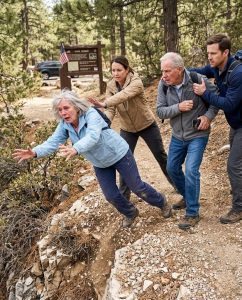
Richard reached the narrow bend first.
The left side dropped away into brush and rock.
The right side pressed against a wall of stone and roots.
I was a few steps behind him.
Ethan and Laura were behind me.
I heard Ethan say, Mom, watch your step.
His voice was calm.
Too calm.
I turned my head halfway.
Then Laura shoved me.
There was no warning argument.
No dramatic confession.
No last chance to understand.
Just the hard slam of two hands into my back and the sudden disappearance of ground under my feet.
At the same time, Ethan grabbed Richard by the shoulder and yanked him forward.
Richard made a broken sound.
I saw his gray jacket tilt.
I saw his hand reach for stone.
Then the sky moved where the ground should have been.
I fell through branches.
They tore my cheek, my coat, my sleeve.
One branch cracked against my left leg with a pain so violent I saw white instead of green.
My shoulder hit dirt.
My hip hit rock.
My head snapped back against something cold.
For a few seconds, there was only silence.
Not quiet.
Silence.
The kind that waits to see if you are still alive.
The taste of blood filled my mouth like pennies.
I could feel wet dirt under my palm and gravel pressed into my skin.
My left leg throbbed with a bright, sickening rhythm.
Beside me, Richard lay twisted on his side.
His face was scratched.
His mouth was bleeding.
One arm was caught under him at an angle that made my stomach turn.
Above us, Ethan shouted, Dad?
Laura said something I could not hear.
I tried to answer.
I do not know why.
Maybe some foolish part of me still believed my son had made a mistake.
Maybe I thought he had slipped and grabbed Richard wrong.
Maybe the mind protects itself for one final second before truth gets in.
Richard opened his eyes.
Barely.
Then he lifted one finger to his lips.
Stay dead.
I froze.
It was not a suggestion.
It was a command from a man who understood the danger more clearly than I did.
I let my body go limp.
Pain screamed through me, but I swallowed it.
Above us, gravel shifted near the edge.
Ethan was looking down.
Through the branches, I could see the shape of him against the sky, navy jacket, one hand braced on a pine trunk.
Laura stood behind him with her arms wrapped around herself.
She looked cold.
That almost made me laugh later, in the hospital, when the shock had given way to rage.
She had shoved a woman off a mountain and looked cold.
Laura asked if I was moving.
Ethan said he did not think so.
There are sentences that split your life in half.
That was one of mine.
My son had looked down at me in dirt and broken branches and hoped I was finished breathing.
I thought of him at six years old, standing in our hallway with a loose tooth and asking if blood meant he was dying.
I thought of him at thirteen, crying behind the garage after another boy called him useless.
I thought of Richard sitting beside him on the back steps, telling him that no son of his would ever be useless.
And now that same son was above us, waiting to see if we were dead enough to leave.
Richard’s hand moved slowly toward mine.
His fingers were cold.
He squeezed once.
Not comfort.
Warning.
Ethan’s phone buzzed.
Laura snapped that they needed to go.
She said if someone came, they were never there.
Then Ethan said, Dad signed it, right?
Laura answered that he said he did.
Richard’s grip tightened so hard his wedding ring pressed into my skin.
For one moment, pain left my body.
Something colder replaced it.
The folder.
The County Clerk tab.
The insurance lie.
Richard went still beside me, but not from injury.
Guilt has a physical presence when you are touching the guilty person.
It came through his hand like a pulse.
Ethan and Laura stayed at the edge for another few seconds.
I did not breathe.
A few pine needles slid down and landed near my face.
Then footsteps retreated.
Somewhere above, a car door slammed.
Another followed.
The mountain returned to its calm little noises.
Water moving below.
Wind through needles.
A bird calling like nothing had happened.
Only then did Richard turn his head toward me.
His lips were split.
His eyes were wet in a way pain could not explain.
I whispered, What did he mean, you signed it?
Richard swallowed.
The sound was rough and small.
He said, Mary, I need you to listen before you hate me.
That was when I understood the fall was not the beginning.
It was the cover-up.
Richard pulled his phone from his vest pocket with two trembling fingers.
The screen was cracked, but it still glowed.
A recording timer was running.
8:27 a.m.
Under it was a file name.
LAURA CALL – HOUSE TRANSFER.
I stared at it until the letters blurred.
Richard said he had started recording before we left the motel because Laura had called him the night before.
She had not known I was in the shower and his phone was on speaker at first.
She had told him Ethan was desperate.
She had told him people do terrible things when they feel trapped.
She had told him the house transfer would calm everything down.
Richard had asked if that was a threat.
Laura had laughed once and said he was being dramatic.
He saved the call.
Then he did something worse.
He signed.
Not the final deed, he said.
A preliminary transfer authorization.
A document Ethan claimed would never be filed unless we both agreed.
Richard said he believed signing it would buy time.
He believed he could fix it later.
He believed Ethan only needed to feel respected.
People use belief as a clean word for fear.
Richard had not believed Ethan.
He had feared losing him.
So he gave him a weapon and called it peace.
I asked where the document was.
Richard said the original was in the glove box folder, along with printed text messages, the call log, and a note he wrote that morning in case something went wrong.
In case something went wrong.
The phrase nearly made me scream.
Something had already gone wrong long before the mountain.
It had gone wrong when my husband hid paperwork from me.
It had gone wrong when my son learned that pressure worked.
It had gone wrong when Laura realized kindness could be used as a rope.
Then we heard an engine above us.
At first I thought Ethan had come back.
Richard did too.
His whole body tightened.
But a woman’s voice called from near the trailhead.
She asked if anyone was down there.
I tried to answer, and this time Richard did not stop me.
My voice came out thin and broken.
Help.
There was a pause.
Then the woman shouted that she was calling 911.
Her name was Sarah.
I learned that later.
She was hiking alone and had seen Ethan and Laura leaving fast, too fast for people finishing a peaceful walk.
She saw Laura wiping her hands on her jacket.
She saw Ethan drop something near the noticeboard, pick it up, and look back toward the trail.
She took a picture because, as she told the deputy later, it felt wrong.
That picture saved us.
The rescue took nearly an hour.
Time became strange down there.
Pain would sharpen, then blur.
Richard faded in and out.
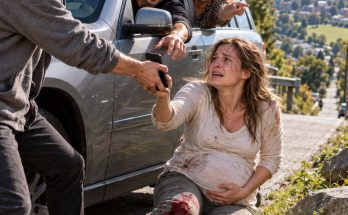
At one point, he pushed the cracked phone into my hand and told me not to let Ethan get it.
Then the screen lit with an incoming call.
Ethan.
I did not answer.
It rang until it stopped.
Then a text appeared.
Where are you?
A minute later another one came.
Mom?
I remember laughing once, a dry sound that hurt my ribs.
He had shoved me off a mountain and then texted Mom with a question mark.
The first responders reached us just after 10 a.m.
A county search-and-rescue volunteer climbed down first, followed by two paramedics.
They placed a collar around my neck and asked me my name, the date, and whether I knew where I was.
I answered all three.
Then I said my son pushed us.
The younger paramedic stopped cutting my sleeve for half a second.
Richard opened his eyes and said, Recordings. Glove box. County Clerk folder.
The deputy who arrived at the trailhead documented the scene.
He photographed the disturbed gravel.
He collected the pine needles and torn fabric from my coat.
He logged Sarah’s picture and the time stamp from her phone.
9:03 a.m.
Ethan and Laura’s SUV leaving the trailhead.
By the time we reached the hospital, the story Ethan had prepared was already falling apart.
He had called 911 at 10:18 a.m., claiming his parents were missing after wandering away from the trail.
But Sarah had called before him.
The recording on Richard’s cracked phone had kept running after the shove.
It captured Ethan’s voice asking whether Richard had signed it.
It captured Laura saying they needed to go.
It captured footsteps leaving us there.
In the emergency room, a nurse cleaned blood from my cheek with gauze that smelled like antiseptic.
My leg was fractured.
Two ribs were cracked.
Richard had a dislocated shoulder, a concussion, and internal bruising that kept the doctors watching him through the night.
A hospital intake form asked whether I felt safe at home.
I stared at the box for a long time.
Then I checked no.
Not because of my home.
Because of who wanted it.
An officer came to take my statement at 3:42 p.m.
Richard gave his after mine.
He cried once during it.
Not loudly.
Not dramatically.
Just one tear sliding into the scratches on his face when he admitted he had signed the authorization without telling me.
I wanted to hate him cleanly.
I could not.
Marriage makes anger complicated.
Forty years of grocery bags, sick beds, mortgage payments, and quiet cups of coffee do not vanish because one man makes a cowardly choice.
But they do not excuse it either.
That is the terrible middle place nobody prepares you for.
You can love someone and still need the truth written down.
So I asked for everything to be documented.
The police report.
The hospital records.
The call recording.
The County Clerk folder.
The text messages.
Sarah’s time-stamped photo.
I wanted no soft family version left for anyone to hide behind.
Ethan and Laura were found that evening at a motel thirty miles away.
They told the first officer they had panicked when they realized we were not behind them.
They said they thought we had turned back.
Then the officer played part of the recording.
Ethan stopped talking.
Laura asked for a lawyer.
The house transfer documents were never filed.
The authorization Richard signed was incomplete without my notarized consent.
That mattered legally.
It mattered emotionally too.
They had nearly killed us over paperwork that could not even do what they thought it would do.
Greed is often stupid.
It just does not feel stupid when you are the one bleeding underneath it.
Richard spent three days in the hospital.
I spent five.
On the fourth night, he asked if I wanted him to leave once we were discharged.
He was sitting in the chair beside my bed, one arm in a sling, looking older than I had ever seen him.
The fluorescent light made every wrinkle sharper.
I told him I did not know.
That was the most honest answer I had.
He nodded.
Then he placed a folder on my hospital tray.
Inside were copies of everything.
Not the old hidden folder.
A new one.
Tabbed.
Labeled.
Complete.
At the front was a handwritten page.
It said he had acted without my knowledge, that he had hidden the document, and that nothing involving our home should ever move forward without my direct consent.
At the bottom, he had signed his full name.
The signature shook.
I stared at that page a long time.
It did not fix what he had done.
But it told me he had stopped hiding.
That mattered.
The case moved forward slowly, the way real consequences often do.
There were hearings.
There were continuances.
There were statements from attorneys in hallways that smelled like burnt coffee and old paper.
Ethan never looked at me during the first hearing.
Laura did.
She looked angry.
That surprised me at first.
Then it did not.
Some people do not hate you because you hurt them.
They hate you because you survived what they did.
Sarah testified about the trailhead.
The deputy testified about the gravel, the fabric, and the phone recording.
The clerk from the county office confirmed the transfer paperwork had never been completed.
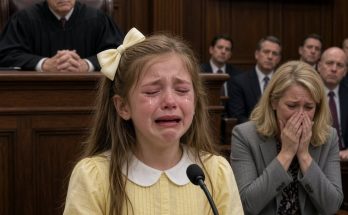
The prosecutor played the audio only once.
Once was enough.
When Ethan’s voice filled the courtroom asking whether Richard had signed it, I felt my own body go cold all over again.
Richard reached for my hand.
This time, the squeeze meant something different.
Not warning.
Witness.
Ethan finally looked at us when Laura’s attorney tried to suggest the shove had been an accident.
His face broke then.
Not enough to undo anything.
Not enough to give me my son back.
But enough for me to see the little boy from the driveway one final time, buried under the man he had chosen to become.
I cried that night in our house.
Not loudly.
Not in a way that made for a clean ending.
I cried standing by the mailbox, touching the small flag Richard had replaced while I was still using a cane.
The porch light buzzed behind me.
A neighbor’s dog barked two houses down.
Life had the nerve to keep sounding normal.
Richard stood in the driveway and did not ask me to forgive him.
That helped more than any apology he could have forced into the air.
He said he would sleep in the guest room as long as I wanted.
I said okay.
For weeks, we lived carefully.
He drove me to follow-up appointments.
I kept the folder in the top drawer of my nightstand.
He made coffee every morning and left mine on the counter without trying to turn kindness into a conversation.
Trust does not return because someone says sorry.
It returns, if it returns at all, through repetition.
The same small act.
The same honest answer.
The same document handed over before anyone has to ask.
Ethan wrote once from jail.
The letter began with Mom.
I did not read past the first line for three days.
When I finally did, I found excuses first, remorse second, and love scattered somewhere near the bottom like he had remembered to include it.
I folded it and placed it in the folder.
Not because I wanted to punish myself.
Because I wanted the whole truth in one place.
A whole childhood can collapse inside one sentence, but it does not erase the childhood.
That is the cruel part.
I still remember the boy on the bicycle.
I also remember the man at the cliff.
Both are real.
One does not cancel the other.
Months later, when my leg had healed enough for me to walk without the cane, Richard asked if I wanted to sell the house.
I looked around the kitchen.
The chipped mug by the sink.
The grocery list under a magnet.
The morning light on the old table where too many lies had sat down with us.
I said no.
Not yet.
The house was never the problem.
The silence was.
So we stopped being silent.
We changed the locks.
We updated the deed.
We filed new estate documents with an attorney who spoke plainly and looked me in the eye.
We put everything in writing.
And on the first Saturday of the next summer, Richard drove me back toward the mountains.
Not to the same trail.
I was not ready for that.
Maybe I never will be.
We stopped at a lower overlook with guardrails, benches, and families walking dogs in the sun.
There was a flag outside the small ranger building, moving gently in the wind.
Richard stood beside me, quiet.
I watched the trees shift below us.
For a long time, neither of us spoke.
Then he said, I thought losing Ethan would kill me.
I said, It almost killed us both.
He nodded.
There was no perfect line after that.
No clean moral.
No moment where pain turned into wisdom and made everything worth it.
Some stories do not heal into something beautiful.
They become something documented, survived, and carried.
That is enough.
I used to think peace meant everyone sitting together at one table again.
Now I know peace can be smaller.
A locked door.
A signed paper.
A phone recording saved in three places.
A husband who tells the truth before he is cornered.
A wife who learns that staying alive is sometimes the first act of self-respect.
The mountain did not give us a second chance.
It exposed the one we had been wasting.
And when I think back to that morning, to the pine air and the soft crunch of gravel under my boots, I no longer wonder why it sounded peaceful.
Danger often does.
Right before it asks you to open your eyes.