A Seven-Year-Old Boy Asked Me to Walk Him Home, Whispering That He Was Too Afraid to Go Alone—But When We Reached His House, I Discovered Why He Had Been So Desperate for Help.
After spending several years patrolling around an elementary school in West Portland, I had come to think I understood every sort of problem a child could possibly bring my way.
Lost lunch boxes. Disagreements on the playground. Missing tablets.
Skinned knees that seemed catastrophic until a teacher appeared with a cartoon-covered bandage.
Most kids greeted my uniform with excitement.
They wanted to tap the radio fastened to my shoulder or ask whether I had ever caught a criminal.
Some were curious about where I carried my handcuffs.
Others simply enjoyed talking to an adult who was not assigning grades, leading practice, or reminding them to complete homework.
That was exactly why I remembered the afternoon that young boy came up to me so vividly.
Nothing about him seemed typical.
School dismissal had just begun at Evergreen Elementary. Parents sat in idling vehicles along Cedar Street while teachers remained on the front steps, guiding children toward the proper pickup areas. Backpacks bounced behind students racing across the sidewalk. Car doors swung open and shut. A yellow school bus slowly pulled away from the curb as someone near the playground shouted about a misplaced jacket.
I was chatting with a little girl about her brand-new soccer cleats when I noticed a boy standing quietly beside me.
He looked seven, perhaps eight at the oldest. His backpack appeared oversized for his slim shoulders, and the straps had been tightened so much they dug into his shirt. His shoes looked undersized.
The front edges curled upward slightly whenever he stood still, as though he had outgrown them several weeks before.
His haircut was uneven. One side stopped above his ear while the other reached lower, as if someone had hurried through it with worn clippers and very little patience.
He didn’t smile.
He didn’t ask about my radio.
He waited until the girl hurried toward her mother before lifting his eyes to mine.
“Officer Dunham?” he asked.
He spoke my name with care, as though he had rehearsed saying it before approaching.
“Yes?”
“Can you walk me home after school?”
His voice remained soft, yet his request was unmistakably clear.
“I need you to see something,” he added. “But I can’t talk about it here.”
Working around children for years teaches you to hear far more than spoken words.
Fear rarely presents itself in a full sentence.
It hides inside the things a child refuses to say, the direction of their eyes, and the effort they make to appear composed.
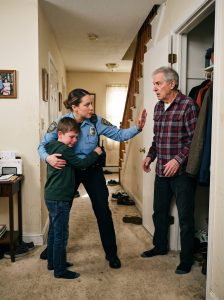
I knelt until we were looking directly at each other.
“Is someone bothering you?” I asked. “A neighbor? Another student?”
He shook his head.
His eyes drifted beyond the pickup line toward a row of modest houses a few blocks away.
“They all think it’s normal,” he whispered.
“Who thinks it’s normal?”
“Everyone.”
A teacher called his name from the front steps, checking whether anyone was there to collect him. He lifted one hand without looking back, then lowered it almost immediately.
“If I tell someone, they’ll say I’m making trouble,” he said. “But if you see it yourself, they can’t say that. Right?”
Some questions children ask because they are searching for comfort.
That question sounded more like a strategy he had carefully created after discovering comfort had never worked before.
I stood up and told the teacher I would accompany him home.
She nodded, though her expression changed when she noticed how closely he remained at my side.
We left the sounds of the school behind and walked through a neighborhood that most people barely noticed.
The grass in the yards had grown a little too long. A sedan sat with two wheels resting on the curb. Wind chimes tapped gently against the railing of an aging porch. Somewhere behind a fence, a dog barked twice before falling silent.
The boy walked steadily without complaining about his backpack or his tight shoes. He never asked about sirens, handcuffs, or whether I had ever taken someone into custody.
Instead, he watched every doorway.
His head shifted slightly whenever a screen door opened or a curtain moved. It wasn’t the casual curiosity of a child heading home from school. He behaved as though he already knew which houses might notice us and which adults might report that he had brought a police officer into the neighborhood.
“What’s your name?” I asked.
He answered so quietly that the rumble of a passing pickup nearly drowned it out.
“Does your father know you’re asking me for help?”
The boy adjusted one strap of his backpack.
“He thinks this is what families are like.”
“What do you mean?”
“Everyone I know thinks this is what families are like.”
He spoke without emotion.
That made his words even more difficult to hear.
Children often judge their own homes against the ones they visit.
They notice which families allow snacks before dinner, whose parents stay awake later, and where shoes are welcome in the living room.
But some children never experience enough outside perspective to realize that a household rule can be harmful, even when an adult insists it is discipline.
We turned onto a quieter road.
The boy’s pace slowed.
In front of us stood a modest single-story house I had driven past countless times while on patrol.
Nothing about it had ever caught my attention.
The siding had faded with age but remained intact. The front steps needed a fresh coat of paint. The blinds stayed shut even though the afternoon sun was still bright.
There were no bicycles on the lawn. No toys. No chalk drawings decorating the walkway.
Only a crooked mailbox and a weather-faded welcome mat.
The boy stopped at the foot of the porch.
For the first time since we had left school, he looked as though he might change his mind.
“You live here?” I asked.
He nodded.
He walked up the steps and pulled a key from his pocket. His fingers shook so badly that the key clicked against his hand.
He tried to slide it into the lock, missed, then lowered his hand.
“Before I unlock the door, can you promise me something?”
Throughout my career, I had heard countless desperate requests. Adults had asked me to overlook unpaid citations, conceal evidence from family members, or persuade someone not to file charges. Children had begged me not to tell their parents about fights or broken windows.
None had ever sounded like this.
“What do you need me to promise?” I asked.
He kept staring at the key.
“If I show you what’s inside, you won’t let them make me go back and pretend everything is okay… right?”
I couldn’t promise him a specific outcome before I knew what waited behind that door. I couldn’t guarantee every adult involved would understand immediately, or that the next several hours would be simple.
But I could promise the one thing he clearly needed before taking the next step.
I placed one hand on the doorknob.
“I promise I’ll listen,” I said. “And I won’t leave you by yourself while we figure out what’s happening.”
He searched my face carefully, looking for the hesitation children learn to recognize.
Then he slipped the key into the lock.
The door swung open, but he stayed standing on the porch.
“Don’t let my dad explain it first,” he whispered. “He makes it sound normal.”
I stepped inside ahead of him.
A faint scent of bleach filled the house.
The living room was spotless, almost unnaturally perfect. Every couch cushion was aligned precisely. Nothing had been left on the floor. No shoes sat by the entrance, no unfinished drink rested on a table, and no homework papers were scattered across the counter.
It didn’t feel peacefully organized.
It felt inspected.
The boy came inside and gently shut the door behind us with both hands, making sure it closed without slamming.
A laminated sheet had been taped to the refrigerator at adult eye level.
Across the top, large letters read FAMILY RULES.
Several neatly arranged lines appeared underneath, resembling a classroom poster. I caught phrases about obedience, respect, and keeping the house peaceful, but the boy walked past it without a glance.
He already knew every sentence.
He guided me down a narrow hallway. His shoulders grew tighter the farther we moved from the front door.
Family photos covered one wall. In every picture, the boy stood beside his father, both wearing clean clothes and facing the camera. In nearly every photograph, his father’s hand rested on the boy’s shoulder.
The boy ignored those photographs as well.
We stopped beside the laundry room.
At first I assumed he wanted to show me something near the washing machine. Then I noticed another door beside it, much narrower than the others.
A metal latch had been installed near the top on the hallway side.
It was positioned far too high for a young child to reach.
The boy slowly raised one trembling hand and pointed.
“That’s where I go when I make the house stressful.”
He spoke the sentence in a flat, rehearsed voice, like a rule repeated countless times.
I looked at the latch, then back at him.
“Who puts you in there?”
He didn’t answer directly.
“Dad says I need a quiet place until I can be part of the family again.”
I lifted the latch.
The metal scraped with a dry, rough sound.
Behind the door wasn’t a bedroom.
It was an unfinished storage area with exposed concrete walls and stacked plastic containers. There was no real bed, no dresser, and no window large enough to provide meaningful light.
A thin camping mattress rested on the floor.
Next to it sat a flashlight, several school worksheets, and an empty water bottle. A folded hoodie served as a pillow. The fabric had been flattened in the center from repeated use.
The air inside felt colder than the rest of the house.
I stepped just far enough into the space to inspect it without disturbing anything.