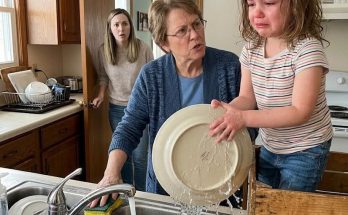
The morning my mother-in-law offered to take my son to the hospital, the kitchen smelled like eggs in butter and vanilla wax warming near the sink.
The window was cold with gray daylight.
The refrigerator hummed the way it always did when the house was too quiet.
Ethan sat at the table in his dinosaur hoodie, swinging his feet above the chair rung, completely unaware that the ordinary sound of breakfast would become the last normal thing I remembered from that day.
He was six years old.
Six is still little enough to believe that adults know what they are doing.
Six is still young enough to look back at your father before leaving the house because the world, to a child, is only safe when the right person nods.
His appointment was not supposed to scare anyone.
Three weeks earlier, he had fallen off his bike on the sidewalk in front of our house.
There had been tears, a scraped knee, a swollen wrist, and one long evening in a hospital waiting room where he sat with his head against my ribs while a nurse wrapped a temporary brace around his arm.
The pediatrician wanted one final look before clearing him for recess again.
That was it.
Orthopedics.
2:00 p.m.
Hospital Orthopedics Desk.
Ethan Richardson.
The reminder was on our refrigerator beneath a small American flag magnet we had picked up from a Fourth of July parade years earlier.
I had read it twice that morning while packing his backpack.
Not because I expected trouble.
Because parenting makes you superstitious about small details.
Say the time out loud.
Pack the snack.
Check the paperwork.
Kiss the top of his head.
Believe the day will obey.
My wife came into the kitchen with a paper coffee cup in one hand and her phone in the other.
She had that expression people wear when they have already made a decision but still want to perform the conversation.
“Actually, Mom is going to take him,” she said.
I stopped moving.
The spatula was still in my hand.
“Why?”
“She offered.”
Those two words carried years inside them.
Gertrude never entered our lives by demanding.
She offered.
She offered to reorganize our pantry and then told my wife I bought the wrong food.
She offered to help with school clothes and then complained that Ethan looked too much like my side of the family.
She offered to babysit and then moved bedtime, snacks, discipline, and every rule we had set as though our home were a branch office of hers.
Control learns the language of concern before it ever shows its teeth.
I had said that once to my wife during an argument, and she had not spoken to me for half the night.
“She knows how to handle appointments,” my wife said that morning, already tired of my face.
“This is a hospital appointment,” I said. “Not a grocery run.”
“You have a meeting.”
“I can move it.”
“You always do this with my mother.”
That sentence had become a wall in our marriage.
Any concern with Gertrude became overreaction.
Any boundary became disrespect.
Any hesitation became proof that I was looking for a fight.
At 10:00 a.m., Gertrude’s silver Mercedes rolled into our driveway, spotless enough to mirror the bare branches over the roof.
She stepped out in a cream coat with sunglasses pushed up into her hair.
She looked past me first.
Not through me exactly.
Past me.
Like I was a table somebody had set too close to the walkway.
Then she saw Ethan, and her whole face changed.
“Ready, sweetheart?” she asked.
Her voice had sugar in it.
Ethan picked up his backpack and looked at me.
That glance is the piece I cannot stop replaying.
It was not fear.
Not yet.
It was trust.
He was asking the question children ask with their eyes.
Is this okay?
I zipped his backpack the rest of the way and crouched in front of him.
“Straight to the appointment,” I said. “Call me when you get there.”
Gertrude smiled.
“We know.”
She said we like she and Ethan had already become a unit and I was outside it.
I watched them back down the driveway.
Ethan waved from the back seat.
The car turned past the mailbox and disappeared.
At 2:15 p.m., I called the clinic.
I told myself I was only checking because I was between meetings.
I told myself fathers are allowed to be annoying when medical appointments are involved.
The receptionist put me on hold, and the music was so low it sounded less like music than air moving through a vent.
When she came back, she was not casual anymore.
“Sir, we don’t show Ethan Richardson as checked in today,” she said. “Are you sure the appointment wasn’t rescheduled?”
My hand went cold around the phone.
I opened the patient portal.
The appointment was still there.
2:00 p.m.
Same department.
Same confirmation number.
I called Gertrude.
Voicemail.
I called again.
Voicemail.
I called my wife.
No answer.
At 2:41, I called the main hospital desk.
At 3:06, I called orthopedics again.
At 3:39, I left Gertrude a message that I tried very hard to keep calm.
By 4:00 p.m., the scheduling office said the sentence I can still hear without trying.
“He never checked in.”
That was when I began documenting.
The call log.
The appointment reminder.
The patient portal page.
Every voicemail timestamp.
The screenshots were not neat because my hands were shaking.
I did not take them because I wanted a fight.
I took them because I had lived in my own house long enough to understand that truth without proof was just another thing Gertrude could talk over.
When my wife came home, she had grocery bags looped over both wrists.
A box of cereal tilted out of one bag.
Milk sweated through the bottom of another.
She found me pacing between the kitchen island and the back door.
“Where is Ethan?” I asked.
She frowned as if I had chosen a bad time.
“Mom probably took him for ice cream.”
“He missed his appointment.”
Her hand tightened around the plastic bag handles.
“What?”
“The hospital said he never checked in.”
For one second, I saw the correct reaction start to form on her face.
Fear.
Then habit covered it.
“Maybe she went to the wrong entrance.”
“She never called me.”
“Maybe her phone died.”
“She has been gone since ten this morning.”
My wife set the bags down too hard.
“You always do this,” she said. “You turn everything involving my mother into a crisis.”
That was the moment something in me went quiet.
Not calm.
Worse than calm.
Still.
I did not argue after that.
I sent one more message to Gertrude.
Then another.
Then I waited.
The evening came down in pieces.
The porch light clicked on.
The microwave clock glowed blue.
The driveway stayed empty.
Every time a car passed the mailbox, my whole body lifted before I realized it was not stopping.
My wife called her mother twice, then stopped after Gertrude did not answer.
By midnight, she had no explanation left, only silence.
She sat at the kitchen table with both hands around a mug she never drank from.
At 1:12 a.m., I called the hospital again.
At 1:28, I called the non-emergency police line and asked what I could file when a family member had taken my child and would not answer.
The dispatcher used careful words.
She told me to keep my phone nearby.
She told me to preserve messages.
She told me that if Ethan returned or if Gertrude contacted us, I should document the time.
Process words sound cold until they are the only thing keeping you upright.
Document.
Preserve.
Confirm.
Report.
At 3:47 a.m., the back door opened.
The sound was small.
A creak.
A scrape of rubber against tile.
Then slow footsteps crossed the kitchen.
I turned so fast my hip hit the island.
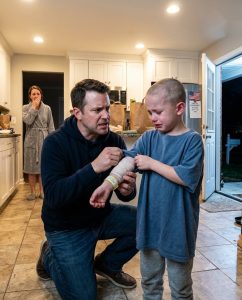
Ethan stood inside the back door.
Alone.
He was wearing sweatpants I had never seen and a faded T-shirt that hung crooked off one shoulder.
His hair was gone.
Shaved almost to the scalp.
The kitchen light made his skin look pale and bare where his soft brown hair had been that morning.
His lips were cracked.
His hands trembled.
He looked at me like he was afraid I might disappear too.
“Daddy…”
I dropped to my knees.
My shoulder hit the cabinet, but I barely felt it.
He smelled like someone else’s laundry detergent, metal, and fear.
I put my hands out slowly, not grabbing, not rushing, because there is a kind of terror in a child that makes every sudden movement feel like another threat.
“Buddy,” I said, keeping my voice low, “where were you?”
His eyes filled.
“Grandma told me I’m not allowed to say where we went.”
My wife made a sound behind me.
Not a word.
Just a broken little intake of air.
I did not look at her.
I kept my face on Ethan.
For one ugly second, I saw Gertrude in my mind, standing in our driveway with her polished smile, and I had to press both hands flat to the floor to keep myself steady.
Then Ethan tugged his sleeve down.
It was a tiny movement.
A child’s movement.
But it told me more than any sentence.
I reached for his arm as gently as I could.
“Can I see?” I asked.
He looked at me first.
The same way he had looked at me before getting into Gertrude’s car.
That time, I did not nod until I was sure he understood he could say no.
After a moment, he let me lift the sleeve.
I will not describe what I saw in the way people ask for details online.
I will only say it was not something a six-year-old explains by falling off a bike.
It was not from recess.
It was not from a wrong entrance at the hospital.
And it was not from ice cream.
My wife came closer, then stopped so suddenly her bare foot slipped on the tile.
Her face changed in a way I had never seen before.
All the defenses she had built around Gertrude cracked at once.
“She said she was taking him to the hospital,” she whispered.
“She lied,” I said.
The phone lit up on the counter at 3:52 a.m.
Gertrude.
Neither of us moved at first.
Then I picked it up and put it on speaker.
There was breathing on the line.
Then Gertrude said, calm as a woman calling about a recipe, “Do not let him talk before I get there.”
My wife slid down against the cabinet.
Her robe bunched around her knees.
Her mug from earlier was still on the table, untouched and cold.
“Mom,” she said, and the word sounded like it hurt her mouth.
Gertrude did not answer her.
She spoke to me.
“You are going to make this ugly if you are not careful.”
I looked at Ethan’s shaved head.
I looked at the unfamiliar clothes.
I looked at the hospital reminder still held to the refrigerator by that little flag magnet.
Then I said, “It was ugly the moment you took my son somewhere he was not supposed to be.”
Gertrude’s breath sharpened.
“You don’t understand.”
“No,” I said. “But the hospital will. And so will whoever takes the report.”
She hung up.
At 4:03 a.m., I called the dispatcher back.
At 4:21, I photographed the clothes without moving Ethan out of the kitchen light.
At 4:34, my wife wrote down the exact sentence Gertrude had said on the phone because her hands needed something to do besides shake.
At 5:10, Ethan fell asleep on the couch with his head in my lap.
He held my sleeve in one fist even while sleeping.
My wife sat on the floor beside us.
Every few minutes, she would look at his hair and press her fingers to her mouth as if holding back a sound.
Morning did not feel like morning when it came.
It felt like the night had simply gotten brighter.
At the hospital intake desk, I gave the nurse the appointment reminder, the patient portal screenshot, and the call log.
I used the same words every time someone asked.
His grandmother picked him up at 10:00 a.m.
He never checked in for his 2:00 p.m. appointment.
He returned alone at 3:47 a.m.
He said he was told not to say where he had been.
The nurse did not interrupt.
She typed as I spoke.
She asked Ethan questions softly, one at a time, with my wife and me sitting where he could see us.
When a child has been made to carry an adult’s secret, the first kindness is letting him answer slowly.
A hospital wristband went around his small wrist.
A medical form went into a folder.
A social worker came in with a badge clipped to her cardigan and eyes that had seen too many parents trying not to fall apart.
She did not accuse.
She did not dramatize.
She asked for timelines.
She asked for names.
She asked who had access to Ethan.
My wife said, “My mother,” and then broke down so hard the social worker had to slide a tissue box across the desk.
That was the first time I felt sorry for her and angry at her in the same breath.
Gertrude had not fooled her in one day.
She had trained her for years.
She had taught her that loyalty meant defense.
She had taught her that concern from anyone else was disrespect.
She had taught her to doubt me faster than she doubted the woman who had brought our son home changed.
By late morning, there was a police report number written on a card in my wallet.
There was an intake packet in my wife’s purse.
There were photographs stored in a folder on my phone that I wished I had never needed to create.
At 11:36 a.m., Gertrude arrived at the hospital.
She did not come rushing like a frightened grandmother.
She came polished.
Cream coat.
Hair done.
Purse tucked neatly over her arm.
She looked at my wife first, because that was where she expected the door to open.
“Come here,” she said.
My wife stood up from the waiting room chair.
For one second, I thought habit would win again.
Then my wife took one step back instead of forward.
“No,” she said.
It was not loud.
It did not need to be.
Gertrude’s face twitched.
“What did he tell you?”
My wife looked at her mother for a long time.
Then she said, “Enough.”
The hospital hallway went very still.
A man at the vending machine stopped with his hand inside the pickup slot.
A nurse at the desk looked down at her clipboard and then back up again.
A woman holding a toddler pulled the child closer against her hip.
Nobody spoke.
Gertrude’s confidence drained out of her face by inches.
She turned to me then.
“You have no idea what you are doing to this family.”
I thought of Ethan’s little glance in the driveway.
I thought of his shaking hands.
I thought of the way he had said Grandma told me I’m not allowed to say where we went.
“I know exactly what I’m doing,” I said.
The next weeks were not dramatic in the way people imagine drama.
They were forms.
Calls.
Waiting rooms.
Quiet drives home.
Ethan sleeping with the hallway light on.
My wife standing outside his bedroom door because she did not yet trust herself to forgive herself.
There was a family court hallway with beige walls and a bulletin board covered in notices.
There was a temporary order with Gertrude’s name on it.
There were conversations with people whose job titles I never wanted to learn.
There were school office notes, pickup restrictions, and a new emergency contact list that did not include my mother-in-law.
Ethan did not tell the whole story at once.
Children rarely do.
He told it in pieces.
In the car.
At bedtime.
While building a dinosaur out of blocks on the living room rug.
He told us enough to understand that Gertrude had not made one bad decision.
She had made a plan.
A route.
A lie.
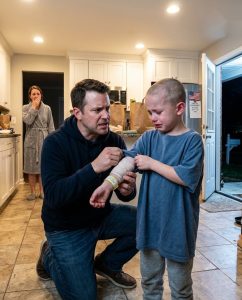
A rule for his silence.
My wife listened to every piece.
Sometimes she cried after he went to sleep.
Sometimes she sat at the kitchen table with the little American flag magnet in her palm, staring at the appointment reminder like paper could explain how close she had come to choosing her mother’s comfort over her child’s safety.
One night she said, “I kept thinking you hated her.”
I was washing Ethan’s favorite plastic cup at the sink.
Water ran over my hands.
“I didn’t hate her,” I said. “I didn’t trust her.”
She nodded.
That was all.
Some marriages survive because nobody ever breaks the silence.
Ours survived because she finally did.
She called Gertrude herself two days later with me sitting beside her.
Her voice shook, but she did not stop.
“You will not pick up Ethan from school,” she said. “You will not come to the house. You will not call him. If you want to speak to me, it will be through the boundaries we give you, not the ones you decide you deserve.”
Gertrude cried.
Then she accused.
Then she threatened.
Then she tried sweetness.
My wife did not move.
That was when I understood how hard courage can look from the outside.
Not dramatic.
Not pretty.
Just a woman in a kitchen robe, holding a phone with both hands, refusing to hand her child back to the person who had scared him.
Ethan’s hair grew back slowly.
At first it came in uneven and soft.
He hated the feel of hats, then wanted one every morning, then stopped asking.
He went back to school after the counselor made a plan with his teacher.
He returned to recess when the doctor finally cleared him.
The first day he rode his bike again, he made it only to the mailbox before turning around.
I did not push him.
I walked beside him.
The next day, he made it past the neighbor’s driveway.
The day after that, he made it to the corner.
Healing, I learned, is often just a child going a little farther than yesterday and looking back to make sure you are still there.
Gertrude did not disappear from the story.
People like Gertrude rarely do.
She sent messages through relatives.
She called from blocked numbers.
She told anyone who would listen that we had misunderstood, exaggerated, poisoned Ethan against her.
But this time, there was a report number.
There were hospital notes.
There were screenshots.
There were timestamps.
There was my wife’s written statement, signed at the bottom with a hand that still trembled but did not stop.
Truth with proof is harder to smother.
Months later, I found Ethan standing in front of the refrigerator.
The old appointment reminder was gone by then.
In its place was a school drawing of our family, held up by the same little American flag magnet.
He had drawn me too tall, my wife with yellow hair even though hers was brown, and himself with a huge round head covered in wild scribbles of hair.
“Is that your hair?” I asked.
He grinned.
“It’s growing back crazy.”
I laughed because he did.
Then he looked at the drawing and said, “Grandma can’t take me anymore, right?”
I crouched beside him.
“No,” I said. “She can’t.”
He studied my face.
Children look back at the person they trust before stepping away.
That day, he looked back and believed me.
Then he picked up his backpack, ran to the front door, and shouted for me to hurry because the school bus was almost at the corner.
I watched him go down the driveway with his hair uneven in the morning light, his sneakers flashing against the concrete, and I understood that the terrible thing Gertrude had done had not become the whole of him.
It had become a line around our family.
A hard one.
A necessary one.
And this time, nobody talked me out of protecting it.