The other teacher pulled the concern folder closer, opened it, and set one finger next to the original entry.
I watched her hand instead of her face.
That mattered.
Because for almost two weeks, every conversation with my mother had depended on people reacting before they stopped to look at what had actually happened.
Now there was a record on the table.
And records were harder to bully than people.
The office was small enough that my damp coat brushed the side of the chair whenever I moved, and the notepad between us still carried my daughter’s name in block letters: LUCY HAYES — WELL-BEING CONCERNS.
Food.
Isolation.
Stress at home.
Three phrases that should have described what had been done to Lucy on Christmas Day had somehow followed me into her school with my name attached to them.
I didn’t reach for the file.
I didn’t demand to know who had called.
I didn’t start defending every meal I had ever cooked or every night I had tucked my daughter into bed.
I remembered the brass doorknob instead.
I remembered Lucy’s stomach growling against my arm.
I remembered my mother saying she needed to learn her place.
I remembered Caroline telling me not to be dramatic while my six-year-old sat locked in a spare room without dinner.
That was the beginning.
Christmas music had been playing when I found the door.
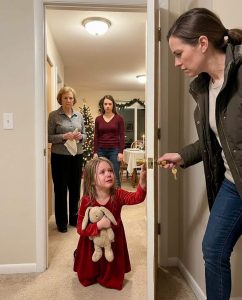
It drifted down Mom’s hallway, cheerful and polished, while the smell of ham and cinnamon candles came from the dining room and my hand closed around a knob that would not turn.
For a second, I thought the door was stuck.
Then I understood.
Locked.
My daughter was behind it.
Caroline stood a few feet away acting annoyed by my concern instead of alarmed by what she had helped create.
“She’s cooling off, Clara. Don’t make this dramatic.”
Then Mom appeared holding a cloth napkin.
She looked composed.
She always looked most composed when someone else was hurting.
“She needs to learn her place,” she said.
Her place.
I turned the key.
Lucy was curled on the carpet in her red velvet Christmas dress, her cheeks wet and her hair stuck to her face.
She had her stuffed rabbit crushed against her chest so tightly that one ear had folded beneath her fist.
No plate.
No cup.
No blanket.
When she saw me, she got up so quickly she nearly stumbled.
“Mommy.”
One word.
That was all it took.
I dropped to my knees and wrapped my coat around her.
She pressed herself against me and whispered that they had told her she was bad.
Then she told me they had said she did not deserve to eat with them.
Then her stomach growled.
Not loudly.
It didn’t need to.
I had spent years explaining my mother’s behavior to myself in softer language.
Strict.
Old-fashioned.
Difficult.
Stressed.
That sound stripped all of those excuses away.
When I carried Lucy back toward the dining room, my nieces still had food on their plates.
Caroline’s wineglass was half full.
My brother-in-law stared down at the china as though the pattern on the plate deserved more attention than the crying child in my arms.
Mom folded her napkin again.
And again.
I knew that posture.
She was waiting for me to explode.
If I screamed, she could stop being the woman who had locked out a hungry child and become the exhausted mother dealing with her unstable daughter.
If I cursed, she could repeat the words later and forget the locked door.
If I threw something, Christmas Day would become the story of Clara losing control.
I wanted to give her the scene.
I didn’t.
I carried Lucy toward the front door.
“You’re overreacting,” Mom said.
There it was.
The phrase had followed me through childhood so faithfully that hearing it then almost made me laugh.
So I did.
Once.
“You said that when I cried at my own birthday party, too.”
Mom’s expression changed.
Barely.
But I saw it.
She knew exactly what I meant.
I left anyway.
Lucy shook against my shoulder until I got her into the car, and before we reached the highway she had fallen asleep with the stuffed rabbit still trapped beneath one arm.
Halfway home, she woke just enough to say my name.
“Yes, baby.”
“They don’t like me.”
I kept my eyes on the road because looking back at her would have broken something open in me that I still needed contained.
“They don’t deserve you.”
She was quiet after that.
At home, ordinary life was waiting for us like it always did.
There was a sick child to check on.
There was Evan’s fever.
There were crayons on the kitchen table, unopened mail, and a school lunch form still stuck to the refrigerator.
Nothing in the house looked like a family line had just been crossed.
That helped.
I tucked Lucy in beside her sick little brother, checked Evan’s fever, and waited until the house settled before I sat alone in the kitchen.