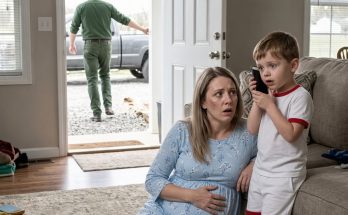
I remembered that sweater.
Green wool.
Sleeves past my hands.
Clara continued. “I thought if I tried too hard, you would believe I wanted to replace her. If I did too little, you would think I did not care.”
“So you did nothing.”
“I stayed too far away.”
“So you did nothing.”
Her answer was not a defense; It was an admission.
“I convinced myself distance was respectful,” Clara added. “Then the years passed, and every attempt felt more awkward than the last.”
I thought about Christmas mornings.
Clara always wrapped my gifts in brown paper because Mom had done that.
“I convinced myself distance was respectful.”
She made cinnamon rolls from Mom’s recipe but never took credit.
She kept my childhood drawings framed in the hallway.
At graduations, she stood at the edge of photographs.
I had interpreted every step backward as rejection.
Maybe some of it had been fear.
Maybe some of it had been mine too.
Maybe some of it had been fear.
***
Ariel climbed into Clara’s lap without asking.
Clara froze, then placed one arm around her.
“Does the lighthouse still work?” Ariel asked.
Clara blinked.
“It’s a tattoo, sweetheart.”
“No. I mean the hope.”
“Does the lighthouse still work?”
Clara looked at me.
The question broke something open between us.
“Yes,” she said. “I think it does.”
***
The party continued, but not as before.
Glen returned to the grill.
My father brought Clara a dry towel.
Ariel spent the afternoon drawing suns on everyone’s paper cups.
The party continued, but not as before.
Near sunset, after the last guest left, I found Clara sitting beside the empty pool with her feet in the water.
I sat beside her.
For a while, we watched abandoned balloons drift against the fence.
Then I touched the tiny lighthouse.
“I thought this tattoo was hiding something that would break our family,” I whispered.
Clara wiped beneath one eye.
I touched the tiny lighthouse.
“It was hiding the reason you survived long enough to become part of it,” I finished.
She covered my hand with hers.
“I’m sorry I made you feel unwanted.”
“I’m sorry I never asked whether you were scared too, Clara.”
Across the patio, Ariel was drawing with sidewalk chalk.
“I’m sorry I made you feel unwanted.”
A crooked lighthouse rose between pink waves.
Inside it stood three smiling figures.
I called to her.
“Who’s that?”
She looked up, delighted that I had asked.
“Family.”
“Who’s that?”
Clara’s fingers locked around mine.
The chalk drawing stayed on the patio until sunset softened its edges.
I did not photograph it.
I did not need to.
I did not photograph it.
Some things stay because they are preserved.
Others stay because they finally explain everything that came before them.
For years, Clara and I had stood on opposite sides of the same loss, each waiting for the other to cross the distance.
It took a child to point at a lighthouse and show us where the door had been all along.
Clara and I had stood on opposite sides of the same loss.