At 12:03 on Christmas morning, my daughter’s voice broke through the quiet of the Fort Liberty operations center and made every monitor in front of me disappear. She did not say merry Christmas. She did not ask why I had taken the holiday shift. She only whispered, “Mom, why did the Pentagon just call Dad?”
For a second, I forgot I was at work. I forgot the radios, the weather maps, the holiday staffing board, the stale coffee cooling beside my keyboard. All I could hear was Emily trying not to sob.
Three days earlier, that same daughter had called to tell me her father and Melissa were hosting Christmas dinner without me. She had said it gently, which somehow cut deeper. Melissa’s parents were flying in. Everyone wanted things to feel simple. It would be immediate family only.
Immediate family. Two ordinary words, sharp enough to erase a mother from a table.
I did what I had learned to do after twenty-four years in Army logistics. I kept my voice steady. I told Emily I understood. I hung a wooden ornament on my old crooked tree, let my coffee go cold, and volunteered to work Christmas because somebody needed to answer the phones.
The shift had been quiet until Emily called. She told me David’s phone had rung while they were opening gifts early. He had walked outside and returned pale. Then a second call came. Melissa followed him into the kitchen, and a few minutes later she locked herself in the guest bedroom. Her parents sat in the living room with wrapping paper on their laps, pretending not to be terrified.
Then two black SUVs pulled up.
The men on the porch asked about military records. They asked for Melissa.
That was the part that made no sense. My ex-husband had retired from defense contracting years earlier. Melissa had never served. She was a third-grade teacher with a soft voice, a tidy Facebook page, and a way of calling strangers sweetheart before she knew their names.
I asked Emily where she was. She had left the house and gone to her friend Lauren’s apartment. That was the first good choice I had heard all night.
“Stay there,” I told her. “Lock the door. I’m coming.”
My supervisor saw my face and waved me out before I finished explaining. I drove toward Charlotte through roads that looked abandoned for Christmas. Every diner sign and gas station light felt too bright against the cold. Forty minutes in, Emily called again. Her apology came out small and broken.
“I shouldn’t have told you not to come.”
I wanted that sentence for years after the divorce. When it finally arrived, it did not feel like victory. It felt like my child was scared and ashamed, and I was too far away to hold her.
At 1:45, an unknown number came through my truck speakers. The man introduced himself as Special Agent Brian Holloway with the Department of Defense. He would not explain details over the phone. He would not tell me if David was under arrest. He did say Emily was safe, and he asked to speak with me after I reached Charlotte.
By sunrise, Emily was in my passenger seat wearing the same Christmas sweater from the night before, mascara smudged beneath both eyes. She ran to my truck like she had when she was fifteen, and when I hugged her, she folded into me without defending herself. Some conversations can wait. That hug could not.
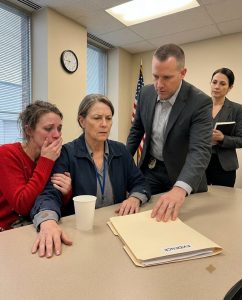
We met Holloway in a federal office building outside downtown. Agent Karen Doyle sat beside him with a folder so thick it looked like it belonged in a courtroom already. Holloway thanked us for coming. I told him I would rather know why we were there.
He opened the folder and said, “We are investigating fraudulent claims involving military survivor benefits.”
The words did not land at first. Then Doyle slid the first photograph across the table.
Melissa stood at a veterans charity banquet in a black dress, a Gold Star pin near her shoulder, one hand pressed to her chest. Beside her was a memorial table. Around her were people who believed they were comforting a military widow.
Melissa had never been a military widow.
Over the next hour, the agents showed us copies of benefit forms, altered identification records, event registrations, travel reimbursements, and photographs from fundraisers across North Carolina. For several years, Melissa had represented herself as the surviving spouse of a soldier killed overseas. She accepted honorariums, donations, discounts, and special assistance intended for Gold Star families.
The amounts were not all dramatic. A hotel room here. A travel stipend there. A donated service. A speaking fee. But lies do not become small because they are collected in pieces.
Emily sat beside me as if every page took another piece of her father away. Then Doyle placed the emails on the table.
One was from David. We need to stop using that story. Somebody is eventually going to ask questions.
Melissa had replied, They never do.
Another message showed David warning her again before a fundraiser. Another showed him standing beside her at an event after he knew. The man who used to lecture our daughter about integrity had chosen comfort over truth and called it not hurting anyone.
I thought of the families I had known. I thought of wives who accepted folded flags with hands that shook. I thought of children too young to understand why everyone at the service was crying. Pretending to belong to that grief was not just fraud. It was theft from people who had already paid enough.
Holloway asked if I recognized anyone from the events. At first I only saw faces from the edge of memory. Charity directors. base volunteers. retired officers. Then I stopped at one photograph.
“Her,” I said.
The woman beside Melissa was Carol Simmons. Her son Jason had been killed overseas. I had attended his memorial service. I had watched Carol hold the folded flag as if her hands were the only thing keeping her upright.
Holloway wrote her name down. A few days later, he called to confirm what I already feared. Carol had believed Melissa was a fellow Gold Star spouse. She had invited her into survivor gatherings. She had cried with her. She had trusted her because grief recognizes itself, and decent people do not expect someone to counterfeit it.
After that, helping the investigation stopped feeling like something I was doing because of David. It became something I owed to Carol and every family Melissa had used as a stage prop.
The rumors began almost immediately. Some neighbors said I was a bitter ex-wife looking for revenge. Others invented stories about classified documents, foreign spies, and hidden cash. The truth was quieter and uglier. A woman had borrowed a dead soldier’s sacrifice, and my ex-husband had known enough to stop it.
The part people misunderstood was my anger. It was not hot. It did not make me want to shout in driveways or ruin anyone’s life for sport. It sat lower than that, colder and steadier, because every new record had a real family on the other side of it. A hotel clerk had waived a fee because she thought she was honoring sacrifice. A volunteer had moved Melissa to the front of a speaking list because survivor voices mattered. Carol had opened her home because she believed grief had knocked politely at her door.
One morning an unsigned note appeared under my office door. Some families deserve to stay buried.
I turned it over to base security and kept working.
Spring brought the hearing. The federal courthouse in Charlotte was not dramatic the way television teaches people to expect. The lights were plain. The benches were hard. The prosecutor’s voice stayed calm. That made the facts heavier, not lighter.
Melissa arrived with her shoulders folded inward. David came with an attorney and the gray look of a man who had not slept in months. When his eyes met mine, neither of us waved.
The prosecutor began with the documents. False applications. Altered records. Event photographs. Payments and reimbursements. Then witnesses described the kindness Melissa had accepted under false pretenses. A charity director said she had been invited because organizers believed she had lost a husband in uniform. A business owner described donating services meant to honor survivor families.
Then Carol Simmons took the stand.
She walked slowly, holding a folded handkerchief. The prosecutor asked why she trusted Melissa.
Carol looked at the woman who had stood beside her at memorial events and said, “Because I believed she understood what it meant to lose someone to military service.”
The courtroom went still.
Carol continued. She had welcomed Melissa into her home. She had introduced her to other families. She had cried with her. Then her voice broke just enough for the room to feel it.
“I did not know I was crying with a stranger wearing someone else’s grief.”
No one typed. No one coughed. Melissa lowered her head.
Then Holloway testified. He walked the court through emails and records, one page at a time. The screen showed David’s messages. Someone’s eventually going to verify your records. We need to stop before this gets bigger.
The prosecutor asked David whether he continued attending events after he learned the truth. David closed his eyes before answering.
“Yes.”
Was he aware donations were being accepted?
“Yes.”
Why did he not report it?
His answer was so quiet I almost missed it. “I convinced myself it wasn’t hurting anyone.”
That was when Carol spoke from the gallery. She did not shout. She did not need to.
“Borrowed grief always leaves a real wound.”
The judge allowed the sentence to sit there. I looked at Emily. Tears slid down her face, not loud, not theatrical, just the kind that come when a parent becomes human in the most painful way.
Melissa accepted a guilty plea to multiple fraud-related charges. Sentencing would come later, but the truth had entered the public record. David was not charged the same way, but cooperation with a lie has consequences. Restitution, civil exposure, lost consulting work, and a reputation damaged in the one community that had once trusted his word.
Outside, a reporter asked me what justice looked like.
I told her justice was not humiliation. It was making sure the truth reached the people who deserved it all along.
Nobody cheered when we left. Real life rarely offers applause at the right time. Instead, veterans gathered around Carol one by one and hugged her. Not because she had won. Because she had finally been believed.
Months passed. The stories faded from the news. Melissa received probation, community service, restitution, and a permanent record. She resigned from teaching before the school district finished its review. David called me one October morning while I was trimming the small maple outside my apartment.
He said he owed me an apology.
I did not make it easy for him, but I listened. He admitted he had blamed me because blaming me was easier than admitting he had looked away. He said he kept believing Melissa would stop after the next event, then the next. I told him problems rarely disappear because we are tired of facing them.
Before he hung up, he said, “You raised Emily better than I gave you credit for.”
“We both raised her,” I said.
There are truths that do not rebuild a marriage or rescue a reputation. They simply make the ruins honest.
Emily and I rebuilt more slowly. Lunch halfway between Charlotte and Fort Liberty. A Thanksgiving dinner where we burned the rolls and laughed until the turkey got cold. Phone calls that did not sound like obligations. She told me she had confused peace with pretending. I told her most people do until pretending costs too much.
The next Christmas, Mark asked if I planned to volunteer for the full holiday shift again. I told him I could cover the morning only.
“Only?” he asked.
“My daughter is expecting me for dinner.”
The drive to Charlotte felt different that year. I was not wondering whether I belonged. Emily opened the door before I knocked. The dining room was not crowded. No careful seating chart. No performance of perfect family. Just two women trying to do better with the truth than we had done with silence.
After dinner, she handed me a small wrapped box. Inside was a wooden ornament painted like a blue pickup carrying a crooked Christmas tree.
“It leans,” she said.
“So does mine.”
We laughed, and then we hung it where everyone could see.
People sometimes ask whether I got revenge. I tell them they are asking the wrong question. Revenge would have made the pain about me. The truth made it useful. It gave Carol back the dignity Melissa had borrowed. It gave Emily a father she could see clearly, even if that clarity hurt. And it gave me one Christmas I did not have to spend pretending I was fine with being left out.
Integrity is easy to admire when it costs nothing. You find out what it means when telling the truth makes the room uncomfortable.
That Christmas, the room finally got honest.