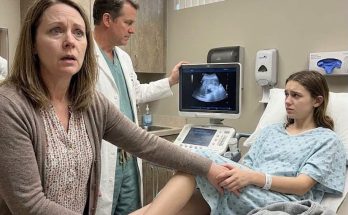
“If you believed the magnets were harmless, why did you instruct Lily not to tell her mother?”
Patricia opened her mouth.
Nothing came out.
Her silence was clearer than any confession.
She was convicted of aggravated child abuse, endangerment, corruption of a minor, domestic violence, and additional charges connected to the planning of the crime.
She received several years in prison and a permanent order prohibiting all contact with Lily.
When officers approached to take her into custody, Patricia screamed Daniel’s name.
“Tell them I love her! Tell them I love my granddaughter!”
Daniel stood, shaking.
But he did not go to her.
Then Patricia turned toward me.
“You poisoned my son against me!”
I held the protection order in both hands.
“No, Patricia. I didn’t poison anyone. I survived your poison long enough for a judge to call it what it was.”
Our divorce was finalized several months later.
I received primary custody.
Daniel was granted supervised visitation, with the possibility of expanded visits if he completed therapy. followed every court order, and never allowed Patricia any access to Lily.
He caught up with me outside the courthouse.
“I still love you.”
“Maybe you do. But while our daughter was fighting for her life, you forced me to fight you too.”
“I can change.”
“You can become a better father. You can never become my husband again.”
He did not argue.
For the first time, he accepted the consequence without trying to blame someone else.
Patricia later sent Lily a letter from prison.
“Grandma made a mistake. Grandma wants to explain.”
I returned it unopened.
Daniel asked whether Lily might want to read it when she was older.
“My daughter does not owe an audience to the person who used her trust as a weapon.”
He never raised the subject again.
A year later, Lily and I moved into a small house in Tucson.
The windows had yellow curtains, and the backyard contained paper cups where Lily planted basil.
She still attended medical appointments.
Some foods still caused pain.
But she laughed much more often than she cried.
One night, she asked me,
“Mommy, can bad secrets come back if somebody opens the door?”
I knelt in front of her.
“Secrets that hurt people lose their power when we tell someone.”
“What if somebody says I’m not allowed to tell you?”
“Safe people never ask you to keep a secret that frightens you or causes you pain.”
She thought for a moment.
“Are we safe now?”
“Yes”
“Why?”
“Because I believe you.”
Daniel gradually earned longer visits.
He learned Lily’s medication schedule.
He respected her silences.
He stopped asking for hugs as though affection were something he was entitled to receive.
Sometimes Lily hugged him.
Sometimes she didn’t.
He learned that both answers had to be respected.
I didn’t hate him.
Hatred is another kind of chain.
But I never confused his remorse with repair.
There were things he might rebuild with Lily.
There were other things he had destroyed forever between us.
One afternoon, while I made tea, I noticed Lily drawing at the kitchen table.
She was drawing fish.
The kettle almost slipped from my hand.
For a moment, I was back in the hospital.
Her body curled in pain.
The X-ray.
The officers’ boots.
Daniel’s accusations.
Patricia’s false tears.
Then Lily raised the paper.
The fish were blue, pink, green, and purple.
“Look, Mommy. These fish are good.”
I sat beside her.
“They’re beautiful.”
“They don’t bite anymore. Now they live on the paper.”
I pulled her into my arms.
She smelled like shampoo, crayons, and sunshine.
Patricia had tried to use my daughter’s suffering to prove that I was an unfit mother.
Daniel had trusted his mother before he trusted me.
The police initially saw a suspect.
The doctor saw evidence of a crime.
But Lily had told the truth from the beginning.
She called them little fish because she was too young to know the word betrayal.
I knew that word.
But I had learned another one too.
Freedom.
Freedom meant no longer begging people to believe me.
Freedom meant understanding that a family without safety is not a family.
Freedom meant building legal, emotional, and physical walls around my daughter, even when the people left outside those walls shared our name.
That night, Lily taped her picture to the refrigerator.
The fish were exactly where they belonged.
Far from her body.
Far from fear.
Visible for everyone to see.
And while she laughed, I understood that justice cannot always return what was taken from you.
But sometimes it gives you something equally valuable.
The certainty that no one will ever again cross the doorway a mother has chosen to close forever.