At four, I learned that a house can be full of chandeliers and still have no warmth.
The Astor estate had marble floors, imported flowers, and a ballroom bright enough to make every guest look innocent.
My father, Lawrence Astor, stood in the middle of it like the world had been built around his shoulders.
My mother, Kathleen, stood near him with one hand resting over the child she had not yet delivered.
That baby was already loved in ways I had never been.
I watched them from the staircase, small enough to hide behind carved wood and sick enough to be treated like a family secret.
The staff had been told to keep me upstairs.
No one wanted a guest asking why the Astor heir sometimes fell to the floor and shook until the room blurred.
The doctors called it epilepsy, though my father preferred shame.
He never shouted that word in public.
Men like Lawrence did not shout when coldness would do.
That night, after the guests left and the estate went quiet, a seizure took me hard enough for my nursemaid to scream.
I woke to my father’s face in the doorway.
He looked at me the way a man looks at a crack in expensive glass.
My mother reached for me, but he caught her wrist.
“We should have corrected this sooner,” he said.
I did not understand the sentence, but I understood the room.
My mother did not pull free.
After that, trays appeared outside my bedroom door.
My mother stopped tucking me in.
My father stopped pretending he could look at me.
The new baby grew under Kathleen’s hand, and I became something the house moved around without touching.
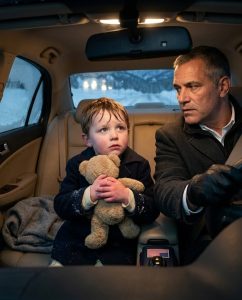
One morning before dawn, Lawrence dressed me in a coat and put me in the back seat of his black car.
I thought good behavior had earned me a drive.
I sat very still, holding my bear and watching the city disappear behind us.
The road climbed into the mountains, where the trees pressed close and the sky seemed too heavy.
My father did not speak until he opened my door in a clearing.
“Stay here,” he said.
I asked if we were playing.
His face did not move.
“Try to follow me, Jason, and you’ll never leave these woods.”
Then he drove away.
Children believe in returns longer than adults deserve.
I waited until the red taillights were gone.
I waited until snow gathered on my sleeves.
I waited until the cold made my fingers feel far away from my body.
Then I walked.
The mountain had no mercy for a child in house slippers.
Branches caught my coat.
Mud sucked at my feet.
The warning flicker of a seizure moved behind my eyes, and I knelt because standing had become too difficult.
That was when headlights found me.
The sedan was not my father’s.
The man behind the wheel held a phone to his ear, and when he saw me, he said, “I found him.”
He opened the back door, put a blanket on the seat, and waited without grabbing me.
That was the first mercy I remember.
He took me to Douglas Carnegie.
My father hated Douglas the way vain men hate anyone they cannot buy.
Douglas lived behind iron gates and did not decorate his kindness with soft words.
He stood in the entry hall and looked at me like he had expected Lawrence to be cruel but still disliked being proved right.
“Your father left you to die,” he said.
It was harsh, but it was honest.
At four, honesty felt safer than comfort.
Then the seizure that had been gathering finally broke over me.
I woke in a bed with clean sheets, a doctor checking my pulse, and Douglas Carnegie sitting in a chair across the room.
He did not leave while the doctor spoke.
He did not flinch when the word epilepsy entered the room.
He only asked what treatment I needed and who had ignored it.
That was how my second life began.
Douglas did not become a warm man overnight.
He was stern, exacting, and allergic to pity.
He gave me doctors before he gave me affection.
He gave me books before he gave me toys.
He gave me rules before he gave me his name.
But he never locked my room.
He never hid me when guests came.
He never treated my body like an insult to his legacy.
I learned quickly that survival had a language, and Douglas was fluent in it.
He taught me contracts at an age when other boys learned baseball cards.
He taught me how men lied with smiles, how money moved before scandal appeared, and how reputation could be both armor and trap.
He told me once that power was not loud.
Power was the person everyone checked before speaking.
I became quiet enough to be dangerous.
Years passed, and the Astors became a portrait I refused to stop looking at.
Lawrence and Kathleen had a second son named Caleb.
Caleb grew into the healthy heir they had wanted, all charm, tailored suits, and expensive failure hidden under confidence.
The city called him golden.
I called him the child they kept.
Douglas watched me read every article, every party notice, every business announcement.
He never asked if I remembered the mountain.
We both knew memory was the wrong word for something still living in my bones.
When I was old enough, I found Caleb where men like him always reveal themselves: a private club where money made consequences feel optional.
I used another name.
Caleb liked me at once because I let him win.
That was the easiest door into his life.
He had his father’s vanity without his father’s discipline.
He gambled because losing made winning feel grander.
He drank because silence frightened him.
He bragged because no one had ever made him earn the room.
I became his friend slowly.
I learned his debts, his dealer, his resentments, and the soft bruised place inside him where Lawrence’s approval still mattered.
I did not push him off a cliff.
I showed him where the cliff was and let him run.
Within months, Caleb owed money to men who did not accept apologies.
Within months, I had proof of every payment, every wager, every powder-dusted table, every lie he had told the board.
I sent the first packet to a reporter who had been waiting years to touch the Astor name.
The headline landed before breakfast.
By noon, investors were calling Lawrence.
By evening, every polite room in the city had stopped pretending Caleb was merely spirited.
Scandal does not break old families all at once.
It finds the hairline fractures and fills them with light.
Caleb checked into rehab because his father told him redemption looked better than ruin.
Kathleen disappeared from public dinners.
Lawrence fought the press with lawyers, threats, and money, which only taught the press where to dig.
Astor Corp began to slide.
Douglas found me in his study that night, watching the news without blinking.
“Is it enough?” he asked.
I said no.
He looked older in the firelight.
“Revenge asks for more even after it has eaten.”
I ignored him because I was still hungry.
The Astor estate looked smaller when I returned.
Not physically.
The columns still rose white and arrogant.
The chandeliers still burned above the foyer.
But the house had lost the power to make me feel small.
Lawrence was alone in his study when I entered.
For a second, he did not recognize me.
That was almost funny.
The man who had left me to be erased could not read the result of his own cruelty standing in front of him.
I placed an envelope on his desk.
Inside was a DNA test linking me to Caleb, photographs from the mountain road, and the medical records he had buried when he decided a sick child was bad for business.
His hands slowed as he read.
I watched the color leave his face.
“Jason,” he whispered.
“You abandoned a child; I returned as the consequence.”
The sentence landed between us, calm as a signature.
Lawrence gripped the edge of the desk.
He tried to reach for anger because anger was the only language he still trusted.
“What do you want?”
I almost laughed.
That was the tragedy of men like my father.
They believed every wound had an invoice.
I told him I did not want his money, his name, his apology, or his chair at the head of a collapsing table.
I wanted him to know that I had lived.
I wanted him to know another man had done what he would not.
I wanted him to spend the rest of his life understanding that the son he threw away had needed nothing from him to become whole.
Kathleen appeared in the doorway before I left.
She looked thinner, smaller, as if the silk and diamonds had been holding her upright all those years.
Her mouth formed my name.
I waited for her to say she had looked for me.
I waited for her to say she had fought him.
I waited for any lie strong enough to bruise me.
Nothing came.
That silence was her confession.
I walked out of the Astor estate without looking back.
For a few days, victory followed me like perfume.
Every headline felt deserved.
Every canceled meeting, every falling stock price, every photograph of Lawrence ducking into his car fed the boy in me who had waited in the snow.
Then the sweetness vanished.
The mountain was still there when I closed my eyes.
Caleb was broken, Lawrence was disgraced, Kathleen was haunted, and I was still awake at three in the morning with my hands curled like a child holding a bear.
Douglas found me packing a week later.
He stood in the doorway and said he had known before I did.
“You don’t pack that neatly unless you’ve made up your mind.”
I told him I did not know where I was going.
He seemed relieved by that, though he tried to hide it.
For once, I had no strategy.
No enemy.
No next move.
Only a life I had built around a wound that no longer knew what to do with itself.
Douglas crossed the room slowly.
He had saved me once with doctors, heat, and a house that did not hide me.
Now he saved me with the harder kindness of letting me leave.
“You are the best thing I ever took in,” he said.
That was the closest he had ever come to begging me to stay.
I shook his hand because hugging him would have broken us both.
Then I left.
I ended up in a coastal town where the air smelled of salt and bread.
There was an orphanage near the cliffs, a tired building with peeling paint, crooked fencing, and children who shouted as if the world had not yet convinced them to be careful.
I stopped at the gate because one girl asked if I was lost.
Her name was Chloe, and she had curls the wind could not organize.
I told her no.
She narrowed her eyes and said I looked like a man who did not know where he was going.
That was the final twist I never planned.
After years of studying revenge, a child with grass stains on her dress diagnosed me in one sentence.
I stayed one day to fix a fence.
Then another day to repair a roof leak.
Then a week to review the orphanage accounts, which were worse than the roof.
The children learned quickly that I could be tricked into staying by handing me broken things.
A loose hinge.
A torn backpack.
A lamp that flickered over the homework table.
Each repair was small, but each one answered a question I had carried since the mountain.
Care did not always arrive as a speech.
Sometimes it arrived as a working latch, a stocked medicine cabinet, and an adult who came back after promising he would.
One boy had seizures so quiet the staff once mistook them for daydreaming.
When I saw his hand twitch around a spoon, the room tilted backward twenty years.
I knelt beside him, kept my voice level, and told the other children to give him space.
No one screamed.
No one looked ashamed.
When he woke, the first thing he asked was whether he had ruined dinner.
I told him dinner could wait.
By the end of the month, I had bought the building through a charitable trust and hired two nurses who knew how to handle seizures without fear.
I did not put my name on the gate.
I put Douglas’s.
The Carnegie House for Children opened in spring, and the first room I finished was the medical room.
It had clean sheets, bright windows, and no locked doors.
On the shelf sat an old tan stuffed bear, carefully mended at one ear.
Sometimes a child would ask whose it was.
I always said it belonged to someone who got found.
Years later, I heard Lawrence Astor died with very few visitors and many regrets.
Caleb recovered enough to become ordinary, which may have been the kindest punishment of all.
Kathleen sent one letter that I never opened.
Some stories do not need one more explanation from the people who caused them.
I kept the orphanage.
I kept the name Carnegie.
And on snowy mornings, when a child with trembling hands reaches for mine, I know exactly what to do.
I wait.
I stay.
I make sure they never have to wonder whether someone is coming back.