On my sixth birthday, I learned that hunger can make a city sound louder.
Every car hissed against the curb.
Every restaurant door opened with a smell that hurt.
Every laugh behind glass reminded me that I was outside.
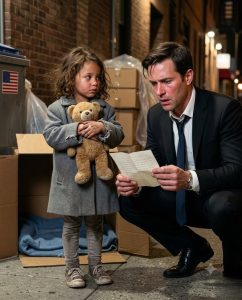
I held Mr. Bubbles under my chin and stood near the bakery window because it was the warmest place on the block.
My teddy bear had one eye, one ribbon, and more loyalty than any adult I knew.
My mother had tied that ribbon the last morning she was strong enough to sit up in her hospital bed.
She told me to keep my backpack close.
She told me the blue blanket was mine.
She told me the folded note was only for someone kind.
Then she closed her eyes, and the hospital people started speaking softly in the doorway.
Tom, my stepfather, lasted seven days after the funeral.
He did not hit me.
He did not shout for long.
He simply decided I was no longer useful.
He packed his own clothes, pushed my backpack at me, and left me outside a closed bakery with a warning sharp enough for a child to remember.
For weeks I believed he might come back.
Children can make hope out of almost nothing.
I slept behind a restaurant in a shelter made of cardboard boxes and a plastic sheet that snapped in the wind.
I learned which trash bags held bread and which men on the street were safe to pass.
I learned that people looked away faster when I looked like I might ask for something.
On my birthday morning, I woke before sunrise with my face cold and my stomach empty.
I sang one line of happy birthday to Mr. Bubbles because my mother had always sung the rest.
By noon, I had eaten half an apple with a bruise on one side.
By late afternoon, I was sitting outside an expensive restaurant, watching people touch napkins to their mouths like food was normal.
That was when Reed Matthews walked out.
He looked like the kind of man whose shoes had never stepped in an alley.
His suit was black, his watch was silver, and his face carried the tired look of someone who had everything except rest.
He almost passed me.
Then he stopped.
I stood because being small on the ground made me feel like something people could move with their feet.
I held Mr. Bubbles in front of me and asked if I could spend my birthday with him.
Reed went down on one knee.
That was the first strange thing.
Most adults bent at the waist if they bent at all.
He put his eyes level with mine and asked my name.
I told him.
He said hello to my bear too.
That was the second strange thing.
He bought me a hamburger, fries, and a chocolate milkshake at a diner two blocks away.
I ate too fast at first, then slowed down because I was afraid he might decide I had eaten enough.
He never did.
He asked careful questions.
Where was my mother.
Where did I sleep.
Did anyone know I was alone.
I answered in small pieces because children learn to hide the worst parts until they know which adults can hold them.
When I told him Tom had left me, Reed stopped stirring his coffee.
His face did not turn angry in a loud way.
It turned still.
After lunch, he asked if I had ever ridden a carousel.
I had not.
So he took me to the little amusement park near the river, bought two wristbands, and let me choose the white horse with the red saddle.
I laughed before I meant to.
The sound surprised both of us.
Reed took a picture, and I asked if my mother would be able to see it from heaven.
He said he hoped so.
At a coffee shop, he put a candle in a chocolate cupcake and told me to make a wish.
I wished for someone to keep me.
I did not tell him the wish then.
I only watched the tiny flame go out and hoped heaven was listening.
When evening settled over the windows, Reed asked where I was going to sleep.
The good day shrank around me.
I thought maybe this was the part where he gave me a sandwich and sent me back.
Instead, he walked beside me all the way to the alley.
I showed him my cardboard shelter.
I showed him the plastic sheet.
I showed him where I tucked the blanket if rain came through the top.
Reed covered his mouth, and for a moment I thought he was sick.
Then he knelt to help me gather my things.
The folded note fell from my backpack.
He picked it up, saw his own name on the front, and opened it with both hands.
The note began with my mother’s apology.
Dear Mr. Matthews, if this reaches you too late, please forgive a dying woman for asking a stranger to see her child.
Reed sat down on the alley pavement.
He read the whole page while I stood there holding Mr. Bubbles and trying to understand why a rich man would look scared of paper.
My mother had cleaned offices in his tower at night.
She had heard him speak once at a charity event about children who fell through cracks.
When she got sick, she wrote three times to the Matthews Foundation, asking for help getting me into school and naming Tom as a danger if she died.
No answer came.
So she wrote one last note and put it in my backpack.
Reed folded the paper carefully, like it was something holy.
He took me home that night.
His apartment was so high above the city that I could see bridges blinking in the distance.
He gave me warm water, a clean shirt to sleep in, and a sofa because I was too frightened to be alone in the guest room.
I fell asleep with Mr. Bubbles under one arm and the new quiet all around me.
In the morning, Reed called a family lawyer named Grace Levin.
Then he called a social worker named Melissa Carter.
He told the truth.
He had found an abandoned child, and he wanted to protect her without hiding from the law.
That mattered later.
Truth is slower than panic, but it holds better.
Melissa arrived with kind eyes and a folder full of questions.
She asked me if Reed had hurt me.
I said no.
She asked if he had fed me.
I pointed at the cereal bowl.
She asked if I wanted to stay there while they checked what was safe.
I looked at Reed before I answered.
He did not nod.
He did not push.
He let the answer be mine.
I said yes.
For one hour, it felt simple.
Then Tom came.
He arrived freshly shaved, wearing a shirt I remembered from church, and told Melissa he had been looking everywhere for me.
He cried without tears.
He said grief had confused him.
He said I had wandered off.
He said Reed, a stranger with money, had no right to keep a child from family.
I hid behind Reed’s leg and shook so hard the cereal in my stomach turned sour.
Grace asked Tom for the missing-person report he had filed.
There was none.
She asked for proof he had contacted hospitals, shelters, police stations, neighbors.
There was none.
Then Reed placed my mother’s note, my birth certificate, and the hospital paper on the table.
Tom’s crying stopped.
Melissa’s face changed.
People reveal themselves when proof enters the room.
Tom was not arrested that day, but he did not leave with me.
Melissa arranged emergency placement with Reed while the court reviewed the case.
That phrase sounded temporary, but Reed treated every hour like it mattered.
He bought shoes that fit.
He learned how to make oatmeal without burning it.
He put nightlights in the hallway because I woke often, certain the apartment would be empty.
Once, at three in the morning, I stood at his office door with Mr. Bubbles in my arms and asked if he was leaving.
He turned away from a stack of legal papers and held out his hand.
He said he was still there.
That was all I needed.
The first person who tried to take the new life apart was not Tom.
It was Reed’s father.
Harold Matthews came on a Saturday afternoon while Reed and I were doing a puzzle on the living room floor.
He looked at my socks, my bear, and the crayon drawings on the refrigerator as if someone had spilled something on his son’s perfect life.
He told Reed the board was concerned.
He told Reed missed meetings had consequences.
Then he looked toward the hallway, where I was pretending not to listen, and called me a domestic problem.
Reed’s voice became quiet.
He told his father I was a child.
Harold said children like me came with histories, costs, and scandals.
He said Reed was risking everything for a girl no one had claimed.
I pressed Mr. Bubbles to my mouth so I would not make a sound.
Reed answered that he was going to claim me.
The room went silent.
Harold left with his jaw tight and his pride wounded.
That night, I asked Reed if I ruined futures.
He sat on the floor beside my bed and told me I had given him one.
The adoption did not happen quickly.
Nothing good with paperwork ever does.
There were inspections, background checks, interviews, home visits, and hearings where adults spoke about my best interest as if my heart were a file tab.
I started therapy.
I started kindergarten late.
I learned that a backpack could hold crayons instead of survival things.
Reed learned that love was not a feeling he could schedule between calls.
He changed his company hours.
He hired people he should have trusted years earlier.
He came to school pickup in person, even when reporters waited outside after someone leaked the story.
Tom tried once more.
He claimed he deserved guardianship because he had been married to my mother.
Then Grace produced security footage from the bakery street, testimony from two restaurant workers who had seen me alone for weeks, and the hospital note where my mother wrote that Tom had refused to sign any responsibility for me.
Tom looked smaller each time another paper appeared.
By the end, even his own lawyer stopped touching his arm.
Harold was the harder wound.
Reed discovered that my mother’s letters had reached the foundation.
They had been marked low priority by Harold’s office because, in Harold’s words, individual hardship requests were endless.
Reed did not shout when he found out.
He simply removed his father from every charitable decision and reopened every neglected request from that year.
The argument between them lasted twenty minutes.
The distance it ended had been growing for forty years.
On the day of the adoption hearing, I wore a light blue dress because my mother once said I looked like morning in blue.
Reed wore the same black suit from my birthday, but this time his tie had tiny yellow stars because I had chosen it.
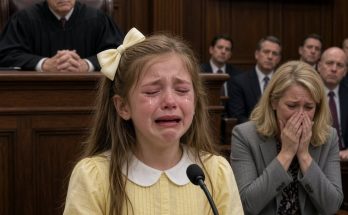
Judge Thompson asked me if I understood what adoption meant.
I said it meant Reed would be my dad on paper, not just in my chest.
The judge took off his glasses.
Melissa smiled into her folder.
Grace pretended to fix a page.
Reed cried openly.
The judge signed the order.
My last name became Matthews.
When it was over, I ran into Reed’s arms so hard he stepped backward.
Outside the courtroom, Harold was waiting.
Reed stiffened, but Harold did not look at him first.
He looked at me.
He held a small wooden box.
Inside was a silver bracelet that had belonged to Reed’s mother, a woman I had never met but whose picture stood on Reed’s office shelf.
Harold said she had wanted grandchildren more than board seats.
Then he said he had been wrong.
It was not enough to repair everything, but it was the first honest sentence I ever heard from him.
I took the bracelet with both hands.
Reed let me decide whether to hug him.
I did not yet.
Healing should never be demanded on the same day as an apology.
After court, Reed took me back to the coffee shop with the cupcakes.
He put a candle in mine again.
This time, when I closed my eyes, I did not wish for someone to keep me.
I already had that.
I wished my mother could see the table.
Two weeks later, I started school with a purple backpack and shoes that did not pinch.
Mrs. Martinez taught me how to write my new name in careful letters.
Clara Elena Matthews.
I wrote it until my hand cramped.
That afternoon, Reed picked me up at the gate, and I ran to him with a page in my fist.
We went to the park, sat on a bench, and took a picture together.
At the last second, I kissed his cheek.
The picture caught his surprise, my closed eyes, and the kind of happiness that does not know how to pose.
At home, I wrote one more page.
Our family, I love you, Daddy.
Reed read it in the kitchen and had to grip the counter.
He framed the park photo, my note, and my mother’s folded letter together.
Only then did he see there was writing on the back of my mother’s page.
It was faint, pressed into the crease, probably added when she was already weak.
If Clara ever finds a safe hand, please tell her I did not leave her alone on purpose.
Reed read it to me at the kitchen table.
For a long time, neither of us spoke.
Then I touched the frame and understood the final gift my mother had managed to give me.
She had not been able to stay.
But she had left a trail.
And on my sixth birthday, that trail led me to the man who became my home.