I went to the park because the apartment had become too quiet to stand.
Every surface in my home was polished, paid for, and empty.
The kitchen had marble counters, the living room had a city view, and the spare bedroom had never held anything but boxes.
People called me lucky because I had built a company before forty and sold enough of it to never worry about money again.
They did not see me eating dinner at the end of a twelve-seat table with the news talking back to me.
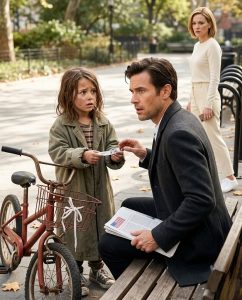
That morning I bought a newspaper I did not want and carried it to my favorite bench under the maple tree.
I was reading the same paragraph for the third time when I heard the scrape of rusted metal.
A little girl came into the park pushing a red bicycle that looked older than she was.
Her coat was too big, her shoes did not match, and her hands were raw from the cold.
But she held the bicycle like it was the first thing in the world that had ever belonged to her.
Three boys near the racks laughed when the front wheel squealed.
Their mother turned and looked at the girl with disgust so sharp it made the child shrink.
“Touch my son’s bike again, and I’ll have police drag you back to whatever gutter made you,” the woman said.
The girl did not answer.
She only pulled the bicycle closer to her body.
I saw myself in that movement before I had time to stop it.
I saw a six-year-old boy in an orphanage hallway, holding a donated toy truck because another child had said it was too good for him.
I folded my newspaper and stood.
The woman looked surprised, maybe because people like her expect men like me to agree with them.
I asked the child her name.
“Ellie,” she whispered.
I told her mine was Dominic, and she looked at me as if names were promises adults usually broke.
Then she asked if I could be her dad just for one day.
She said all children had a dad who taught them to ride.
She said she had found the bike in the trash behind the diner.
She said she had tried all morning, but nobody was there to hold the seat.
There are moments that do not ask permission before they rearrange your life.
I told Ellie I could be her dad for that day.
Her smile arrived slowly, like she was afraid to use too much hope at once.
The bicycle was barely holding together.
The seat was torn, the handlebar grips were split, and the front basket had been tied on with shoelaces.
I held the back of the seat while Ellie climbed on.
Her legs trembled.
She apologized before she even moved.
I told her falling was allowed.
I told her trying was allowed.
I told her I would not let go until she was ready.
The first attempt lasted three seconds.
The second ended with one sneaker scraping the pavement.
The third got us halfway past the bench, and Ellie laughed as if she had won a race.
By the eighth try she was pedaling without my hand.
I was still running beside her, but I was no longer holding her up.
She did not know that yet.
When she realized it, she screamed, “I’m doing it,” and the sound went straight through the armor I had spent years building.
I had closed million-dollar deals without feeling half that proud.
When Ellie got tired, we sat in the grass.
Her stomach growled, and she pressed both hands over it as if hunger were rude.
I bought her a sandwich, an apple, and orange juice from the diner across the street.
She thanked me after every bite.
Not at the end.
After every bite.
That was how I learned she had not eaten a real meal in two days.
That was how I learned she slept in a refrigerator box behind a hardware store.
That was how I learned she kept flattened cardboard hidden behind a dumpster because someone had stolen her bedding once.
I listened without interrupting because questions felt too heavy for a child already carrying so much.
The woman in cream pants had stayed near the bike racks the whole time.
She stepped closer when Ellie leaned against the red bicycle.
She said children like that learned to lie early.
She said the bicycle was probably stolen.
Ellie shook her head, panic widening her eyes.
She dug into the bent basket and pulled out a cracked plastic wristband.
“It was tied on when I found it,” she said.
The county seal had nearly rubbed away, but the number had not.
St. Agnes Children’s Home.
214-B.
For a second I heard no birds, no traffic, no woman complaining.
I heard a dormitory radiator clanging in winter.
I heard boys whispering after lights-out.
I heard my own younger voice asking a volunteer if anyone had come for me.
Before Tom and Sarah Evans adopted me, 214-B had been my number.
Ellie watched my face as if my silence would decide her future.
I knelt in front of her and asked where she had found the bicycle.
She pointed across the street to the diner alley.
The woman muttered something about calling the police.
I looked at her once, and she stepped back.
Then I called the county office.
It took three transfers before an older voice came on the line and asked me to repeat the number.
When I did, the woman went quiet.
Then she asked my full name.
I said Dominic Evans.
The silence on the phone changed.
It became careful.
It became personal.
The woman told me to bring the child and the bicycle to St. Agnes before the office closed.
St. Agnes had not housed children in years.
The old brick building had become a family services archive and emergency intake center.
I had avoided that neighborhood for most of my adult life.
Success makes it easy to tell yourself the past is gone because you can finally buy better furniture.
The past was waiting behind a locked glass door with a receptionist who recognized my name.
Ellie held my sleeve in one hand and the bicycle in the other.
She was quiet on the ride over.
Every few minutes she asked if she was in trouble.
Every time I told her no.
The director was a woman named Clare Morrison, with silver hair and the kind of tired eyes that had seen too many children arrive hungry.
She looked at Ellie first.
Then she looked at the bicycle.
Then she looked at me.
“I wondered if this day would ever come,” she said.
I did not understand until she opened the blue folder.
The first photograph inside was me at six years old, standing in the St. Agnes yard with one hand on the same red bicycle.
The paint had been brighter then.
The seat had been whole.
My front tooth had been missing.
I touched the edge of the photo and felt my throat close.
Clare explained that Tom Evans had donated the bicycle back to St. Agnes when I outgrew it.
He had asked them to keep it for another child who needed to feel brave.
Years later, when the building closed, the bicycle had gone into storage.
Last week, a contractor cleaning the basement mistook the storage pile for junk and hauled it behind the diner.
That was how Ellie found it.
That was how my old number found its way back into my hands.
Then Clare showed me the second page.
It was a note in Sarah Evans’s handwriting.
My adoptive mother had volunteered at St. Agnes until the year she died.
In the note she had written that some children recognize one another before adults understand why.
She had written that if a child ever came through the old system with no one, and if I was willing, they should call me.
She had not named Ellie.
She could not have known Ellie.
But she knew me.
She knew the empty place in me better than I had admitted.
Ellie tugged my sleeve and asked if the bike used to be mine.
I told her yes.
She looked at the rusted frame with new wonder, as if the bicycle had become a bridge instead of trash.
Clare asked Ellie where she had been sleeping.
Ellie told the truth in a voice so small I almost could not bear it.
The refrigerator box.
The rain.
The nights when people shouted.
The mornings when restaurants threw food away before she got there.
Clare wrote everything down.
I expected her to call a shelter.
Instead, she looked at me and asked whether I could provide emergency foster care for the weekend while the county verified Ellie’s status.
I said yes before she finished the question.
Ellie looked up sharply.
“With you?” she asked.
“With me,” I said.
She held the handlebars tighter.
“And the bike?”
“The bike comes too.”
My apartment had never felt so nervous as it did when Ellie stepped inside.
She stood just past the doorway and asked if her shoes were too dirty for the floor.
I told her floors could be cleaned.
Children needed to be safe.
She took a hot bath that lasted almost an hour.
I made rice, chicken, carrots, and warm milk with cocoa because those were the softest things I knew how to make.
She ate slowly, watching me after every bite to make sure I had not changed my mind.
That night I heard her crying in the living room.
She was curled around the bicycle, half asleep and shaking.
She said she dreamed she woke up back in the box and I was gone.
I sat beside her and told her about St. Agnes.
I told her about the bunk by the window.
I told her about the families who visited and never came back.
I told her about Tom and Sarah, who finally did.
Ellie listened with tears drying on her face.
“So you were scared too?” she asked.
“Every night,” I said.
“Did it stop?”
“Not all at once.”
She leaned into my arm.
I stayed there until she slept.
The next morning, the apartment sounded different.
There was a spoon clinking against a cereal bowl.
There were small feet in the hallway.
There was a red bicycle leaning against the wall like it had always belonged there.
Clare visited that afternoon.
She inspected the spare room, the kitchen, the locks, the refrigerator, the school district, and me.
Ellie held my hand through the entire interview.
When Clare asked whether she felt safe, Ellie looked at me first.
Then she said yes.
When Clare asked whether she wanted to stay, Ellie answered faster.
“Forever,” she said.
The word landed in the room like a decision I had been afraid to make alone.
After Clare left, I called a family lawyer.
Emergency placement became temporary foster care.
Temporary foster care became hearings, background checks, home studies, and forms that asked the same question in fifty different ways.
Could I love this child when love became hard?
Could I stay when fear made her push me away?
Could I give her more than rescue?
Could I give her routine, patience, school mornings, dentist appointments, bedtime stories, and the ordinary proof of staying?
I answered yes in ink every time.
Ellie learned to sleep in the spare room with the door open.
She learned the cookie jar was not a trap.
She learned pencils could be sharpened again after they got small.
She learned that breakfast came every morning.
I learned that being needed is not a burden when your heart has been waiting for work.
I learned where to buy hair ties.
I learned that six-year-olds can ask the same question twelve ways when they are trying to believe the answer.
I learned that love is mostly repetition.
One Thursday morning, my lawyer called while Ellie was coloring at the kitchen table.
The judge had signed the adoption order.
Ellie Helena Jones was now Ellie Helena Evans.
I held the phone against my chest for a moment because I could not speak.
Ellie looked up from her drawing.
“Is it bad?” she asked.
I knelt beside her chair.
“It is finished,” I said.
She stared at me.
“What is finished?”
“The papers. You are my daughter now.”
She blinked twice.
Then her mouth trembled.
“For real?”
“For real.”
“Nobody can send me away?”
“Nobody.”
She climbed into my arms so fast the chair tipped backward.
I caught her, and she laughed while crying into my shirt.
Family is the person who comes back.
We celebrated at the diner across from the park because Ellie had spent months looking through its window, imagining what warm food tasted like on the inside.
She ordered a hamburger, fries, and a chocolate milkshake with whipped cream.
She sat by the window and waved at the alley where she had found the bicycle.
After lunch, I took her to a bicycle shop.
She chose a light blue bike with a basket and a gold bell.
The old red one stayed with us too.
I had it restored enough to be safe but not enough to erase its scars.
Some things should keep the marks that prove they survived.
That evening we returned to the same park.
Ellie rode the blue bicycle in wide circles while the red one rested beside my bench.
The woman in cream pants was there again.
She recognized Ellie first, then me.
Her face tightened.
Ellie did not hide behind me.
She rang her bell once and pedaled past with her braids flying.
An older man walking his dog smiled at me.
“Your daughter?” he asked.
I looked at Ellie circling back toward me, fearless now, bright now, home now.
I said yes.
Not because a judge had signed it.
Not because a file had closed.
Because a little girl had asked me to be her dad for one day, and somehow that was long enough for both of us to find the rest of our lives.