Noah Bennett had never been good at asking for help.
His grandfather used to say that asking was not weakness, but Noah had watched Staff Sergeant Thomas Bennett live a whole life by doing what was in front of him without making it anyone else’s burden. Thomas fixed loose cabinet doors. Thomas patched bicycle tires for neighborhood kids. Thomas learned how to braid a small boy’s hair for school costume day because Noah’s mother was gone and someone had to learn. Thomas stood at the stove on Sunday mornings and made pancakes that were always a little uneven, then called them field rations with syrup.
So on the morning of the funeral, Noah did what was in front of him.
He ironed his own shirt. He folded the cuffs of Thomas’s old Army jacket twice. He put the watch on his left wrist, the heavy silver one his grandfather had worn every day, and checked the address written in blue pen above the strap. Then he bought white carnations with the last money he had and took the Metro from Alexandria toward the church.
He was twelve. He was alone. And he was trying very hard to be brave in a city built for people who already knew where they belonged.
At St. Michael’s Episcopal Church, belonging was apparently printed on a list.
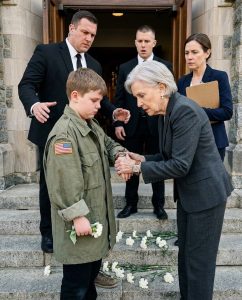
The first guard did not raise his voice. That almost made it worse. He looked at Noah’s cracked shoes, the too-short pants, the grocery-store flowers, and the old jacket with Bennett stenciled above the pocket, then told him the service was invitation only.
“Thomas Bennett was my grandfather,” Noah said.
The second guard arrived. Then Diane Marsh, the coordinator with the clipboard. Noah explained that Thomas had raised him since he was four, that his parents were dead, that he lived on Pendleton Street, that he only wanted to say goodbye. Diane scanned her roster twice and found no Noah Bennett.
There are cruel people in the world, but there are also people who do cruel things while sounding very reasonable. Diane was the second kind. She told him prominent guests were inside. She told him she could not allow an unverified individual into a private service. She called him honey as she closed the door on him.
Noah did not cry. He asked if he could at least leave the flowers by the casket.
That was when the guards took his arms.
Not violently. Not in a way that would look terrible in a report. Just firmly enough to move a grieving child away from the only family he had left.
The carnations spilled across the steps.
Inside, several guests saw. Some turned their faces away because looking directly would have required choosing a side. Others watched through the tall glass as if the scene were a problem that belonged to someone else.
Margaret Ashford stood from the front row.
She had come to the funeral because, three days earlier, a woman at the Veterans Care and Memorial Foundation had told her that a quiet volunteer named Thomas Bennett had died. Margaret had asked the full name. Then the birth year. Then the service record. By the time she hung up, her hands were not steady.
She had searched for Thomas Bennett for thirty-seven years.
In March of 1987, Margaret was thirty-three, ambitious, injured, and very sure she was about to die in a collapsed building overseas. She had been there for a medical equipment contract when the area turned violent. The evacuation plan broke apart. Her escort was injured. A young Army staff sergeant from Alexandria went back into a place no one wanted to enter because a civilian was still inside.
Thomas found her with a fractured leg and blood soaking through her side.
He gave her his watch to hold.
“Why your watch?” she had asked, half-delirious.
“Helps me stay calm,” he said. “Might help you.”
She told him that was ridiculous.
He smiled and told her to hold it anyway.
She held it while he got her out. She held it while she promised him that if she survived, she would make something worth saving out of the life he had handed back to her. Thomas told her to start with the people around her and work outward.
She did survive. She built a company. She funded hospitals and scholarships and veteran programs. She became the kind of person whose name appeared in rooms she had not entered yet.
But Thomas disappeared into an ordinary life.
Now, in the doorway of St. Michael’s, his watch was on the wrist of a boy being removed from his funeral.
Margaret reached Noah before anyone else found the courage to move. She took his wrist gently and turned it toward the light. The watch was scratched, older, unmistakable. On the inside of the lower lug, barely visible, was the small Latin phrase she had once dared Thomas to carve into the metal with a borrowed tool.
By promise.
Noah whispered, “He told me if someone recognized it, I should trust them.”
For the first time in years, Margaret Ashford had no prepared sentence.
Thomas had known.
He had put the watch on Noah’s wrist the night before he died. He had given the boy one instruction. He had trusted that the promise he never collected for himself might still find his grandson.
Margaret turned to the guards.
“Leave,” she said.
They left.
Then she turned to Diane Marsh and said, with a calm that made every word heavier, “This child asked to leave flowers at his grandfather’s casket, and your answer was to have him physically removed. The foundation that retained your services will be hearing from me.”
Diane’s face went pale.
Margaret bent and picked up the carnations herself. A Marine captain stepped forward and gathered the last three from the entryway. Noah straightened the torn green paper around them, and Margaret offered her arm.
“Your grandfather saved my life,” she said. “I would be honored if you allowed me to walk in with you.”
Noah nodded once.
They entered together: the billionaire in the tailored charcoal suit and the boy in the oversized Army jacket. The church went so quiet that everyone heard Noah’s worn shoes on the stone floor. He placed the carnations beside the casket and rested his hand on the dark wood.
The front-row seat that should have been his from the beginning was empty.
Margaret sat beside him.
After the service, she took him to a quiet hotel in Old Town Alexandria. She ordered lunch neither of them touched and told him about the field hospital, the watch, and the promise. Noah listened with both hands around a glass of water.
“He never told me,” he said.
“That seems like him,” Margaret replied.
Noah looked down at the watch. “He used to say he just did what was in front of him.”
Margaret’s eyes filled. “That may be the clearest definition of courage I’ve ever heard.”
Then she asked the question no one at the funeral had asked.
“What happens to you now?”
Noah told her about Patricia Howell, the social worker. Foster care while they figured out placement. The rented house on Pendleton Street only paid through the end of the month. No other family. No safe plan that sounded like home.
Margaret did not make a speech about charity. She did not offer him a mansion like a fairy tale. She said she owed Thomas a debt and wanted to honor it properly. She asked permission to speak with Patricia. She asked permission to involve attorneys. She asked permission before she stepped into Noah’s life, because the first kindness she gave him was choice.
Two days later, Noah found the second thing Thomas had left.
It was in the file cabinet in the small back bedroom, behind army papers and repair manuals. A handwritten letter, dated eleven months before Thomas died, notarized and plain. In it, Thomas wrote that if no family member was available to care for Noah, he wished the matter to be referred to Ms. Margaret Ashford. Her contact information was written at the bottom.
Thomas had found her.
He had known exactly who she became.
And he had chosen not to ask anything for himself.
But for Noah, he had prepared the door.
Patricia Howell read the letter three times. She had worked in social services for twenty-eight years, long enough to distrust sudden wealthy interest in vulnerable children. She met Margaret with a notebook full of hard questions. Margaret answered every one. She did not rush the process. She did not throw money at rules. She hired the right lawyers, submitted every document, and accepted every inspection because what was built for Noah had to be stable enough to stand.
For four months, Noah lived with the Kowalski family in Arlington. They had three children, a dog named Biscuit, and a mother who made tamales and did not ask him to explain his grief every time he entered a room. He appreciated that more than he knew how to say.
He kept going to the veterans center on Fridays because Thomas had gone there. Hector Vasquez, one of Thomas’s friends, brought a chessboard and said, “Your grandfather was terrible at this. Maybe you won’t be.”
Noah was not terrible. Within weeks, he was making Hector work for every game.
At school, his English teacher, Mr. Flores, noticed the way Noah listened before he spoke. He gave him books. Noah returned them with questions written on folded paper. Mr. Flores kept the questions because good teachers know when a child is building a mind in front of them.
In October, a judge finalized the guardianship. Margaret stood in the hallway with Patricia and the attorneys. When Noah came out, he walked to her and hugged her before either of them could overthink it. It was awkward. It was careful. It was real.
Margaret had a home in McLean with a guest wing that became Noah’s apartment. He kept Thomas’s flag, the bicycle tools, two photographs, and the box of army letters he was not ready to read yet. He replaced the watch strap but not the watch. The scratched silver case stayed exactly as it was.
On his first night there, Noah woke before sunrise because the house was too quiet. He made his bed the way Thomas had taught him and sat by the window until the garden became visible. Margaret found him there with the watch cupped in both hands. She did not ask him to talk. She simply brought two mugs of hot chocolate, sat in the other chair, and waited with him until morning arrived.
The funeral had consequences, too.
Margaret withdrew a pledged donation that covered nearly a quarter of the Veterans Care and Memorial Foundation’s annual budget until the foundation completed a formal review. The two guards were dismissed. Procedures were rewritten so no grieving child could be removed from a service without proper verification. Diane Marsh sent a two-page apology to Noah. He read it once and put it in a drawer.
He had expected apology to feel bigger.
Mostly, it made him tired.
Seven months after the funeral, the veterans center dedicated a reading room to Thomas Bennett. Margaret’s foundation paid for the room, a new HVAC system, and the military history library the regulars actually wanted. Hector spoke about Thomas fixing a kid’s bike at two in the morning and collecting 347 coats because he had asked people for one coat each, not a vague donation.
Noah spoke last.
He had written remarks, but when he saw Hector, Patricia, Mr. Flores, the Kowalskis, Margaret, and the people who had chosen to remember Thomas properly, he folded the paper.
“My grandfather never talked about himself,” Noah said. “He talked about what needed doing. I used to think that was just his personality. Now I think it was a philosophy.”
The room listened.
“He planned the watch,” Noah said. “He knew I would need someone. He knew the watch was the thing that would work. He never stopped taking care of what was in front of him.”
He looked down at the scratched silver face.
“I think about him every day,” he said. “I think I’ll think about him every day for the rest of my life. I don’t think that’s sad anymore. I think that’s the inheritance.”
That was the line people remembered.
Not the billionaire. Not the dismissed guards. Not the public embarrassment of adults who should have known better.
The inheritance.
Because Thomas Bennett left no fortune. He left a boy who knew how to stand straight. He left a watch that carried a promise. He left a letter that proved love could be practical, quiet, notarized, and waiting in a file cabinet.
Outside afterward, Noah stood in the cold and touched the watch.
He thought about white carnations on stone steps. He thought about Sunday pancakes. He thought about a frightened woman in 1987 holding time in her hand because a young soldier told her she still had things left to do.
Then Noah looked toward the warm room where Margaret, Hector, Patricia, Mr. Flores, and the rest were waiting.
He had things left to do, too.
And this time, he did not have to do them alone.