For twelve years, Caleb Morgan crossed the street every Sunday with grocery bags in both hands and never once thought he was doing anything extraordinary.
He thought he was being decent.
He thought he was helping an elderly neighbor who had outlived his wife, most of his friends, and nearly all the noise that used to fill his house.
He thought a weekly grocery run was just a small kindness.
Then Mr. Henry died.
And after the funeral, outside a quiet funeral home in Brookside, a gray-haired lawyer handed Caleb an old leather suitcase and changed the shape of everything Caleb thought he knew.
The day was hot in that sticky Chicago way that makes black clothes feel heavier than grief should.
The funeral home smelled like lilies, carpet cleaner, and coffee that had been sitting too long in a silver urn near the lobby wall.
Caleb stood on the sidewalk with his wife Hannah beside him, holding a folded funeral program that had already softened from the sweat in his palm.
Inside, Mr. Henry’s coffin had been plain, covered in white flowers.
That suited him.
Henry Whitman had never liked anything showy.
He kept his porch swept, his grass trimmed, his shoes lined up by the back door, and his grocery lists written on the same yellow notepad every Sunday.
Milk.
Eggs.
Rice.
Beans.
Whole wheat bread.
Apples.
And sometimes, when he was feeling bold, a small box of vanilla cookies.
Caleb had carried those lists in his truck, folded into his wallet, tucked into the cup holder, or held between two fingers while he pushed a cart through the grocery store.
He knew which brand of instant coffee Henry liked.
He knew Henry hated bruised apples.
He knew Henry pretended the vanilla cookies were for guests, even though nobody came by often enough to finish a box.
At the funeral, the room should have been full.
Henry had lived on that street for decades.
He knew whose basement flooded every spring.
He knew which neighbor’s dog slipped the fence.
He knew which kids had grown up and moved away, and which ones had stopped waving because they were too busy being adults.
But the chapel held only a small crowd.
A few neighbors.
One woman from the church hallway Henry used to visit when Margaret was alive.
A funeral director who kept his voice gentle.
Caleb and Hannah.
And Evan Parker.
Evan arrived late.
He came in while the last hymn was already playing, wearing an expensive dark suit and cologne sharp enough to cut through the lilies.
He did not look like a nephew coming to bury his uncle.
He looked like a man arriving for an appointment.
Caleb noticed the phone in Evan’s hand first.
Then the watch.
Then the way Evan glanced around the room, not at the coffin, but at the smallness of the crowd, as though calculating how easy this was going to be.
When the service ended, Caleb stepped outside because he could not breathe in there anymore.
The sun hit his face.
Hannah slipped her hand into his.
For a moment, neither of them spoke.
Then Evan’s voice came from behind them.
“That old man was never your family. You were just the delivery boy for twelve years.”
Hannah’s fingers tightened around Caleb’s hand.
Caleb turned slowly.
Evan was standing near the funeral home steps with that little cruel smile people wear when they want witnesses.
His uncle’s body was still inside.
The flowers had not even been moved.
And Evan was smiling.
Caleb stared at him for a second, trying to decide whether grief made people worse or simply made it harder for them to hide what was already there.
“I’m not doing this here,” Caleb said.
“That’s convenient,” Evan said. “You were always convenient, weren’t you? Every Sunday, right on schedule.”
Caleb felt heat rise up the back of his neck.
For one ugly second, he imagined dropping the funeral program, stepping close, and saying every word Henry had been too tired to say.
He imagined asking Evan where he had been when Henry’s porch light went out in winter.
He imagined asking who sat with Henry when his hands shook too badly to open a jar.
He imagined saying that a nephew who only called about money did not get to define family at a funeral.
But Hannah’s thumb moved once over his knuckle.
That tiny motion brought him back.
Not because Evan deserved restraint.
Because Henry deserved peace.
So Caleb swallowed it.
That was something Henry had taught him without ever calling it a lesson.
A man does not have to answer every insult to keep his dignity.
Sometimes dignity is the answer.
The first time Caleb met Henry, he had been twenty-eight and new to the street.
He had moved into the small house across from Henry’s with a used couch, a mattress still wrapped in plastic, two kitchen chairs, and the stubborn belief that he would only be there for a couple of years.
It was a quiet street with older mailboxes, patched sidewalks, a few small American flags on porches, and lawns that looked cared for by people who had lived there long enough to remember when everything cost less.
On a Sunday morning, Caleb took out the trash and heard a paper bag tear.
He looked across the street.
Henry was standing beside an old sedan, one hand braced on the open trunk, the other reaching for tomatoes that had rolled across the sidewalk.
He bent halfway, then stopped.
His face tightened.
He tried again.
Caleb crossed the street before he had time to think about it.
“Let me help you, sir.”
Henry looked up with pride already forming a defense.
“That isn’t necessary, young man. I can still do it.”
“I know you can,” Caleb said, picking up the tomatoes. “But you don’t have to do it by yourself.”
Henry studied him for a moment.
Then he gave the smallest nod.
The house smelled like old wood, coffee, medicine, and lemon dish soap.
Caleb carried the groceries into the kitchen and set them on the counter.
Henry moved slowly behind him, naming which cabinet held what, as if Caleb had been sent by a company and needed instructions.
When the last bag was empty, Henry asked him to sit for only five minutes.
Caleb did.
Five minutes became almost an hour.
Henry told him about Margaret.
Her laugh.
Her rose bushes.
The way she used to leave notes on the refrigerator in blue ink because she said black ink made errands look like bills.
He talked about the street before it changed.
He talked about kids riding bikes until dark.
He talked about neighbors borrowing sugar and returning it with cookies.
He talked the way lonely people talk when someone finally sits down and does not look at the clock.
When Caleb stood to leave, he paused by the kitchen doorway.
“I go to the market every Sunday,” he said. “If you need anything, let me know.”
Henry looked embarrassed.
“I don’t want to be a burden.”
“Then don’t call it a burden.”
Henry smiled then.
It was not a big smile.
It was a small opening in a house that had been sealed too long.
The next Sunday, a list was waiting.
Henry had written it in careful block letters, as if making his hand steady through discipline alone.
Caleb shopped.
Henry tried to pay him for gas.
Caleb refused.
The same conversation happened for weeks.
“I’m not asking for charity, Caleb.”
“And I’m not asking for money, Mr. Henry. I’m already going.”
Eventually Henry stopped offering every time.
He still left a ten-dollar bill under the sugar bowl once in a while.
Caleb always put it back in the coffee can near the stove.
Years passed that way.
Not dramatically.
Not in a way anyone outside would notice.
Just Sundays stacked on Sundays until kindness became routine, and routine became a kind of family neither of them had named.
Caleb married Hannah three years after moving in.
Henry wore his best gray jacket to the small reception and brought a card with twenty dollars tucked inside.
Caleb tried to give it back.
Henry said, “Don’t insult an old man at a wedding.”
Hannah liked him immediately.
She started baking extra whenever she made sweet rolls, cookies, or orange loaf cake.
“Take this to your friend,” she would say, wrapping a few pieces in foil.
Henry always asked about her.
He asked whether Caleb was sleeping enough.
He asked how work was going.
He asked whether they still hoped to have children someday, then apologized for asking, then asked again months later with the tender awkwardness of someone who cared but did not want to pry.
Caleb told him things he did not tell many people.
He told him about the layoffs at work.
He told him about the medical bills after Hannah’s first miscarriage.
He told him about how strange it felt to be nearly forty and still feel like life had not started in the order he expected.
Henry listened.
He never rushed to fix it.
He simply poured coffee, pushed the plate of sweet bread closer, and said, “Sit a little longer.”
That was Henry’s gift.
He made room.
He almost never spoke about his own family.
When he did, it was usually Evan.
“He calls when he wants money,” Henry said one rainy Sunday morning, staring into his coffee.
Rain tapped the kitchen window.
The clock above the stove read 10:16.
“Or when he wants to know whether I’ve made plans for the house.”
Caleb looked up.
“What did you tell him?”
Henry’s mouth twitched.
“That I’m planning to keep living in it.”
They laughed.
But the laugh did not erase the bitterness under the words.
Some people love old houses only when old people are no longer standing in the doorway.
Evan was one of those people.
Caleb understood that before he ever met him.
The Sunday Henry died, the porch light was still on at nine in the morning.
That was wrong.
Henry never left it burning after sunrise.
Caleb had two paper grocery bags in his hands and a box of vanilla cookies tucked under one arm.
He stood at the bottom of the porch steps and looked at the light.
Then he knocked.
No answer.
He knocked again.
The street was quiet enough that he could hear a lawn mower two houses down.
He tried the bell.
Nothing.
By noon, an ambulance was parked in front of the house.
The red reflection flashed against Henry’s mailbox.
The paramedics were kind.
They told Caleb there was no sign Henry had suffered.
They said he had passed in his sleep at eighty-four.
Caleb nodded because nodding was easier than understanding.
The hospital intake note later said the same thing in colder language.
Peaceful passing.
No trauma.
Next of kin notified.
That last line made Caleb stare longer than he wanted to.
Next of kin.
Evan.
The nephew who called about the house.
The nephew who arrived late to the funeral.
The nephew who stood outside afterward and called Caleb the delivery boy.
“The house will be sold this week,” Evan said after the service, checking his phone as if the sale were already scheduled between lunch and a haircut.
Caleb looked at him.
“It was his home.”
“It was an asset,” Evan said. “And now it can finally be useful.”
The words landed wrong in the air.
Even the funeral director stopped moving for a second.
A neighbor named Mrs. Alvarez looked down at the carpet near the entrance.
Hannah’s face tightened.
Caleb folded the funeral program once, then again.
He knew that tone.
Evan was dressing greed up as practicality.
People like that always do.
They use words like asset because saying house would force them to picture the person who lived inside it.
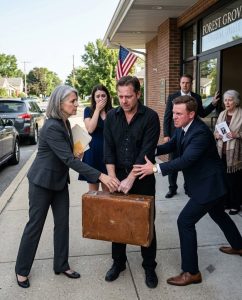
Before Caleb could answer, a man with gray hair and a charcoal suit stepped out of the funeral home.
He carried a folder under one arm and an old suitcase in his right hand.
The suitcase was brown leather, cracked at the corners, with faded brass clasps and a handle worn smooth in the middle.
“Caleb Morgan?” the man asked.
“Yes.”
“I’m Attorney Whitaker.”
Caleb straightened.
The lawyer looked tired, but not uncertain.
“Mr. Henry left very specific notarized instructions. This is for you. Only for you.”
He held out the suitcase.
Caleb did not take it right away.
He looked at Hannah.
She looked just as confused as he felt.
Then he reached for it.
The handle was warm from the sun.
The suitcase was heavier than he expected.
The moment it touched Caleb’s hand, Evan’s expression changed.
It was not grief.
It was alarm.
“What’s that?” Evan demanded.
“An item excluded from the estate,” Attorney Whitaker said.
Evan stepped closer.
“That belongs to the family.”
“Your uncle made a different decision years ago.”
Caleb held the suitcase against his chest.
The leather pressed into his shirt.
He could feel the hard shape of something inside.
Evan leaned in until his voice was low enough to sound private and cruel enough for everyone nearby to hear.
“Don’t celebrate yet. Whatever that old man left you, I’m going to take it back.”
Caleb’s hand tightened on the handle.
For the first time in twelve years, he was afraid to open something Henry had left him.
Attorney Whitaker watched Evan for a moment, then turned back to Caleb.
“Mr. Morgan,” he said quietly, “before you open that, there’s something you need to know about why Henry chose you.”
Caleb swallowed.
“Why he chose me?”
The lawyer reached into his folder and withdrew a cream envelope.
Across the front, in Henry’s shaking handwriting, were four words.
Caleb Morgan — Sunday List.
Hannah covered her mouth.
The title struck Caleb harder than any legal language could have.
Sunday List.
Not heir.
Not beneficiary.
Not stranger.
Sunday List.
The same hand that had written milk and eggs and apples had written his name like it belonged with the things Henry trusted to be carried safely.
“This envelope was signed, notarized, and attached to a private instruction letter dated eight years ago,” Attorney Whitaker said.
Caleb looked up.
“Eight years?”
The lawyer nodded.
“He updated it twice. The last update was at 3:42 p.m. on the Thursday before he passed.”
Evan’s face went tight.
“What update?”
Attorney Whitaker ignored him.
He opened the folder just enough for Caleb to see labels clipped to the documents inside.
Private instruction letter.
Personal property exclusion.
Household inventory addendum.
Witnessed statement.
Every page had been dated, signed, copied, and filed with the careful patience of a man who knew someone would try to argue once he was gone.
Henry had not been confused.
Henry had been preparing.
That realization made Caleb’s stomach drop.
All those Sundays, all those quiet cups of coffee, all those stories about Margaret and the house and the street, and somewhere beneath them Henry had been building a defense against his own blood.
Evan saw the envelope then.
More importantly, he saw the folded photograph tucked behind it.
His confidence drained out of his face.
“Give me that,” he said.
Attorney Whitaker’s voice changed.
It became sharper.
“Mr. Parker, I would advise you not to touch anything.”
But Caleb had already seen part of the photograph.
It was old.
The color had faded toward yellow.
Henry was younger in it, standing beside Margaret on a front porch Caleb did not recognize.
And Margaret was holding a baby.
Evan whispered, “No.”
Nobody moved.
The funeral director stood near the glass doors with one hand on the frame.
Mrs. Alvarez stared at the photograph with her lips parted.
Hannah’s eyes moved from the baby to Caleb, then back again.
Caleb felt the suitcase sliding slightly in his grip.
He tightened his fingers around the handle until his knuckles ached.
“What is this?” Caleb asked.
Attorney Whitaker lowered his voice.
“It is the reason Henry asked me to meet you today.”
Evan shook his head.
“He promised he burned that.”
The sentence hung there.
Not denied.
Not explained.
Confessed by accident.
Caleb turned slowly toward Evan.
“What did he promise to burn?”
Evan did not answer.
Attorney Whitaker removed a second envelope from the folder.
This one was sealed in clear plastic.
Across the front was a label printed in clean black type.
Birth record copy and correspondence, 1984.
Caleb felt the world tilt slightly.
He had been born in 1984.
His mouth went dry.
Hannah whispered his name, but he could not look at her yet.
The lawyer held the sealed envelope between them.
“Henry did not want this opened in anger,” he said. “He did not want it opened in front of anyone who might use your first reaction against you. But he also knew Mr. Parker might force a confrontation.”
Evan took a step back.
“You don’t have authority to do this here.”
“I have written authority,” Attorney Whitaker said.
Then he looked at Caleb.
“And so do you, if you choose to open it.”
Caleb could hear traffic moving somewhere beyond the funeral home parking lot.
He could hear the buzz of a light fixture near the door.
He could hear his own breathing.
For twelve years, he had believed Henry was a lonely old neighbor who became a friend.
Now he stood with an old suitcase, a photograph of a baby, and a sealed envelope marked with the year of his birth.
“Open it,” Evan said suddenly.
His voice was too sharp.
Too eager.
Then he corrected himself.
“No. Actually, don’t. This is private family business.”
Caleb looked at him.
“Funny,” he said quietly. “A minute ago I wasn’t family.”
Hannah’s hand found his back.
That was enough.
Caleb set the suitcase on the low stone ledge beside the funeral home steps.
The metal clasps were stiff.
His hands shook so badly that the first one slipped.
He tried again.
Click.
The sound was small.
It still made Evan flinch.
Caleb opened the suitcase.
Inside were not stacks of cash.
Not jewelry.
Not anything Evan could easily value at a glance.
There was a bundle of letters tied with blue ribbon.
A small framed photograph of Margaret.
A yellow notepad with several unused pages still attached.
A coffee can label folded flat.
A house key.
And on top, a letter in Henry’s handwriting.
Caleb’s name was written across it.
This time there was no Sunday List.
Just Caleb.
His throat tightened.
Attorney Whitaker said, “He asked that you read the first page before making any decision about the rest.”
Caleb lifted the letter.
The paper trembled in his hands.
Dear Caleb,
If you are reading this, then I was not brave enough to say it while I was alive.
Caleb stopped.
His eyes blurred.
Hannah pressed her hand to her mouth again.
Evan said, “This is manipulation.”
Attorney Whitaker turned on him.
“Enough.”
It was the first time the lawyer sounded angry.
Evan shut his mouth, but only barely.
Caleb forced himself to keep reading.
There are debts that money cannot pay, and there are kindnesses a man does not forget simply because he is old.
You thought you were bringing groceries.
You were bringing me back into the world.
Caleb had to stop again.
All the ordinary Sundays rushed at him at once.
Henry waiting by the window.
Henry pretending he did not want the orange loaf.
Henry asking about Hannah.
Henry pushing coffee across the table when Caleb looked tired.
Henry saying sit a little longer.
The letter continued.
I asked Attorney Whitaker to document everything because I know Evan will tell you that you were nothing to me.
He will be wrong.
He has been wrong for a long time.
Caleb looked at Evan.
Evan’s jaw worked, but no words came out.
Attorney Whitaker removed another sheet from the folder.
“This is the household inventory addendum,” he said. “It confirms the suitcase and its contents were transferred to Caleb Morgan as personal property outside the estate.”
Evan snapped, “You think that stops me?”
“No,” the lawyer said. “I think the notarized instruction letter, witness statement, and video declaration stop you.”
The word video changed the air.
Evan’s eyes flicked to the folder.
Caleb saw it.
So did Hannah.
So did everyone else.
Attorney Whitaker looked at Caleb.
“Henry recorded a statement two weeks ago. He asked me not to play it unless Mr. Parker challenged the transfer.”
Evan laughed once.
It sounded thin.
“You’re bluffing.”
Attorney Whitaker opened his folder and removed a small flash drive in a clear evidence sleeve.
“I am not.”
Evan’s shoulders dropped by an inch.
That was the first visible crack.
The funeral director quietly stepped inside and returned with a small laptop from the office.
Nobody asked him to.
He just did it, maybe because he had heard enough cruel things for one afternoon.
Attorney Whitaker inserted the flash drive.
The video opened to Henry sitting in his kitchen.
The same kitchen Caleb knew by heart.
The coffee maker was behind him.
The yellow notepad was on the table.
Henry looked thinner than Caleb remembered, but his eyes were clear.
When he spoke, his voice came through weak but steady.
“My name is Henry Whitman,” he said. “This statement is being recorded voluntarily, in the presence of Attorney Samuel Whitaker, on June 6 at 2:15 p.m.”
Caleb pressed his fingers to his mouth.
Henry continued.
“I am of sound mind. I know what I own. I know who my relatives are. And I know who showed up for me.”
Evan whispered a curse under his breath.
On the screen, Henry’s eyes moved toward someone off camera.
Maybe the lawyer.
Maybe the empty chair Caleb usually sat in.
“For twelve years, Caleb Morgan crossed the street every Sunday. He brought me groceries. He brought me bread his wife baked. He fixed the porch rail without asking for money. He sat with me on the anniversary of Margaret’s death when I had not told anyone what day it was.”
Caleb shut his eyes.
He remembered that day.
Henry had been wearing the blue sweater Margaret bought him.
Caleb had found him at the table with two cups of coffee poured.
He had not asked why.
He had simply sat down.
On the video, Henry breathed slowly.
“I should have told him sooner.”
Caleb opened his eyes.
The old man on the screen looked straight into the camera.
“Margaret and I had a daughter before she died.”
Evan’s head jerked up.
Attorney Whitaker stood perfectly still.
Henry continued.
“Her name was Laura.”
Caleb’s heart began to pound.
His mother’s name had been Laura.
Laura Morgan.
She died when Caleb was too young to remember her clearly, and his father had never liked questions.
What Caleb knew of her came from a shoebox of photographs and a few tired stories told by people who always changed the subject.
Henry’s voice shook on the screen.
“She was my daughter. She married against my wishes, and I let pride do what pride always does. I let it cost me time I could never get back.”
Hannah whispered, “Caleb…”
Caleb could not move.
Henry wiped his eyes with a handkerchief.
“By the time I found her again, she was gone. And her son had been raised under another name, across the street from me, without knowing who I was.”
The funeral home sidewalk seemed to fall silent around Caleb.
Even the traffic noise faded.
On the laptop screen, Henry’s mouth trembled.
“Caleb was my grandson.”
Evan said, “No.”
But the word had no strength in it.
Attorney Whitaker removed another document from the folder and handed it to Caleb.
It was a copy of a birth record.
Laura Morgan listed as mother.
A supplemental correspondence file clipped behind it.
Old letters.
Returned envelopes.
A private investigator’s report dated nine years earlier.
Process notes.
Addresses checked.
Names matched.
Photographs compared.
Henry had known for nine years.
Caleb looked at the date.
Then at the suitcase.
Then at the yellow notepad inside it.
Nine years.
That meant Henry had known through thousands of cups of coffee.
Through Hannah’s sweet rolls.
Through Caleb’s stories about work and bills and grief.
Through all those Sundays when Caleb had thought he was choosing Henry first.
Henry had been choosing him back.
“Why didn’t he tell me?” Caleb asked.
It came out broken.
On the video, as if answering across time, Henry said, “I was afraid.”
Caleb stared at the screen.
“I was afraid he would think I only cared because of blood. I was afraid he would hate me for finding him late. I was afraid because old men can be cowards, too, and I had already lost one child by letting pride speak first.”
The old man took a slow breath.
“So I let him be kind without burdening him with my guilt.”
Caleb’s tears came then.
Not loudly.
Not dramatically.
They simply spilled over before he could stop them.
Hannah wrapped one arm around his back.
On the screen, Henry leaned closer.
“Caleb, if Attorney Whitaker is playing this, then Evan has likely made you feel small. Do not let him. You were never my delivery boy. You were my family before either of us had the courage to say it.”
Mrs. Alvarez began to cry behind them.
The funeral director turned away and wiped his face with his sleeve.
Evan stood rigid, pale with fury.
The video was not finished.
Henry looked down at something on the table.
“I have left Caleb the suitcase because it contains the letters, photographs, and records of the truth. I have left him the house because it was Margaret’s wish that Laura’s child always have a home, if we ever found him.”
Evan lunged toward the laptop.
Attorney Whitaker moved faster than anyone expected.
He snapped it shut and stepped back.
“Do not,” he said.
Evan’s face twisted.
“That house is mine.”
“No,” the lawyer said. “The deed transfer was executed into a trust eight years ago. Caleb is the named beneficiary upon Henry’s death. You were notified of the estate inventory this morning because Henry knew you would try to move quickly.”
Evan looked at Caleb then.
All the contempt was still there, but panic had joined it.
“You think this makes you somebody?”
Caleb wiped his face with the heel of his hand.
For twelve years, he had crossed the street to carry groceries.
He had thought love was something he was giving away quietly.
He had not understood it was also returning to him, week after week, in coffee cups, yellow lists, remembered questions, and an empty chair by the window.
That was the thing Evan could not understand.
Family is not proven by who shows up when property is counted.
It is proven by who shows up before there is anything to gain.
Caleb looked at the suitcase.
Then at the lawyer.
Then at the funeral home doors.
Henry was still inside, and for the first time that day, Caleb did not feel like he had come only to say goodbye.
He felt like Henry had waited until the last possible moment to bring him home.
Evan said, “I’ll fight this.”
Attorney Whitaker nodded once.
“I expected you would. So did Henry.”
He tapped the folder.
“Every document has been copied, cataloged, and filed. The trust document, the notarized instruction letter, the video declaration, the household inventory addendum, and the correspondence record all say the same thing.”
Evan’s mouth opened.
Nothing came out.
Caleb picked up the yellow notepad from the suitcase.
The top page was blank.
Under it, he could see the faint imprint of Henry’s last grocery list pressed into the paper.
Milk.
Eggs.
Apples.
Vanilla cookies.
Ordinary things.
Sacred things, now.
Hannah touched the page with two fingers.
“He knew you,” she whispered.
Caleb nodded.
“He did.”
And maybe that was the real inheritance.
Not the house.
Not the suitcase.
Not the papers that made Evan tremble.
The real inheritance was twelve years of being seen by someone who had every reason to be bitter and chose tenderness instead.
A week later, Caleb walked into Henry’s house with the key from the suitcase.
The porch light was off.
For once, that felt right.
Hannah stood beside him holding a paper bag from the grocery store.
She had bought milk, eggs, rice, beans, apples, and vanilla cookies.
Caleb laughed when he saw them.
Then he cried.
They sat in Henry’s kitchen for a long time.
The chair by the window was empty.
Caleb placed the suitcase on the table and opened it again, this time without shaking as badly.
Inside the bundle of letters, he found one written by Margaret before she died.
It was addressed to Laura.
Caleb did not read it right away.
Some truths deserve a quiet room.
Some grief needs a chair, a cup of coffee, and enough daylight to hold it.
Months later, after the legal challenge failed, Evan stopped calling.
Attorney Whitaker sent Caleb a final copy of the court order confirming what Henry had already made clear.
The house stayed with Caleb.
The suitcase stayed with Caleb.
The story stayed with Caleb, too.
But he did not keep it like a secret.
He framed one photograph of Henry and Margaret and placed it on the kitchen wall.
He kept the yellow notepad by the coffee maker.
And every Sunday morning, even after Henry was gone, Caleb still went to the market.
Sometimes Hannah asked why he kept buying vanilla cookies when nobody in their house really ate them.
Caleb always smiled and put the box in the cart anyway.
Because for twelve years, he had crossed the street thinking he was simply being kind.
And in the end, an old suitcase taught him that kindness had been carrying a truth home long before he knew its name.