
The trail ended about twenty yards downstream at a concrete culvert, where a rescue technician found Andrew alive on a shelf of mud, one arm locked around a root and his left leg pinned beneath storm debris.
He had been there for days.
When Natalie reached the edge of the washed-out shoulder, two firefighters were already moving down the bank with ropes while muddy water pushed branches through the ditch below them.
Andrew lifted his head once when they called his name.
Then it dropped again.
His shirt was stiff with dried mud, his lips had almost no color, and one shoe was missing.
Natalie looked toward the pickup and then toward the sealed pharmacy bag still visible through the passenger window.
Whatever people had been saying about him back on Ashley’s street, he had not driven away from his daughter.
He had been trying to drive home.
A firefighter named Mason reached him first and checked his pulse while another worker cut away branches around his trapped leg.
Andrew tried to speak.
Only one word came out clearly.
“Ashley.”
Natalie crouched as close as the unstable bank allowed.
“She’s alive. She’s at the hospital.”
Andrew closed his eyes.
For several seconds, he did nothing except breathe.
Then his fingers loosened from the root he had apparently been gripping whenever the water rose.
The rescue crew warned him not to move, but Andrew tried anyway.
His body barely shifted.
“I have to get home.”
“You’re not getting up yet,” Mason told him.
Andrew swallowed and tried again.
“She was sick.”
Natalie already knew.
The grocery list on the kitchen table had Ashley’s medication written beneath rice, chicken, and electrolyte drinks, and the bag inside the wrecked pickup contained every one of those things.
The ordinary NOTE that had looked almost meaningless when Natalie first entered the house now gave the roadway scene a timeline.
Andrew had expected to be gone for thirty minutes.
He had purchased what Ashley needed.
Then something had happened between the store and home.
The firefighters lifted the branch pinning his leg and slid a rescue board beneath him.
Andrew groaned once but did not scream.
His first question was whether Ashley had eaten.
Natalie told him doctors were treating her for dehydration and that she was awake again.
He stared at the brown water.
“Four days?”
Natalie did not soften it.
“Four days.”
Andrew covered his face with both hands.
A rescue worker tightened one strap across his chest while a loose plastic bottle rolled back and forth near the truck’s rear tire for no useful reason at all.
They carried him up the embankment.
At the ambulance, Natalie tried calling Andrew’s number once more, although she already suspected the phone was somewhere in the wreck.
Nothing rang.
She put her own phone away.
Several hours later, investigators recovered Andrew’s waterlogged phone beneath the driver’s seat, along with a pharmacy receipt and a grocery receipt carrying timestamps from sometime that afternoon.
The purchases matched the handwritten list.
There was no withdrawal of cash, no luggage in the truck, no packed clothing, and no sign that Andrew had prepared Ashley for anyone else to care for her.
The evidence pointed in one direction.
He had left on an errand and never made it back.
But finding him alive created another problem.
Andrew had a fractured leg, cracked ribs, severe dehydration, and a concussion that left portions of the previous days confused.
He could remember leaving the store.
He remembered heavy rain.
He remembered turning onto the county road because it was his normal route home.
After that, his memories came in pieces.
A wall of water crossing the pavement.
The truck sliding sideways.
Glass breaking.
Cold mud.
Then waking in darkness with water below him and no idea how much time had passed.
He remembered trying to climb toward the road.
His injured leg would not support him.
He remembered shouting until his throat hurt.
At some point he crawled toward higher ground beside the culvert, dragging himself through reeds because staying inside the pickup felt more dangerous as the channel rose.
He had no working phone.
He could not reach the road.
And he did not know that, several miles away, Ashley was still sitting beside a kitchen faucet waiting for him.
At the hospital, Ashley knew only that the police had found her daddy.
She sat upright despite the nurse telling her to rest, Buddy wedged beneath one arm and a paper cup of apple juice untouched beside her.
A nurse named Jenna came in, glanced at Buddy, and called him a bear.
Ashley looked down at the stuffed puppy but said nothing.
“Can I see my daddy?”
Natalie was beside the bed.
“Not yet. Doctors are helping him.”
Ashley pulled one of Buddy’s ears straight.
“Is he mad because I called 911?”
Natalie’s answer came immediately.
“No.”
Ashley studied her face.
“I waited like he said.”
“I know.”
The child took one sip of juice.
Then she asked for her father again.
Across the hospital, Andrew was asking for her too.
Doctors would not allow either of them to leave their rooms, so Natalie carried messages between two people separated by a few hallways after spending four days unable to reach each other at all.
Andrew wanted Ashley told that he had tried to come home.
Ashley wanted Andrew told that she had kept Buddy safe.
Neither asked why the other had failed them.
Outside the hospital, the story was becoming uglier.
The short video recorded by someone near Ashley’s house had already spread through local social media, stripped of everything rescuers had learned at the roadway.
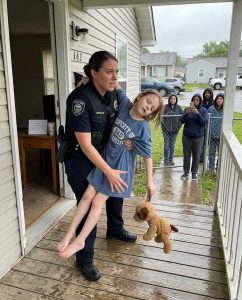
It showed an ambulance, police cars, a frightened child being carried from a house, and neighbors saying her father had disappeared.
That was enough for strangers.
Comments multiplied.
People called Andrew selfish.
Some called him cruel.
Others demanded to know why a father would leave a sick seven-year-old alone for four days.
The answer existed in a muddy ditch several miles away, but most of the people typing had not heard it yet.
Natalie saw the video sometime that morning while standing beside a vending machine that had a piece of blue tape stuck crookedly over one button.
She watched less than a minute.
Then she shut it off.
Her supervisor, Lieutenant Harris, told officers to stick to verified facts until the roadway reconstruction was complete.
Natalie agreed.
She also asked that the photograph of the NOTE be attached near the beginning of the incident file instead of buried among routine property photographs.
The NOTE did not prove how the crash happened.
It proved intent.
Andrew had written down what his daughter needed because he planned to bring it back to her.
By late morning, road crews had found another piece of the sequence.
A section of the shoulder above the pickup had collapsed during the storm, leaving fresh erosion beneath what had looked like solid pavement.
Marks on the road suggested Andrew had braked before his truck left the surface.
He had not simply driven into standing water.
The ground beneath the edge had failed.
That discovery changed the scale of what rescuers believed had happened, but it did not immediately solve everything.
There was still no witness to the crash.
Andrew’s memory stopped before the truck went over.
And because he remained hospitalized, Ashley could not simply be sent home with him.
That afternoon, a hospital social worker named Dana explained that Ashley would need a safe adult placement until Andrew was medically capable of caring for her again.
Andrew listened without interrupting.
His hands stayed flat against the blanket.
“Can she stay here?”
Dana said the pediatric unit could not keep a medically stable child solely because a parent remained admitted elsewhere.
Andrew looked toward the window.
For a moment, after surviving the crash and finally being found, he was facing the possibility that Ashley would leave the building without him.
His sister lived several hours away and had not answered the first call because she was working an overnight shift.
Andrew asked them to call again.
They did.
Nothing.
He gave Dana the number of an older neighbor who had occasionally watched Ashley after school.
That did not work either.
Andrew rubbed his thumb against the edge of the hospital blanket until the fabric rolled beneath his nail.
“Keep trying my sister.”
Sometime later, she called back.
Her name was Rachel.
She had learned what happened only after turning on her phone after work, and her first words were not about paperwork or the crash.
“Where is Ashley?”
Dana arranged the necessary checks while Rachel started driving toward the hospital.
For Andrew, it was not the reunion he wanted.
But it meant Ashley could leave with family instead of a stranger if her doctors discharged her before his.
That was enough for the moment.
The next reversal came from the roadway.
A maintenance camera positioned near an intersection had captured Andrew’s pickup passing toward home sometime after he left the pharmacy.
Minutes later, rain blurred most of the image.
Then the camera stopped transmitting.
Investigators could not see the crash itself.
They could see that Andrew was headed toward Ashley’s house, not away from it.
The finding was useful, but it changed almost nothing about the immediate problem.
Ashley still could not see him.
Andrew still could not walk.
The people online were still repeating the first version of the story.
Natalie returned to Ashley’s room before evening.
The room was warm enough that the child had pushed her blanket down with both feet.
A tray with crackers sat near the bed.
Ashley had eaten two and arranged a third beside Buddy.
“He doesn’t really eat,” she explained.
Natalie nodded.
“Probably saves the hospital money.”
Ashley almost smiled.
Then she asked the question she had been saving.
“Did Daddy crash because he was getting my medicine?”
Natalie could have answered with everything investigators believed.
Instead she kept it small.