
Trisha was smiling too hard at my parents’ barbecue.
The kind of smile that looked perfect from across the yard but felt wrong the second you were close enough to see it.
Charcoal smoke drifted over the backyard while the kids tore through the sprinkler, shrieking every time the cold water swung their way.
Mom had sliced watermelon into a big plastic bowl, Dad was hovering near the grill, and folding chairs were scattered across the grass wherever relatives had dragged them.
At Trisha’s feet sat several glossy shopping bags.
She kept reaching into them and calling people over as if the afternoon had quietly turned into her personal gift ceremony.
My seven-year-old daughter, Hannah, sat beside me in her pale yellow dress with both hands folded tightly in her lap.
She wasn’t watching the sprinkler.
She wasn’t asking for watermelon.
She wasn’t interested in the bags at Trisha’s feet.
She had been quiet all week, and by then I knew there was a difference between a tired child and a child protecting something she didn’t know how to explain.
Hannah was protecting something.
I just didn’t know what yet.
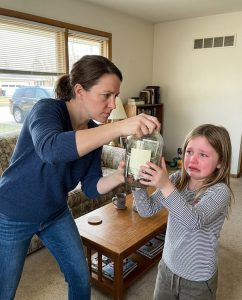
Only a few days earlier, she had carried her savings jar around our house with the kind of seriousness only a seven-year-old can give an ordinary glass container.
Neil and I had helped her count every bill and every coin at the kitchen table.
The total was $1,651.26.
Hannah had stared at the number as if we had just revealed buried treasure.
To her, maybe we had.
That money hadn’t appeared all at once.
It was birthday money she had tucked away instead of spending immediately.
Christmas bills folded inside little envelopes.
Five-dollar rewards from helping neighbors pull weeds.
Money from her grandparents that she had carefully divided because Neil and I had been trying to teach her something simple: saving meant deciding that something mattered enough to protect for later.
She was proud of that jar.
So were we.
And yet, at the barbecue, Hannah looked like she wanted to disappear every time Trisha reached into another bag.
First came new sneakers for Logan.
Then a glittering tablet case for Stella.
There were tissue-wrapped boxes, bright bags, ribbons, and price tags that had been hidden badly enough that anyone paying attention could still see them.
Mom looked delighted.
Dad clapped Trisha on the shoulder.
“We’re so proud,” Mom said.
Something about those words landed wrong.
A month earlier, Trisha had called me crying from a grocery store parking lot.
Her card had declined while she was trying to buy milk, cereal, and chicken thighs.
Neil drove over with cash while I stayed home packing Hannah’s school lunch.
There hadn’t been any judgment attached to helping her.
She was my sister.
She needed groceries.
We helped.
That was what family did, at least according to the rules everyone seemed happy to quote whenever Trisha needed something.
Now she was standing in my parents’ backyard handing out expensive-looking gifts while everyone praised how generous she had suddenly become.
Neil leaned closer to me.
“Since when can she afford all this?”
I kept my eyes on Trisha.
“Good question.”
Then Trisha turned toward Hannah.
She reached into one of the bags, pulled out a wrapped package, and placed it in my daughter’s hands.
“Something for my niece,” she announced loudly enough for the people around us to hear.
Hannah stared down at the package.
She didn’t smile.
She didn’t touch the ribbon.
She barely seemed to breathe.
“Go ahead, sweetheart,” I whispered. “Open it.”
Hannah shook her head.
Trisha didn’t seem to notice, or maybe she noticed and didn’t care.
She had moved on to the next part of the performance.
She handed my parents an envelope for a spa day and accepted every compliment as if she had been waiting weeks to hear them.
Then she looked at me.
“And Andrea,” she said, “what did you bring?”
I almost laughed because the question made so little sense.
I had brought exactly what my parents had asked me to bring: pasta salad, juice boxes, sunscreen, and folding chairs.
I hadn’t brought presents because Trisha herself had called me two days earlier and specifically told me not to bring anything.
Someone nearby quietly said, “Isn’t Andrea the one who helps her out?”
Trisha heard it.
She just smiled.
That was when I stopped looking at my sister and looked at Hannah instead.
Her fingers were pressing so hard into the wrapping paper that pale half-moons had formed around her fingertips.
Her eyes stayed fixed on the grass.
Logan and Stella ran past with their new things while Hannah sat frozen with the package on her lap.
A few minutes later, she slipped inside the house.
I followed.
The den was cooler and quieter than the backyard.
I found Hannah curled into one end of the couch with the unopened present still resting on her knees.
“Baby, what happened?”
Her chin started trembling before she said a word.
“I don’t want this.”
I sat beside her.
“Why?”
She looked at the package.
“It’s for Stella.”
For a second, I didn’t understand what she meant.
Then her voice dropped.
“I just want my jar back.”
Everything inside me went still.
I asked her what had happened, and the story came out slowly, the way stories do when a child is afraid the adult listening might somehow confirm that the terrible thing was actually her own fault.
Trisha had asked to see Hannah’s savings jar.
She had noticed the sticky note Neil had put under the lid after we counted the money together.
$1,651.26.
Trisha knew exactly how much was inside.
She told Hannah that Logan and Stella didn’t have anything like it.
She told her that good kids helped family.
Hannah said no.
That part mattered to me more than she probably understood.
My seven-year-old had tried to protect something that belonged to her.
She had remembered what Neil and I taught her.
She had said no to an adult.
And then my grown sister leaned over my child and said, “Hand it over, or everyone will know you’re a selfish little brat.”
So Hannah gave her the jar.
Because she was seven.
Because Trisha was her aunt.
Because children are taught that adults in the family are supposed to be safe people.
Because when someone older tells a seven-year-old that protecting her own belongings makes her selfish, the threat is bigger than the words.
It tells the child that love and approval can disappear if she refuses.
Hannah had spent days carrying that shame around by herself.
And now she was sitting on my parents’ couch holding a present that she believed had been bought with her own money for someone else.
I pulled her against me while she cried into my shirt.
I could hear the barbecue continuing outside.
People were laughing.
The sprinkler was still running.
Someone opened the back door and closed it again.
The entire afternoon was continuing as though nothing had happened.
I wanted to walk into that yard and expose Trisha in front of everyone.
I wanted to ask where Hannah’s jar was.
I wanted to dump every glossy shopping bag onto the grass and make her explain each purchase in front of our parents.
But that would have given Trisha exactly what she seemed to want all afternoon: an audience.
And Hannah had already been humiliated enough.
So I stayed with my daughter until her breathing slowed.
Then I walked outside.
Neil was near the cooler.
I looked at him once.
I didn’t need to explain anything in front of everyone.
He stood up without asking a question.
At 6:42 p.m., we buckled Hannah into the backseat and left.
There was no dramatic confrontation in the driveway.
No shouting match across the lawn.
No speech for my parents to referee.
My priority was getting Hannah home.
By 7:18, she had eaten half a grilled cheese.
Her eyes were swollen from crying, and eventually exhaustion took over.
When she finally fell asleep, I went to the kitchen table and opened my laptop.
There was another amount of money sitting behind a password.
$40,000.
That number belonged to a completely different kind of jar, although nobody in my family would have called it that.
It was money I had stretched, borrowed, and saved so Trisha could attend an acting program in London.
Tuition.
Housing.
Travel.
Her dream.
And somehow, over time, everyone had started treating that dream as my responsibility.
I had accepted that role long enough that it almost felt permanent.
If Trisha needed help, I found a way.
If something fell short, I stretched further.
If there was paperwork, I handled it.
If money needed to move, I was expected to make it move.
But that night, for the first time, I looked at the arrangement differently.
The account was in my name.
The bank portal was in my name.
The tuition authorization was tied to me.
The routing confirmation was tied to me.
Every receipt Neil had scanned and organized by date carried my signature.
I wasn’t looking at some mysterious family resource that naturally belonged to Trisha because she wanted it badly enough.
I was looking at money I had spent years taking responsibility for.
And upstairs, my seven-year-old daughter was asleep after asking me, through tears, whether saving her own money had made her selfish.