My mom went to Europe for a month and left me with $20 when I was eleven.
When she finally came back, what she saw in the kitchen made the souvenir bags slip out of her hands.
“No,” she whispered.
Then her voice rose.
“No. No. This can’t be happening.”
My name is Sydney, and I was eleven years old when my childhood ended with a crumpled twenty-dollar bill and one word my mother kept repeating as if saying it often enough could turn neglect into a life lesson.
Independent.
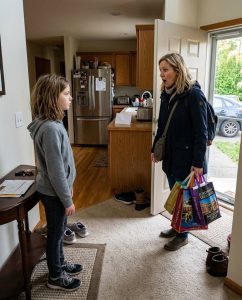
“See? You’re independent now,” she told me with a bright, brittle smile while dragging her massive Samsonite suitcase toward the front door.
The suitcase looked almost as tall as I felt.
She was dressed for travel, already mentally somewhere else, and everything about the way she moved told me this conversation was not really a conversation.
The decision had already been made.
“You’re not a baby anymore, Sydney. Just order food if you need to. I’m going to Europe for a month. I’ll be back before you know it.”
Then she pressed the bill into my hand.
I looked down at it.
Twenty dollars.
For thirty days.
At eleven, I did not know exactly how much a month of food should cost, but I knew enough to understand that twenty dollars was not it.
I kept staring at the bill, waiting for her to laugh and pull out more money.
Waiting for her to point toward a drawer where she had left emergency cash.
Waiting for her to mention a person who would check on me.
Waiting for anything that would make the situation feel less impossible.
Nothing came.
There were no emergency numbers taped to the refrigerator.
There was no neighbor she told me to call if something happened.
There was no stocked pantry waiting for me.
She did not walk through the house with me and explain what to do if I got sick, if something broke, or if I became scared in the middle of the night.
She did not even give me a real goodbye.
I heard the sharp click of her heels against the floor, then the front door opening.
A moment later, the suitcase wheels rattled down the driveway.
Then the door shut.
The sound was ordinary.
That was what made it so frightening.
No dramatic argument.
No final warning.
No last-second change of heart.
Just a door closing and a house suddenly becoming far too quiet for an eleven-year-old girl standing alone inside it.
“I’ll be fine,” I told the empty hallway.
Even then, I knew I was lying.
For a few seconds, I stayed exactly where I was with the twenty-dollar bill still folded in my hand.
Part of me expected the door to open again.
Maybe she had forgotten her passport.
Maybe she would come rushing back inside and look at me differently.
Maybe seeing me standing there alone would finally make the reality of what she was doing hit her.
But the door stayed closed.
So I went to the kitchen.
I opened the refrigerator and stared inside, trying to make myself believe I had overlooked something.
There was a carton of sour milk.
A jar of pickles.
That was basically it.
I opened the pantry next.
One can of creamed corn.
One dented tin of tuna.
I remember looking from the pantry to the refrigerator and then back down at the twenty dollars in my hand.
That was the moment the fear changed.
Before that, the fear had been vague.
It had been the kind of fear a kid feels when an adult says something strange and you assume there must be another explanation because adults are supposed to know what they are doing.
But the refrigerator was real.
The pantry was real.
The money was real.
And my mother was gone.
I was alone in a big house with twenty dollars and almost nothing to eat.
At first, I treated the money like it was something fragile.
I counted it before I spent anything.
Then I counted what remained afterward.
I thought about every meal before buying it because I understood quickly that one careless choice did not just mean losing a few dollars.
It meant losing future meals.
That changed the way I looked at money almost overnight.
A number stopped being a number.
Every dollar represented time.
Every purchase represented a decision about how hungry I was willing to be later.
I tried to make the twenty dollars last.
I really did.
I stretched what I could and avoided spending whenever possible, always trying to convince myself that the next day would somehow be easier.
But days do not stop arriving because a child has run out of options.
Morning still came.
Afternoon still came.
Night still came.
And every day, the amount of money got smaller.
The house seemed to grow larger as the money disappeared.
During the daytime, I could move from room to room and pretend I was doing something ordinary.
But when evening came, there was no adult voice from another room asking if I had eaten.
Nobody opened the front door carrying groceries.
Nobody called my name from the kitchen.
Nobody asked whether I needed anything.
The silence became its own kind of answer.
My mother had not forgotten to prepare for me.
Preparation would have required her to think seriously about what thirty days alone meant for an eleven-year-old.
Instead, she had given me twenty dollars and called me independent.
For the first few days, I kept returning to that word.
Independent.
It sounded almost flattering when she said it.
Like I had earned some special promotion from childhood.
Like being left alone was evidence that I was unusually mature.
That was the story she had handed me with the money.
But each day I spent calculating what I could afford made the word feel different.
Independence was supposed to mean being capable of making choices for yourself.
What I had been given was not a real choice.
I had not chosen to stay home alone.
I had not chosen how much money I would have.
I had not chosen whether the kitchen would contain enough food.
I had simply been told that I should handle it.
There is a strange thing that happens when a child realizes an adult is not coming to fix the problem the adult created.
At first, you wait.
You imagine explanations.
You invent reasons.
You tell yourself there must be something you do not understand.
I spent days doing that.
Maybe my mother would call and realize she had made a mistake.
Maybe she would suddenly ask how much money I had left.
Maybe she would hear my voice and understand that I was scared.
Maybe she would apologize and arrange something.
Maybe there had been some misunderstanding so obvious that it would eventually reveal itself.
But as the days passed, those possibilities stopped feeling comforting.
They started feeling childish.
The twenty dollars eventually disappeared.
Then the food disappeared.
And once that happened, something inside me changed too.
I stopped waiting for my mother to suddenly become the person I needed her to be.
I stopped imagining the perfect phone call where she finally understood everything and rushed home full of regret.
I stopped rehearsing what I would say if she asked whether I was okay.
She had called me independent.
So I began thinking about what that word actually meant when the person saying it was using it as permission to leave an eleven-year-old behind.
That question stayed with me.
Not because I was trying to become philosophical about it.
I was eleven.
I was hungry, frightened, and angry.
But I was also paying attention.
Children notice more than adults sometimes realize, especially when the adult expects the child to absorb the consequences quietly.
I noticed how quickly fear could turn into planning when there was nobody else to depend on.
I noticed how carefully I had started thinking before every decision.
I noticed that I was no longer counting the days because I missed my mother.
I was counting them because I wanted to know exactly when she would walk back through that door and expect everything to look normal.
That became important to me.
Normal.
I kept wondering what she expected to find when she returned.
Did she imagine me smiling in the foyer?
Did she imagine the kitchen exactly as she left it?
Did she imagine herself handing me some souvenir and telling me how grown-up I had been?
Did she think the twenty dollars would become part of a funny family story about the month Sydney proved she could take care of herself?
I could not know what she imagined.
But I knew what I was beginning to understand.
If I simply told her I had been afraid, she could dismiss it.
If I cried, she could call me dramatic.
If I screamed, she could make the argument about my behavior instead of hers.
If I begged her to admit she had been wrong, she could refuse.
For the first time, I understood that sometimes the strongest response is not the loudest one.
Sometimes you need something that can sit silently in front of a person and force them to confront what they would rather explain away.
By the time the month was nearly over, I was not thinking like the same girl who had stood in the foyer holding that twenty-dollar bill.
That girl had been waiting for an adult to tell her what came next.
I was no longer waiting.
I had made a decision.
And it was not going to require screaming.
It was not going to require breaking anything.
I was not going to stand in the doorway and demand that my mother admit she had failed me.
I was not going to give her the chance to turn the moment into a fight about whether I was being disrespectful.
Instead, I spent the last part of the month preparing something.
Something simple.
Something quiet.
Something she could not mistake for a tantrum.
There was a piece of paper involved.
There was a pen.
And there was a reason I placed both of them where she would see them almost immediately after coming home.
As the expected return day got closer, the house felt different again.
For most of the month, every room had reminded me that she was absent.
Now every room reminded me that she was coming back.
I thought about the sound of her suitcase wheels.
I thought about that bright smile she had worn before leaving.
I thought about the way she had said “independent” as though the word itself had released her from responsibility.
Most of all, I wondered what would happen when she realized I had taken that word more seriously than she ever intended.
When the day finally came, I heard her before I saw her.
The familiar sounds returned to the driveway.
Movement outside.
Luggage.
Then the front door opened.
For a strange second, I was eleven years old in two different moments at once.
I could remember standing in the same house a month earlier, watching her leave with twenty dollars in my hand.
And now I was standing there after surviving every day that had come between those two moments.
My mother walked inside looking rested and tan.
Souvenir bags hung from her hands.
Her trip had clearly ended very differently from the month I had just lived through.
She moved into the house with the easy confidence of someone returning to a place she still assumed belonged to the life she had left behind.
Nothing about her expression suggested that she expected a confrontation.
Nothing about her posture suggested that she had spent the trip worrying about whether her eleven-year-old daughter had enough food.
She looked like someone coming home from an ordinary vacation.
That hurt more than I expected.
Not because I wanted her to look miserable.
I wanted evidence that somewhere during those thirty days, she had understood the weight of what she had done.
Instead, she looked comfortable.
She carried her bags farther inside.
I did not rush toward her.
I did not ask what she had brought me.
I did not start explaining what the month had been like.
I watched.
She headed toward the kitchen.
My heart began pounding harder with every step she took.
Not because I had changed my mind.
Because after weeks of thinking and waiting, the moment I had prepared for was finally happening.
She reached the kitchen entrance.
Then she stopped.
The souvenir bags slipped from her fingers.
Her eyes locked on the counter.
For the first time since coming through the door, the relaxed vacation expression vanished.
“No,” she whispered.
I stayed where I was.
She took another look, almost as if changing the angle would somehow change what was in front of her.
Then her voice rose.
“No. No. This can’t be happening.”
I stood across from her and said nothing.
That silence was not fear anymore.
It was a choice.
For weeks, I had imagined all the things I might say when she returned.
I had imagined telling her what it felt like to open that nearly empty refrigerator.
I had imagined asking how she could possibly believe twenty dollars was enough.
I had imagined repeating her own word back to her.
Independent.
But none of those sentences seemed necessary now.
She was staring at the counter.
Sitting there was the one thing I had spent the last part of the month preparing for her to see.
A very specific piece of paper.
It was not hidden in a drawer.
It was not folded inside an envelope.
It was placed where she could not walk into that kitchen without noticing it.
And beside it was a pen.
My mother looked at the paper again.
Then at the pen.
Then at me.
Something in her expression shifted.
The disbelief was still there, but now something else had joined it.
For the first time since she came home, she was not looking at me like the same child she had left behind with twenty dollars and a label she found convenient.
She was looking at me as if she had finally realized that the month had changed something she could not simply undo by unpacking her suitcase and returning to normal.
I did not smile.
I did not celebrate her reaction.
There was nothing satisfying about being eleven years old and learning that the only way to make your own mother understand the seriousness of abandoning you was to prepare for her return instead of trusting that she would come back sorry.
But I had learned something during those thirty days.
I could not force her to care.
I could not rewrite what had happened.
I could not make twenty dollars become enough food for a month simply because she had called me independent.
What I could do was make a decision about what happened next.
Her eyes dropped to the paper one more time.
Then they moved to the blank place where the pen was waiting beside it.
And that was when her expression changed completely.