The trust’s marriage-linked access provisions terminated permanently.
I retained my forty-one percent.
After the board issued new shares to stabilize the company, my interest diluted slightly.
I did not care.
Control was not the same thing as possessing every percentage point.
Control meant never again giving one person enough authority to make truth difficult to reach.
We rebuilt Cross Meridian differently.
Independent audit committee.
Dual approvals on large transfers.
No spouse-based access.
Whistleblower protection.
Mandatory conflict disclosures.
Vanessa’s foundation contracts were canceled.
The flagship hotel loan was unwound after a settlement with the lender.
It cost us millions.
We survived.
Nathan had always claimed the company could not survive without him.
Within eighteen months of his removal, operating profits increased twenty-three percent.
Apparently fraud was expensive.
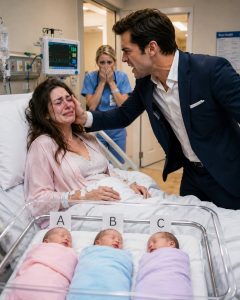
The triplets came home after seven weeks.
Sophie first.
Then Noah.
Then Grace.
The first night all three slept under one roof, I did not sleep at all.
Every sound terrified me.
Every silence terrified me more.
I checked their breathing so often my mother eventually took my phone away and ordered me to close my eyes.
“You cannot guard three babies by staring at them.”
“Watch me.”
She laughed.
Then cried.
Then we both laughed while crying.
My mother moved into the guest wing for six months.
Michael came every weekend.
Lucas became Uncle Lucas despite having no biological claim whatsoever.
Dr. Rao attended the babies’ first birthday.
Margaret Ellis sent books instead of toys.
The house Nathan once treated like proof of his success became loud.
Messy.
Warm.
There were bottles on counters.
Blankets over expensive chairs.
Tiny socks in impossible locations.
One evening I found a pacifier inside a decorative vase.
I never learned how it got there.
For years, Nathan insisted the mansion needed to remain immaculate because investors visited.
After he was gone, I realized homes are more beautiful when people are allowed to live inside them.
When the children turned three, I took them to the flagship hotel.
Not for business.
For pancakes.
They sat in a booth overlooking the river.
Sophie poured syrup onto the table.
Noah tried to eat butter directly.
Grace announced that pancakes were “round bread.”
I looked around the dining room.
This was the property Nathan had nearly pledged away.
The marble floors.
The chandeliers.
The staff who had worked there for decades.
My grandfather once told me real wealth was not the building.
It was the system that allowed hundreds of people to earn a living inside it.
I understood that differently now.
Nathan saw assets as leverage.
My grandfather saw them as stewardship.
I had spent too many years adopting Nathan’s language.
Expansion.
Control.
Winning.
I preferred stewardship.
One of the hotel managers approached.
“Ms. Bennett?”
I had returned to my maiden name.
“Yes?”
“There’s a letter for you.”
My stomach tightened.
“From?”
“He asked that we not say.”
I opened the envelope after the children finished breakfast.
Nathan’s handwriting.
He was three years into his sentence.
Amelia,
I know you probably won’t answer.
I saw a photograph of the triplets in a newspaper article about the company. They look healthy.
I think about the hospital every day.
Not the court case. Not the money. The hospital.
I keep hearing myself say, “But you’re still here.”
I don’t know how I became someone who could say that.
I’m sorry.
I stopped reading.
For years, I had wanted Nathan to understand.
Now he did.
Or believed he did.
It changed nothing.
Understanding is not a time machine.
I folded the letter and placed it inside my purse.
Grace looked at me.
“Who wrote that?”
“Someone I used to know.”
“Bad person?”
Children want simple categories.
Good.
Bad.
Hero.
Villain.
I looked at her.
“Someone who made very bad choices.”
“Does he say sorry?”
“Yes.”
She considered this.
“Then is everything fixed?”
I smiled sadly.
“No.”
“Why?”
“Because sorry is the beginning of fixing something. Not the end.”
She nodded as if this were obvious.
Then demanded more pancakes.
I never answered Nathan.
But I kept the letter.
Not because I needed his apology.
Because one day the children might ask whether their father ever understood what he had done.
I wanted to be able to answer honestly.
Maybe.
Eventually.
Too late.
Five years after the night I nearly died, Cross Meridian opened a maternal-family support program in every hotel we operated near major medical centers.
Discounted rooms for families with babies in intensive care.
Emergency transportation.
Meals for parents who had been sleeping beside hospital beds.
It began because I remembered being wheeled into the NICU alone.
The empty chair beside me.
The mothers I met during those seven weeks.
Some lived hours away.
Some slept in cars.
Some lost jobs because they refused to leave sick children.
At the opening of the first family floor, Dr. Rao stood beside me.
“You turned one terrible night into something useful.”
I looked through a window at the hospital across the street.
“No.”
She frowned.
“I did something useful afterward.”
“That’s what I meant.”
“It matters to me that they’re different.”
The terrible night remained terrible.
I did not need to call it destiny.
Or a gift.
Or the reason something good happened.
Nathan’s betrayal did not deserve credit for what I built after surviving it.
I made those choices.
That distinction mattered.
On the triplets’ sixth birthday, we held a party in the mansion garden.
Nothing elegant.
Balloons.
A magician.
Too much cake.
Thirty children running across grass Nathan once refused to let anyone step on during business dinners.
My mother sat beneath a tree laughing with Margaret Ellis.
Lucas attempted to assemble a toy airplane and failed publicly.
Sophie wore a crown.
Noah had chocolate icing on his forehead.
Grace disappeared for ten minutes and returned carrying three worms in a teacup.
At sunset, the children gathered around the cake.
I lit six candles for each of them because they insisted one candle was not enough.
Eighteen flames flickered in the evening air.
For one second, I remembered three incubators.
Three tiny hands.
Three heartbeats doctors fought to preserve.
Then the children screamed for me to hurry.
I laughed.
“All right.”
We sang.
They blew out the candles.
Smoke curled into the evening.
My mother came to stand beside me.
“You okay?”
“Yes.”
“You looked far away.”
“I was.”
“Where?”
“2:13 a.m.”
She knew.
My mother always knew.
She touched my shoulder.
“You came a long way.”
I looked at my children.
“No.”
I smiled.
“They did.”
Later, after everyone left, I walked through the quiet house turning off lights.
In the old study, I stopped beside a framed document.
Not my divorce decree.
Not Nathan’s conviction.
My grandfather’s trust certificate.
Beside it was one sentence from a letter he wrote shortly before he died:
Never give anyone permanent power merely because you currently love them.
At twenty-five, I thought it was cynical.
At forty, I understood it was not advice against love.
It was advice against surrender.
You can love someone and keep your name on the deed.
Love someone and read the contract.
Love someone and retain access to the bank account.
Love someone and still ask questions.
Trust should make transparency easier.
Not unnecessary.
I turned off the study light.
Upstairs, one of the children called.
“Mama!”
Three doors opened almost simultaneously.
Then another voice.
“Mama!”
And another.
“Mama!”
I laughed.
“I’m coming!”
I climbed the stairs.
Nathan once believed three newborns would make me too tired to leave him.
He was right about one thing.
They exhausted me.
They exhausted me so completely that I stopped having energy for lies.
No energy to protect his ego.
No energy to explain away missing money.
No energy to pretend his cruelty was stress.
No energy to rescue a marriage after he abandoned us when we needed him most.
The night I nearly died did not make me powerful.
I had power all along.
The trust.
The shares.
The evidence.
My education.
My family.
My own judgment.
Nathan’s greatest achievement had been convincing me not to use any of it.
When I finally did, he called it betrayal.
But taking back what someone stole is not betrayal.
Neither is leaving a person who benefits from your silence.
I reached the top of the stairs.
Three children stood in the hallway arguing about whose room contained a monster.
Apparently the monster had moved between all three.
I opened my arms.
“Come on.”
They ran toward me.
All three at once.
For a second, I almost lost my balance.
Then I steadied myself.
Six years earlier, I had held my phone from a hospital bed and whispered:
I’m done pretending I’m helpless.
At the time, I thought those words meant I was about to take back a company.
A fortune.
A house.
I was wrong.
The most important thing I took back was the right to believe my own life belonged to me.
Everything else followed.