The smell of charcoal and sweet barbecue sauce had always made me think of summer before that day.
Afterward, I could not pass a backyard grill without tasting panic in the back of my throat.
My parents lived in a quiet suburban neighborhood in Ohio, the kind with trimmed hedges, basketball hoops in driveways, and small American flags clipped to porch railings in July.
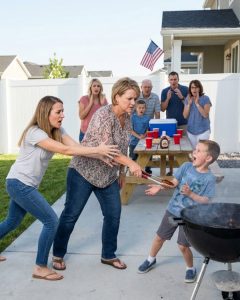
Their backyard was where our family gathered for birthdays, cookouts, graduations, and all the ordinary performances of closeness.
That Saturday was supposed to be one more harmless family barbecue.
My husband, Daniel, had almost not come.
He had a work call he could not miss, and he knew my family had a way of making simple afternoons feel like inspections.
Still, he came because Ethan asked him to.
Our son was seven.
He had Daniel’s serious eyes and my habit of apologizing before anyone had accused him of anything.
Ethan was not a rough child.
He was the kind of boy who said sorry when someone else stepped on his shoe.
He lined up his crayons by color.
He asked before touching other people’s things.
He loved bubbles because, as he once told me, “they don’t last long, but they’re still happy.”
That sentence had stayed with me for months.
It sounded too gentle for a world that kept rewarding loud people.
My mother, Carol Whitman, had never known what to do with gentleness.
In her house, children were either obedient or they were problems.
There was no room between.
I grew up learning that tone mattered less than power.
If she raised her voice, it was discipline.
If I raised mine, it was disrespect.
If she grabbed my arm, it was correction.
If I pulled away, it was attitude.
By the time I became a mother myself, I had promised Daniel that our child would never have to earn safety by staying silent.
But promises are easy to make in your own kitchen.
They are harder to keep in the backyard where you learned fear.
We arrived a little after one.
The grill was already smoking.
My father stood beside it in a faded baseball cap, turning burgers with the careful focus of a man who avoided conflict by becoming useful.
My sister Melissa sat under the patio umbrella, laughing too loudly at something my uncle said.
Her son Tyler was running across the grass with a plastic bubble wand in one hand and a red cup in the other.
Tyler was nine, all speed and elbows, a good kid when nobody trained him to perform for attention.
Melissa loved him, but she loved being approved of by my mother even more.
That was the old family gravity.
Everything bent toward Carol.
Daniel carried the cooler from our SUV to the patio, then checked his phone.
“I need ten minutes,” he said quietly.
Ethan looked up at him.
Daniel bent and kissed the top of his head.
“Stay where Mom can see you, buddy.”
“I will,” Ethan said.
He meant it.
That was the part that broke me later.
He meant to be good.
For the first hour, nothing looked dangerous.
Kids chased bubbles near the patio.
Adults argued about whether the burgers were done.
Someone opened a bag of chips too loudly.
A neighbor’s dog barked twice and gave up.
I stood near the cooler, digging through melting ice for a juice box because Ethan had asked for fruit punch and Tyler wanted apple.
The sun was hot on the back of my neck.
The grass smelled freshly cut.
The grill hissed every time grease dropped through the grate.
At 2:17 p.m., Tyler sprinted backward without looking.
I know the time because later Daniel showed me the call log.
His 911 call was placed at 2:19 p.m.
Two minutes can become a lifetime when people choose the wrong story.
Tyler’s shoulder slammed into Ethan’s chest.
Tyler lost his balance and fell onto the grass near the edge of the patio.
It was a fall any child could have shaken off.
He was startled more than hurt.
Ethan stopped immediately.
His hands went up.
“I’m sorry!” he yelled. “I didn’t do it! He bumped into me!”
That should have been enough.
Any adult who had been watching would have seen it.
But Melissa screamed first.
“Mom! Ethan pushed Tyler!”
The whole afternoon changed shape around that sentence.
Carol turned from the grill.
I saw her face before she moved.
That was when the little girl inside me woke up and recognized danger.
Her mouth tightened.
Her eyes cooled.
She had not asked a question yet, but she had already found someone guilty.
“Mom, wait,” I said, stepping forward. “That’s not what happened.”
She did not look at me.
The metal barbecue tongs were lying across the edge of the fire pit beside the grill.
Their tips had been close to the heat long enough to glow faintly.
She picked them up.
At first my mind rejected what my eyes were seeing.
There are moments so wrong that your brain wastes precious seconds trying to translate them into something normal.
Maybe she was moving them away from the kids.
Maybe she was going to point with them.
Maybe she was just angry and careless.
Then she crossed the patio toward my son.
Ethan took one step back.
“Grandma, I didn’t—”
Carol grabbed his wrist.
She pressed the hot metal into the center of his small palm.
For one second, the backyard went silent.
Then Ethan screamed.
It was not a normal cry.
It was raw and terrified, a sound that seemed to tear through his whole body before it reached the air.
His knees buckled.
I dropped the juice boxes and ran.
I shoved my mother away with both hands.
She stumbled backward, still gripping the tongs, her face more irritated than horrified.
I caught Ethan before he hit the ground and wrapped his hand in the clean towel from the picnic table.
His body shook against mine.
“What did you do?” I screamed.
Carol straightened her shoulders.
“He needed to learn.”
Those four words landed worse than any apology could have helped.
“He needed to learn?” I repeated.
“Children don’t get to hurt people and lie,” she said.
“He didn’t hurt anyone,” I said. “Tyler ran into him.”
Melissa looked away.
My father stared at the grill.
My uncle muttered, “Don’t make this bigger than it is.”
That was when I understood something I should have admitted years earlier.
Family loyalty can become a locked door when the wrong person controls the key.
They had called it discipline for decades because discipline sounded cleaner than cruelty.
Ethan sobbed into my shirt.
His towel-wrapped hand was pressed against his chest.
I could feel his teeth knocking together.
The smell of scorched skin mixed with barbecue smoke, and for one dizzy second, I thought I might throw up right there on my mother’s patio.
Then Tyler spoke.
He was standing beside Melissa, pale and trembling.
“Grandma,” he whispered, “I did. I fell into him.”
Nobody answered him.
That silence told me everything.
Carol’s face did not soften.
Melissa did not rush to Ethan.
My father did not turn off the grill.
My uncle did not apologize.
The table just froze.
A paper plate bent in my aunt’s hand.
A fly circled the open potato salad.
Smoke rose from the grill in thin gray strips.
One of the kids near the fence started crying because she did not understand why everyone else had stopped breathing.
Nobody moved.
Then the siren came.
It rose from the street, sharp and close.
Not passing by.
Not somewhere else.
It stopped directly in front of my parents’ house.
Red and blue light flashed against the white fence.
Every adult in the backyard turned toward the gate.
Two police cruisers pulled up first.
An ambulance followed.
Daniel stepped through the side gate with his phone in his hand.
His face was colder than I had ever seen it.
He looked at Ethan.
He looked at the towel.
He looked at the tongs still in Carol’s hand.
Then he said, “Don’t touch him again.”
His voice was quiet.
That made it worse.
Daniel was not a man who performed anger for a crowd.
He did not puff up or threaten.
He moved between Carol and our son like a door closing.
The first officer came through the gate and asked who had called.
Daniel lifted his phone.
“I did,” he said. “My son has a burn injury. The object is still in her hand.”
Carol finally looked down at the tongs.
For the first time, her face flickered.
Not with guilt.
With calculation.
“I was disciplining him,” she said.
The officer did not move toward Ethan until the paramedics did.
He kept his eyes on Carol.
“Ma’am, set the tongs down.”
She laughed once, a hard little sound.
“This is family business.”
Daniel’s jaw tightened.
“No,” he said. “It became an emergency call when you burned a child.”
The paramedic knelt beside Ethan.
She asked his name.
He pressed his face into my shirt.
I answered for him because his mouth was still shaking.
“Ethan. He’s seven.”
She asked if she could see his hand.
Ethan looked at Daniel first.
Daniel crouched beside him, keeping his body between Ethan and the rest of my family.
“You’re safe,” he said. “Let her help.”
Ethan held out his hand.
The paramedic’s expression changed, just for a second.
Professionals learn to keep their faces calm, but mothers learn to read the smallest break in someone’s eyes.
She did not say what she saw in front of him.
She just opened a sterile dressing and began working with careful hands.
The second officer asked who had witnessed the incident.
Nobody spoke.
That was when our neighbor, Mr. Alvarez, appeared near the fence.
He was still holding his phone.
“My backyard camera caught part of it,” he said. “My wife recorded after the boy screamed.”
Carol’s head snapped toward him.
“You were filming us?”
Mr. Alvarez did not flinch.
“We heard a child scream,” he said. “My wife looked over the fence.”
That was the first crack in my family’s wall.
Not my screaming.
Not Ethan’s pain.
Not Tyler’s confession.
Evidence.
Some families will ignore a child until a camera forces them to become honest.
The officer took Mr. Alvarez aside.
Daniel handed over his phone log.
The paramedic asked me questions in a calm voice.
Time of injury.
Object involved.
Any known allergies.
Did Ethan lose consciousness.
The words became little anchors in the middle of chaos.
At 2:19 p.m., Daniel had called 911.
At 2:24 p.m., the first cruiser arrived.
At 2:27 p.m., the paramedic documented a contact burn to the palm on the medical intake form.
At 2:31 p.m., the officer bagged the tongs as evidence.
Those details mattered later.
In that moment, they felt unreal.
My mother kept talking.
She told the officer Ethan was difficult.
She told him kids lied all the time.
She told him I was emotional.
That word came out of her mouth the way it had my whole life.
Emotional meant inconvenient.
Emotional meant unreliable.
Emotional meant easy to dismiss.
But this time, Daniel was there.
The neighbors were there.
The sirens were there.
And Ethan’s hand was wrapped in medical gauze while the officer held a pair of burned metal tongs in a sealed evidence bag.
Melissa started crying quietly.
Tyler pulled away from her and walked toward the officer.
“I need to say something,” he said.
His voice was tiny.
Melissa grabbed his shoulder.
“Tyler, don’t.”
He looked at her, and something in his face made her let go.
“I ran backward,” he told the officer. “I hit Ethan. He didn’t push me. Grandma grabbed him anyway.”
The officer asked him to repeat it slowly.
Tyler did.
My father sat down in a lawn chair like his legs had stopped working.
Carol’s face drained of color.
The ambulance took Ethan and me to the hospital.
Daniel followed in our SUV after giving his statement.
At the hospital intake desk, I signed forms with a hand that would not stop shaking.
The waiting room smelled like antiseptic, vending-machine coffee, and rain from people’s shoes even though it had not rained outside.
Ethan sat on the exam bed with his bandaged hand held carefully in his lap.
He kept asking if he was in trouble.
Every time he asked, a piece of me broke in a new place.
“No,” I said. “You are not in trouble.”
“But Grandma was mad.”
“Grandma was wrong.”
He blinked at me.
Children hear the truth differently when it goes against everything a family has trained them to accept.
Daniel stood beside the bed and touched Ethan’s hair.
“You told the truth,” he said. “We believe you.”
Ethan’s lower lip trembled.
“Tyler told, too.”
“Yes,” Daniel said. “Tyler told the truth, too.”
The doctor examined the burn and explained the treatment plan.
There would be pain control, dressing changes, follow-up visits, and careful watching for infection.
She spoke kindly, but I heard the controlled anger under her professionalism.
When she left, Daniel showed me a text from Melissa.
It said, Mom didn’t mean for it to be that bad.
I stared at the screen until the words blurred.
Not an apology.
Not concern.
A reduction.
A way to shrink the thing small enough to fit back inside the family closet.
Daniel took the phone from my hand before I could answer.
“Not tonight,” he said.
The police report was filed that evening.
The neighbor’s videos were submitted.
The medical record documented the injury.
Tyler’s statement matched what I had seen.
For the first time in my life, my mother’s version of events was not the only one in the room.
Carol called me twelve times before midnight.
I did not answer.
My father left one voicemail.
He sounded old and tired.
“Your mother is upset,” he said. “This has gone too far.”
I listened to it once.
Then I deleted it.
The next morning, Melissa came to our house.
She stood on the porch with no makeup, her hair pulled into a loose ponytail, looking like she had not slept.
Daniel opened the door but did not invite her in.
Ethan was asleep on the couch, his bandaged hand resting on a pillow.
Melissa saw him through the gap and covered her mouth.
“I’m sorry,” she whispered.
I stepped onto the porch and shut the door behind me.
“Are you sorry because he was hurt,” I asked, “or because there was video?”
She cried harder then.
“I froze.”
“Yes,” I said. “You did.”
“I thought if I said anything, Mom would turn on me.”
“She turned on a seven-year-old.”
Melissa looked down.
For years, I had wanted my sister to see what our mother was.
Now that she finally did, there was no satisfaction in it.
Only exhaustion.
She told me Tyler had cried all night.
He thought Ethan would hate him.
He thought the police would take Grandma away because of him.
I told her Tyler had done the only brave thing anyone in that backyard had done before the sirens.
He told the truth.
Carol was charged after the investigation moved forward.
I will not pretend the process was clean or quick.
Family members called.
Relatives sent messages.
Some said I was destroying the family.
Some said Carol was from a different generation.
Some said the police should not be involved in discipline.
Every message sounded like a person stepping around Ethan’s pain to protect an adult’s pride.
Daniel saved all of them.
He printed the worst ones and put them in a folder with the police report, hospital discharge papers, photos of the injury, and copies of the neighbor’s video statements.
Not because we wanted revenge.
Because memory gets attacked when the truth becomes inconvenient.
Weeks later, Ethan asked if he had to see Grandma again.
We were in the kitchen.
His bandage was smaller by then, but he still guarded his hand when people came too close.
“No,” I said.
He looked at me like he was checking for a trick.
“Not even at Christmas?”
“Not even at Christmas.”
He nodded slowly.
Then he asked, “Will everyone be mad?”
I thought about the backyard.
The smoke.
The silence.
The way adults stared at paper plates while my child screamed.
“They can be mad,” I said. “Your safety matters more than their comfort.”
That was the sentence I wish someone had said to me when I was a child.
Your safety matters more than their comfort.
It took me too long to learn it.
It took my son’s scream to make me live by it.
The last time I saw my mother before the hearing, she stood outside the courthouse hallway with my father beside her.
She looked smaller than she had in my childhood memories.
But small is not the same as sorry.
She saw Ethan’s bandaged hand and looked away.
Daniel put his hand gently on our son’s shoulder.
Ethan did not hide behind him.
He stood there, quiet and nervous, but standing.
Tyler was there too, holding Melissa’s hand.
When he saw Ethan, his eyes filled.
“I’m sorry,” he said.
Ethan looked at him for a long second.
Then he said, “I know.”
Two children did what a yard full of adults had failed to do.
They told the truth without dressing it up.
They made room for pain without pretending it was manners.
My family used to say we kept things private because blood mattered.
I know better now.
Blood is not a shield for cruelty.
A backyard secret does not become family business just because the person holding the tongs is called Grandma.
That day started with charcoal smoke, barbecue sauce, and children chasing bubbles in the grass.
It ended with a police report, a hospital intake form, neighbor videos, and a little boy finally hearing his parents say the words no one in that backyard could bury.
We believe you.
You are safe.
And no one gets to call what happened to you discipline.