
The first thing I smelled when I opened my front door was butter, garlic, lemon, and expensive seafood.
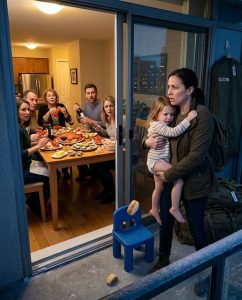
The next thing I saw was my three-year-old daughter shivering alone on a freezing balcony while six adults feasted on food I had paid for.
They thought I would forgive them like I always had.
They had no idea that by the end of the night, every dollar keeping their comfortable lives together would be gone.
My name is Sarah Mitchell, and I had just returned from two weeks of official duty with the United States Army.
My duffel bag was still sitting beside the front door, heavy enough that the strap had left a groove across my shoulder, and my dress uniform was still zipped inside its garment bag.
After two weeks away, I wasn’t thinking about bills, family arguments, or the endless list of things waiting for me at home.
I wanted one thing.
I wanted to hold Emma.
She was three years old, still small enough to wrap both arms around my neck when I picked her up, and I had spent the trip home imagining the exact moment she would hear the door and come running.
Instead, nobody came.
The house was warm, almost too warm after the cold outside, and the smell coming from the dining room was so rich it seemed to coat the air.
I stepped farther inside and saw a table that looked like it belonged in an expensive seafood restaurant rather than our dining room.
There were lobster tails split open on white plates, king crab legs stacked beside bowls of melted butter, oysters on crushed ice, pink shrimp arranged around serving platters, and bottles of imported wine standing among half-empty glasses.
Cracked shells covered the tablecloth.
Butter pooled in little dishes.
Napkins had been tossed beside plates as if everyone had been eating for a while and expected the evening to continue exactly the way it had started.
My mother-in-law, Olivia, sat at the head of the table working meat from a lobster tail while my husband, Daniel, stood beside her refilling her wineglass.
My sister-in-law, Emily, and her boyfriend were taking pictures of the spread for social media, shifting plates around to make the table look even more extravagant.
The other adults were eating and talking as though this were a celebration.
I was still standing in the entryway when Olivia spoke.
“Sarah works hard,” she said. “Someone should enjoy the money she earns.”
The table erupted in laughter.
It was the kind of joke I had heard before, always wrapped in the same excuse that we were family and family shared everything.
Over the years, I had learned how easily generosity could become expectation when the people receiving it never had to feel the cost.
Then Daniel looked toward the doorway.
His face changed the instant he saw me.
The wine bottle tilted in his hand, and for a second I thought he was going to drop it.
“Sarah… you’re home early.”
I didn’t answer him.
I didn’t ask why there were hundreds of dollars’ worth of seafood on the table or why my mother-in-law was making jokes about my paycheck.
There was only one question that mattered.
“Where’s Emma?”
Daniel glanced toward the hallway instead of looking at me.
“I think she’s asleep.”
That answer landed wrong immediately.
Emma never went to sleep that early.
Even after a long day, she fought bedtime like it was a personal challenge, asking for water, another story, one more hug, or permission to bring one stuffed animal after another into bed.
If she had actually been asleep, Daniel would have known.
He wouldn’t have said he thought she was.
I walked past the dining room without another word.
Her bedroom door was open.
The bed was untouched.
Her blanket was still folded the way it had been left, and there was no small shape curled beneath it.
I checked the playroom.
Empty.
No toys moving, no little voice, no cartoons playing in the background.
Then I noticed the balcony door.
I don’t remember deciding to cross the room.
I only remember my hand closing around the handle and the blast of freezing air that hit my face the second I pulled it open.
Emma was sitting outside on a tiny plastic chair.
She wore nothing but a thin sweater over her clothes, and her knees were pulled tightly against her chest as if she had been trying to make herself as small as possible to hold onto her body heat.
Both hands were wrapped around half of a stale bread roll.
For a second, she just stared at me.
Then her lips trembled.
“Mommy,” she whispered. “Can I come inside now?”
Something inside me went absolutely still.
I lifted her so fast that the bread slipped from her hands and fell onto the balcony floor.
Her fingers were cold against my neck.
Not cool from playing outside for a few minutes.
Cold.
Her body felt frighteningly light under that sweater, and when she pressed herself against me, I could feel how hard she was shivering.
I pulled her close and carried her through the open door.
Behind me, the dining room was still full of warm food.
Six adults had been sitting under a heated roof, eating lobster and crab bought with my paycheck, while my three-year-old daughter sat outside with stale bread.
That contrast was so ugly that for several seconds I couldn’t even process it as something people I knew had actually done.
I had trusted these people.
More than that, I had financed their lives because I believed helping them meant helping my daughter.
For three years, I had sent thirty-five thousand dollars home every month.
That money covered the mortgage.
It covered groceries.
It covered Olivia’s expenses and my father-in-law’s medical bills.
It covered Daniel’s credit card debt.
It even covered Emily’s shopping trips whenever somebody decided a purchase could be stretched far enough to qualify as a “family necessity.”
Every transfer had been easy for them to accept because I was the one earning it somewhere else.
I had taken dangerous assignments believing that every sacrifice, every missed night at home, every exhausting stretch away from Emma was buying her stability and safety.
I had told myself the money meant she would never go without what she needed just because I wasn’t physically there to provide it.
Standing in that hallway with her shivering against me, I understood how badly I had misjudged the people I trusted to use it.
I carried Emma into the dining room.
The conversation stopped in pieces as people noticed us.
Daniel looked at Emma first and then at me.
Olivia barely paused before reaching for her napkin.
I didn’t raise my voice.
“What did you do to my daughter?”
Olivia wiped butter from her mouth as though I had interrupted her over something petty.
“Don’t be dramatic,” she said. “Children don’t need lobster.”
I looked at Emma’s pale hands against my shirt, then back at the plates piled with seafood.
The issue had never been whether a three-year-old needed lobster.
The issue was that a room full of adults had chosen comfort for themselves and punishment for a child who depended on them.
Emily laughed.
Actually laughed.
“A little discipline never hurts.”
I turned toward Daniel.
Whatever anger I felt toward everyone else, part of me was still waiting for my husband to break from them.
I wanted him to look at our daughter and finally understand what had happened.
I wanted him to say his mother had crossed a line.
I wanted him to explain that he hadn’t known Emma was outside, even though I already knew how weak that excuse would sound.
Instead, he sighed.
“My mother knows how to raise kids,” he said. “Emma has to learn she can’t always get what she wants.”
Emma buried her face against my shoulder.
That movement told me more than any argument could have.
She wasn’t trying to defend herself.
She wasn’t protesting.
She was hiding.
For one brief moment, every instinct in me wanted to explode.
I wanted to sweep the plates off that table.
I wanted the sound of breaking dishes to be as shocking to them as that balcony had been to me.
I wanted to make every person in that room feel the rage I was holding while my daughter shook in my arms.
But anger wasn’t going to protect Emma five minutes from then, and it wasn’t going to tell me how my money had been used while I was away.
Then my eyes caught something beside the wine bottles.
A grocery receipt.
It was long enough to curl slightly at one end, trapped partly beneath a dish near the bottles.
The last four digits printed on it matched my military salary account.
I stepped closer without putting Emma down.
There were timestamps.
There were itemized charges.
Seafood.
Wine.
Hundreds of dollars spent on a single meal by the same people who had decided my three-year-old daughter should sit outside with stale bread.
The receipt didn’t create the betrayal.
It made the betrayal measurable.
They hadn’t simply been careless with money I had sent home.
They had used my own earnings to create comfort for themselves while excluding the one person I had believed that money was protecting.
That was when years of habit and training took over.
Secure the facts first.
React later.
I took out my phone.
Nobody at the table seemed to understand what I was doing at first.
I photographed the receipt so the timestamps and charges were visible.
Then I photographed the table exactly as it was, with the lobster shells, crab legs, wine bottles, serving dishes, and plates still in front of them.
I photographed the balcony.
I didn’t need to shout while I did it.
The pictures said what mattered.
Daniel watched me, his expression tightening.
Olivia looked irritated, as though documenting the scene were somehow more offensive than what had happened to Emma.
Emily’s phone was no longer pointed at the seafood.
I slipped my phone away and shifted Emma higher against my chest.
Then I walked back to the entryway.
My duffel bag was still where I had left it when I came through the door expecting a welcome home.
I picked it up with one hand while keeping Emma secure with the other.
The bag that had felt like proof I was finally home now felt like something else entirely.
It meant I didn’t need to unpack.
It meant I could leave.
Behind me, somebody pushed back a chair.
I turned toward the dining room.
“You’re right,” I said quietly.
Daniel frowned.
“Right about what?”
I looked at him first.
Then Olivia.
Then Emily and the others sitting around a table funded by the work they had spent years treating as an endless supply.
“Starting tonight, you’re all going to learn exactly what life feels like without my paycheck.”
There was no speech after that.
I didn’t explain every transfer I had made or list every bill I had covered.
They already knew.
They knew who paid the mortgage.
They knew who kept groceries in the house.
They knew who covered Olivia’s expenses, the medical bills, Daniel’s debt, and the purchases Emily called necessities.
The only thing they had never seriously considered was what would happen if I stopped letting access to my money stand in for respect.
I carried Emma downstairs.
She stayed pressed against me, one arm around my neck while I managed the duffel with my free hand.
Every few steps, I could still feel a small shiver move through her.
I didn’t go back to argue.
I didn’t wait for Daniel to follow.
I didn’t give Olivia another chance to explain why a toddler needed to be taught a lesson while adults ate a luxury dinner.
By the time I reached the bottom of the stairs, my phone was in my hand again.
I froze every credit card connected to my accounts.
Then I revoked Daniel’s access.
The decisions were simple because the reason was simple.
The money was mine to earn, but I had treated it for years as a family resource because I believed the people around Emma were acting like family when I wasn’t there.
That trust was gone.
What remained was control over the accounts I had been funding.
Upstairs, the dinner continued for a little while longer.
Olivia, apparently assuming my anger would pass the way she believed it always had, ordered another bottle of wine.
Maybe she thought I would cool down.
Maybe Daniel thought he could call me later and explain that his mother meant well.
Maybe Emily assumed this would become another family argument that ended with me paying the next bill because refusing would make me look selfish.
That had been the pattern for years.
I worked.
They spent.
When something bothered me, they called it family obligation, brushed it aside, or waited until my anger softened under the pressure of keeping everyone comfortable.
But Emma’s question from the balcony had changed the meaning of every excuse they had ever used.
“Can I come inside now?”
A three-year-old should never have needed permission to come in from the cold while the adults responsible for her ate dinner a few feet away.
I looked down at her as I held her close, and the anger in me stopped feeling wild.
It became precise.
I could not undo the time she had spent outside.
I could not make the people upstairs become the family I had believed they were simply because I wanted the story of my marriage to be different.
But I could stop financing the arrangement that had allowed them to confuse access to my money with authority over my child.
The receipt mattered because it showed where my paycheck had gone that night.
The balcony mattered because it showed what that comfort had cost Emma.
Daniel’s response mattered most because, when given the chance to choose between defending his daughter and defending his mother’s behavior, he had already made his choice.
There was nothing left for me to misunderstand.
For years, I had believed sending more money was one way of taking care of Emma when duty kept me away.
That night showed me that money could provide a house, groceries, medical bills, and every material convenience imaginable, but once it passed into the hands of people who did not protect her, the amount meant nothing.
Thirty-five thousand dollars a month had bought an expensive dinner.
It had not bought my daughter kindness.
Upstairs, Olivia’s new bottle of wine was being processed against a card attached to the same financial system she had treated like it would always be available.
For the first time, it wasn’t.
The charge was declined.