
My newborn daughter was crying loudly at midnight when my mother-in-law suddenly lashed out at me during an argument.
I lost my balance, and my baby slipped from my arms.
She suddenly became unresponsive.
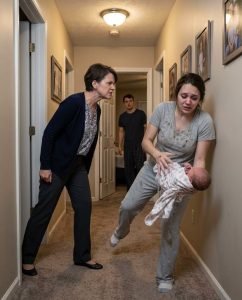
My mother-in-law coldly said, “Shut her up, or get out of the house.”
At the hospital, the doctor told me my daughter was in critical condition.
I immediately called the police.
It happened so quickly that even afterward, when I tried to replay those few seconds in my head, everything seemed to move faster than my mind could follow.
One second, I was standing in the dim hallway of our house in Columbus, Ohio, holding my three-week-old daughter, Lily, against my shoulder while she cried.
It was after midnight, the kind of hour when every sound inside a house seems louder than it really is, and Lily’s cries carried from the hallway toward the bedrooms.
I was exhausted, but exhaustion did not matter to me in that moment because Lily was three weeks old and crying was the only way she could tell me that she needed something.
I shifted her carefully against my shoulder, one hand supporting her small body while I tried to soothe her.
I was focused on Lily when Patricia Miller stepped toward me in anger.
Patricia was my mother-in-law, and whatever frustration had been building inside her suddenly landed directly on me.
“Shut her up, or get out of the house!” she shouted.
For a split second, I simply stared at her.
I could understand being tired.
I could understand being irritated by noise in the middle of the night.
What I could not understand was looking at a mother holding a three-week-old baby and deciding that shouting and moving toward her was going to make anything better.
Lily kept crying against my shoulder as Patricia came closer.
I shifted backward instinctively.
It was not a planned movement, and I was not trying to start another argument with her.
My body simply reacted to someone advancing toward me while I was holding my newborn.
Then my balance went out from under me.
Everything happened in one terrible sequence that I would later wish I could stop frame by frame.
My foot moved back.
My weight shifted.
My arms tightened too late.
Lily slipped from my hold before I could catch her securely.
Then the crying stopped.
The silence was immediate, and it was worse than the crying had ever been.
“Lily!”
I dropped to my knees beside her.
My daughter was frighteningly still, her eyes closed, one tiny hand resting beside her face.
I remember staring at that hand because it looked impossibly small against the floor.
Three weeks earlier, those fingers had curled around mine.
Now I was waiting for any movement at all.
“Lily, baby, please.”
I was afraid to move her carelessly, but I was also terrified of doing nothing.
The argument with Patricia disappeared from my mind almost completely because there was only one thing that mattered anymore.
My daughter was not responding to me.
Daniel came running from the bedroom.
“What happened?”
He looked from me to Lily and then toward his mother, trying to understand a scene that had unfolded in seconds.
“Call 911!” I yelled.
My voice sounded strange to me, too sharp and too loud, but I did not care.
Patricia stood behind me, pale but rigid.
She did not kneel beside Lily.
She did not ask what she could do.
Instead, she spoke with a certainty that made me look up from my daughter.
“She dropped the baby,” Patricia said.
For a moment, I could not believe those were the words she had chosen.
Not an apology.
Not a question about Lily.
A version of the story.
I looked up at her from the floor.
“You came at me!”
Patricia’s expression stayed hard.
“I barely touched you.”
Daniel stared between the two of us.
“Mom?”
There was confusion in his voice, but there was something else too: the awful hesitation of someone trying to decide what had actually happened while the person who needed help most was still lying in front of us.
Patricia answered him immediately.
“She’s exhausted. She doesn’t know what she’s saying.”
That sentence landed differently than the others.
Patricia was no longer simply denying what I said had happened.
She was explaining why nobody should believe me.
I could hear Daniel trying to make sense of both versions, but I was not going to spend another second standing in that hallway arguing over whose account sounded more reasonable.
Lily needed help.
That was the only decision I had to make.
The nearest emergency department was less than ten minutes away.
I carefully lifted Lily, holding her as steadily as I could, and hurried toward my car.
My hands were shaking badly enough that I had to concentrate on every movement.
I remember the ordinary things around me feeling completely wrong because the rest of the world had not changed just because mine had.
The house was still the same house.
The driveway was still there.
My car was where I had left it.
But I was carrying my silent newborn instead of the crying baby I had been rocking only moments before.
I called 911 on speaker as I drove.
The dispatcher asked questions in a controlled voice, and I answered as clearly as I could.
My daughter was three weeks old.
She had fallen.
She was not responding normally.
I was driving toward the emergency department.
The dispatcher told me help could meet me, but I was already close to Riverside Methodist Hospital.
I kept talking because answering those questions gave me something concrete to do while fear threatened to take over everything else.
I watched the road, checked Lily whenever I safely could, and listened desperately for any sound from her.
A cry would have terrified me five minutes earlier.
Now I would have given anything to hear one.
The distance to the hospital was short, but it felt stretched beyond reason.
Every stop, every turn, every second behind the wheel seemed to take too long.
I kept thinking about the exact instant Lily had slipped from my arms.
I kept hearing Patricia’s voice before it happened.
Then I would force my attention back to the road because getting Lily to help was more important than replaying blame.
When I arrived, the medical team took her from me immediately.
There was no long conversation at the entrance and no time for me to explain the family argument in detail.
The urgency on their faces told me enough.
They moved Lily away from me, and suddenly I had nothing in my arms.
That emptiness was almost physical.
For three weeks, I had become used to adjusting everything around the fact that I was holding, feeding, changing, or checking on a newborn.
Now my arms were empty while strangers rushed to do for Lily what I could not.
I stood in the hospital hallway shaking.
I was still wearing pajama pants and a shirt stained with formula.
Until then, I had not even noticed what I was wearing.
My hands kept curling automatically as if they were supposed to be supporting Lily’s head or pulling her closer to my chest.
Each time I realized she was not there, panic rose again.
She was already behind the emergency-room doors.
I could not see what the team was doing.
I could not tell whether she was improving.
I could not fix anything by standing there.
So I waited.
Waiting turned out to be its own kind of terror.
When Lily had been crying at home, I had been able to act.
I could rock her, check her diaper, feed her, walk with her, whisper to her, and keep trying until something helped.
In the hallway, there was nothing useful for me to do except answer questions and stay available.
My mind kept returning to Patricia.
“She dropped the baby.”
The speed with which she had said it bothered me almost as much as the accusation itself.
There had been no hesitation in her voice.
She had watched me fall backward while holding Lily, yet somehow the first version she gave Daniel reduced the entire moment to four words that placed everything on me.
Then she had gone one step further.
“She’s exhausted. She doesn’t know what she’s saying.”
I was exhausted.
That part was true.
I was the mother of a three-week-old baby standing in a hospital after midnight in formula-stained clothes.
But being tired did not erase my memory of someone stepping toward me during an argument.
It did not erase Patricia’s shout.
It did not change what had happened immediately afterward.
I did not need to decide in that hallway what consequences Patricia should face.
I needed the truth of that night to be recorded accurately, especially now that Lily’s condition was serious enough for doctors to be working behind closed doors.
About twenty minutes later, a physician named Dr. Aaron Blake walked toward me.
Twenty minutes does not sound long until you are waiting for someone to tell you whether your newborn is all right.
I had spent those minutes studying every person who came through the doors, trying to tell from their pace or expression whether they were coming toward me.
When Dr. Blake finally did, the look on his face made my stomach drop before he said a word.
“Mrs. Miller?”
I stood so quickly that my knees nearly gave way.
“Yes.”
He stopped in front of me.
“Your daughter is in critical condition.”
For a second, the sentence did not seem to belong to my life.
I understood every word separately.
Your daughter.
Critical condition.
But together they felt impossible.
Only a short time earlier, Lily had been crying loudly enough for Patricia to complain about it.
Now a doctor was telling me that the same baby was critically ill.
“What happened?” I asked.
My voice came out quieter than I expected.
“She was unresponsive when you arrived,” Dr. Blake said carefully. “Our team is working on her now.”
My knees weakened.
A nurse standing nearby reached out and steadied my arm.
I barely noticed the contact because all I could think about was Lily behind those doors.
“Can I see her?” I asked.
I wanted to get to my daughter, but I also understood from the doctor’s expression that the medical team was still dealing with an emergency.
Dr. Blake stayed in front of me, calm but serious.
“There are signs of a serious injury,” he said. “We need to know exactly what happened tonight.”
Exactly what happened.
Those words cut through the panic because I knew there were now two urgent truths in front of me.
The first was medical: Lily was critically ill.
The second was factual: the people caring for her needed an accurate account of how she had ended up there.
I opened my mouth to answer.
I was going to tell him about Lily crying in the hallway.
I was going to tell him about Patricia becoming angry.
I was going to repeat her exact words: “Shut her up, or get out of the house.”
I was going to tell him that Patricia stepped toward me, that I moved backward instinctively, that I lost my balance, and that Lily slipped from my arms before I could recover.
I was not going to let exhaustion become an excuse for rewriting the sequence.
Then movement farther down the corridor caught my attention.
Daniel and Patricia were coming toward us.
Daniel looked tense and worried, his attention moving immediately toward me and the doctor.
Patricia saw Dr. Blake standing beside me and quickened her pace.
The sight of her brought the hallway back into sharp focus.
At home, she had told Daniel that I had simply dropped the baby.
Then she had said I was too exhausted to know what I was saying.
Now she was walking toward the physician who had just told me Lily was in critical condition.
I did not know what Daniel believed yet.
I did not know what Patricia planned to say.
But I knew what I had seen, what I had heard, and what had happened immediately after she stepped toward me.
Dr. Blake was still waiting for my explanation.
My phone was in my hand.
After hearing that Lily was in critical condition and being asked for the exact sequence of events, I knew this could no longer be treated as nothing more than a private family argument.
I called the police.
Whatever happened next, I wanted the events of that night documented instead of reduced to whichever version Patricia repeated most confidently.
Patricia reached us before I could say everything I needed to say to the doctor.
She looked at me, then at Dr. Blake, and for the first time since I had arrived, I felt the argument from our hallway enter the hospital with us.
The difference was that we were no longer arguing beside a crying newborn in the middle of the night.
Lily was now behind emergency-room doors in critical condition.
Every word mattered.
Patricia rushed forward.
“Emily,” she said, “tell them it was an accident.”