My mother-in-law shaved my 8-year-old daughter bald and blocked the door so I couldn’t leave.
My husband called it “discipline.”
I didn’t argue with either of them.
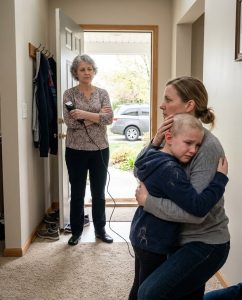
I took my daughter to a doctor, saved every message I could find, and then called a lawyer.
When I picked Meadow up that Tuesday afternoon, I expected the usual things.
A sticky face from whatever Judith had given her after school. Too much candy tucked into her pockets. Maybe another pointed comment about how Meadow needed more structure, more rules, or less time being “babied” by me.
Judith had opinions about nearly everything I did as a mother, and she rarely kept them to herself.
I had learned to tolerate the criticism because Meadow loved seeing her grandmother, and because every disagreement with Judith eventually became a disagreement with my husband, Dustin.
That afternoon was different before Judith even said a word.
The house was too still when I walked in.
I called Meadow’s name from the hallway and heard nothing.
Then I reached the guest room.
My daughter was sitting on the floor with her knees pulled tightly against her chest.
At first, my mind refused to make sense of what I was seeing.
Golden hair covered the carpet around her.
It clung to Meadow’s shirt. It wrapped around her bare feet. Long strands lay across the room in loose piles, the same hair she had been proudly growing since preschool.
For years, trimming the ends had been a negotiation because Meadow loved her hair long.
She liked braids. She liked ponytails. She liked asking me to try styles she had seen other girls wearing.
Now almost all of it was gone.
Uneven stubble covered her scalp.
Near one ear, the skin was bright red where the clippers had caught her.
Judith was still holding them.
That was the detail that made everything real.
The clippers were not sitting on a counter somewhere. They had not been put away after some misunderstanding I had arrived too late to stop.
They were still in Judith’s hand.
Meadow looked up at me.
Her mouth moved as though she wanted to explain, apologize, or call for me, but no sound came out.
Then she pressed both hands against her bare head and started shaking.
Judith stood behind me with the calm satisfaction of someone who believed she had corrected a problem.
“She was getting vain,” she said. “Girls who stare in mirrors need humility.”
I barely heard the rest.
I dropped to my knees and moved across the floor toward Meadow.
Her cut hair stuck to my palms as I reached for her.
When I pulled her into my chest, she shook so violently that I could hear her teeth clicking together.
I held the back of her head carefully because I didn’t yet know how badly the clippers had scraped her skin.
Judith continued talking over us.
She explained herself as if she were describing a reasonable consequence for a child who had refused to clean her room.
Then she told me she had called Dustin at work before doing it.
According to Judith, she had told him Meadow was becoming too focused on her appearance.
Dustin had told his mother to do whatever she thought was best.
I still wanted to believe there had been some misunderstanding.
Maybe Judith was exaggerating Dustin’s approval. Maybe he had thought she meant taking away a mirror, grounding Meadow, or imposing some ordinary consequence.
Then Meadow finally spoke.
Her voice was barely above a whisper.
“Daddy said Grandma knows best.”
I felt something inside me go completely still.
That sentence did more than confirm what Judith had said.
It told me Meadow knew her father had approved what happened to her.
She had sat on that floor while her grandmother removed her hair believing her own dad had agreed she deserved it.
I lifted Meadow into my arms.
She wrapped herself around me immediately, face buried against my shoulder.
I carried her toward the front door.
Judith followed us down the hallway.
She said I was overreacting.
She said I was teaching Meadow to be dramatic.
She said hair grew back.
When I reached the doorway, Judith stepped in front of it.
She crossed her arms and blocked our path.
“You are not taking her anywhere while you’re acting like this.”
Meadow tightened her arms around my neck.
Her tears soaked through my shirt.
“Move,” I said.
Judith gave me a small, dismissive smile.
The clippers were still hanging from her hand.
“Hair grows back.”
I looked at her.
“Move.”
I didn’t yell.
I didn’t threaten her.
I didn’t tell her what I thought of a grown woman who could shave a frightened 8-year-old child’s head and then stand in front of the door as if the child belonged to her.
I only repeated that one word.
Something in my voice finally reached her.
Judith stepped aside.
I carried Meadow outside, down the driveway, and into the car.
Once the doors were shut, I expected Meadow to start crying harder.
Instead, she became quiet.
That frightened me more.
My daughter barely spoke for the next two days.
Even though it was May, she slept wearing a winter hat.
The first morning, I told her she could take it off inside if she wanted.
She immediately grabbed the edge and pulled it lower.
So I stopped asking.
At breakfast, I made strawberry pancakes because they were her favorite.
Usually she would have eaten the strawberries first and asked for extra syrup.
That morning she pushed the plate away after a few bites.
She kept one hand near the side of her head as though checking that the hat was still there.
At the kitchen table, she began drawing.
Again and again, the picture was almost the same.
A small girl with no hair.
A much larger woman beside her.
The girl was crying.
The woman’s arms were enormous.
I kept every drawing.
I also made an appointment with Meadow’s pediatrician.
I had spent the first day after the incident moving between anger and disbelief, but by the time we reached the doctor’s office, I knew I needed someone other than me to look at what had happened.
The pediatrician examined Meadow slowly and carefully.
She looked at the redness around her scalp and the small cuts near the area where the clippers had caught her.
She documented what she saw.
She photographed the visible injuries.
Just as important, she paid attention to Meadow.
She noticed how reluctant Meadow was to remove the hat.
She noticed the way Meadow became tense when the haircut was discussed.
She noticed how little she was speaking.
Then the doctor used words I had been unable to say aloud since walking into Judith’s guest room.
Abuse.
Trauma response.
Mandatory report.
Hearing those words did not make me feel triumphant.
It made my stomach turn.
Because once someone else said them, I could no longer tell myself this was an ugly family disagreement that Dustin and I might somehow discuss after everyone calmed down.
My daughter had been harmed by someone she was supposed to trust.
And her father had apparently approved it.
That afternoon, I called my sister, Francine.
Francine worked for a family law firm.
I told her everything in order because I was afraid that if I let myself become emotional, I would skip something important.
I told her about Judith holding the clippers.
I told her what Meadow’s scalp looked like.
I told her about the doorway.
I told her Judith said Dustin had approved the punishment.
I repeated Meadow’s words exactly.
“Daddy said Grandma knows best.”
I told Francine about the winter hat, the pancakes, the silence, and the drawings.
Francine did not tell me to calm down.
She did not suggest that I wait until Dustin got home so the three adults could talk it over.
She told me to photograph every visible mark.
Save the medical notes.
Preserve every message.
Keep the drawings.
Pack what Meadow needed most.
Then Francine asked me a question that turned the situation from something happening around me into a choice I had to make.
“What are you willing to lose?”
I looked across the room.
Meadow was sitting with a soft pink hat pulled low over her ears.
Her purple stuffed elephant was pressed against her chest.
She was gripping it so tightly that the fabric folded beneath her fingers.
I knew the answer immediately.
Everything except my child.
By the time Dustin came home, Meadow and I were gone.
His first calls were angry.
He wanted to know where I had taken her.
He wanted to know why I had left without speaking to him.
Then his tone shifted.
He became offended that I was treating the situation as something serious.
After that, he became increasingly concerned about what other people might think.
What struck me was what he did not ask.
He never asked whether the cuts on Meadow’s scalp hurt.
He never asked whether she had been crying.
He never asked why she had barely spoken since it happened.
He never asked why his 8-year-old daughter was sleeping in a winter hat in May.
Instead, he kept defending Judith.
“Mom was trying to help.”
That sentence appeared again and again.
When I mentioned Meadow’s fear, he said his mother had meant well.
When I mentioned the doctor, he said I was escalating a family issue.
When I mentioned that Judith physically blocked the door while I was holding Meadow, he accused me of making the moment sound worse than it was.
“Mom was trying to help.”
Each time he said it, I understood something a little more clearly.
Dustin was not confused about what his mother had done.
He knew.
His priority was explaining it away.
I stopped trying to convince him.
Instead, I saved the messages.
The difference between arguing and documenting changed everything for me.
Before, I had been responding to Dustin as his wife, still hoping there was some combination of words that would make him understand what Meadow needed.
Now I was reading his messages as a record of what he believed had happened and what he was willing to defend.
I did not need him to agree with my interpretation before I protected her.
By Friday morning, Meadow and I were sitting in a family court hearing.
I had a folder on my lap.
Inside were photographs of Meadow’s scalp.
The doctor’s notes were there too, along with copies of Dustin’s messages and our request for temporary protection while the situation was reviewed.
Meadow sat beside me wearing her pink hat.
Under the table, she held the purple elephant against her stomach.
She kept rubbing one ear between two fingers, a nervous habit I had started noticing since Tuesday.
I wanted to tell her everything would be fine.
I couldn’t promise that.
So I kept my hand close enough that she could reach it whenever she wanted.
Then Dustin walked in.
Judith was with him.
I watched them enter together, and even after everything that had happened, some small part of me still expected Dustin to look at Meadow first.
There were open seats near his daughter.
There was room beside his attorney.
There was an empty chair between the two sides.
Dustin walked past all of them.
He sat beside his mother.
Then he placed one hand on Judith’s shoulder.
The gesture lasted only a moment, but I saw Meadow notice it.
So did I.
Judith had shaved Meadow’s head.
Judith had stood behind me holding the clippers while my daughter shook on the floor.
Judith had blocked the doorway when I tried to leave.
Yet Dustin touched his mother as though she were the person entering that room in need of reassurance.
I looked down at Meadow.
Her fingers tightened around the purple elephant.
That was when I stopped wondering whether Dustin might finally see what I had been trying to tell him.
He had already chosen where to sit.
The hearing began.
The judge opened our file.
She reviewed the first photograph.
Then the second.
Her expression remained controlled.
I watched her eyes move across the pages while the room stayed quiet around us.
When she reached the photograph showing the red marks near Meadow’s ear, she stopped turning pages.
For several seconds, she studied the image.
Then she lifted it slightly.
She looked past me and directly toward Dustin.
Dustin shifted in his chair.
Judith sat beside him.
His hand was no longer on her shoulder, but he had not moved away from her either.
The judge looked once more at the photograph.
Then she asked my husband one question.
And the entire room went silent.