
The text from Mark’s father made the room feel smaller: Mark had apparently been expected to keep me quiet while his father finished whatever he had planned.
I read it twice because the first time my mind refused to put the words together.
Lucy was still holding my hand beneath the hospital blanket, her fingers curled tightly around two of mine while the redness across her feet slowly faded from furious red to a darker, uneven pink.
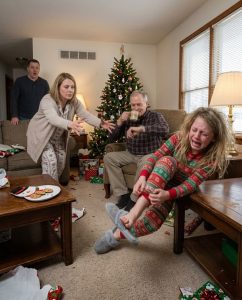
Mark stood on the other side of the bed.
He did not ask to see the message again.
He already knew what it meant.
I turned the screen toward him anyway.
“What was he supposed to handle?”
Mark rubbed his thumb over the blue smear left by the visitor sticker.
“I don’t know.”
Lucy looked at him.
He corrected himself almost immediately.
“I mean, I don’t know exactly.”
Exactly.
One word changed everything.
I asked him what he did know.
Mark glanced toward the hospital room door, as if he still believed privacy was the problem we needed to solve.
Then he told me his father had been talking for months about my parenting.
Not because Lucy was neglected.
Not because she was unsafe with me.
Because I had stopped allowing his father to overrule me.
It had started with little things that were easy to dismiss when they happened one at a time.
My father-in-law would tell Lucy she could stay up after I had said bedtime.
He would offer her money after I said no to something.
He would ask questions about arguments between Mark and me, then act offended when I told him those conversations were private.
Whenever I objected, he called me controlling.
Whenever Lucy defended me, he called her confused.
I had thought those comments were about power inside the family.
Mark now admitted his father had been treating them like material for a case.
“What kind of case?” I asked.
Mark stared at the floor.
His father believed that if he could collect enough examples of me becoming angry, raising my voice, or refusing him access to Lucy, he could portray me as unstable and convince Mark to seek emergency custody.
The word we from the draft email suddenly had a shape.
I looked at my husband.
“You knew about the custody plan.”
Mark’s answer took too long.
“I knew he wanted me to talk to an attorney.”
Lucy stopped squeezing my hand.
That hurt more than anything Mark had said to me.
She was eleven years old, lying in a hospital bed after being injured by a Christmas gift, and she had just learned that two adults she trusted had been discussing whether her mother should be removed from her life.
Mark moved closer to her.
“Luce, this wasn’t supposed to involve you like this.”
She pulled her hand beneath the blanket.
“But it did involve me.”
He had no answer.
I asked when his father first mentioned an attorney.
Mark said it had been late fall, after a family dinner when his father and I argued because he had privately promised Lucy she could attend an overnight gathering after I had already said no.
I remembered that night clearly.
His father had smiled while I tried to explain that asking a child to choose between a parent and a grandparent was unfair.
Then he had leaned toward Mark and said, “See how quickly she gets worked up?”
At the time, I had thought it was another cheap insult.
Now I wondered whether someone had been recording.
I called Jenna again.
She was still inside the guest room at their father’s house with his phone and Grandma’s old tablet.
I told her not to search randomly through anything else.
We already had enough to know something serious had happened, and I did not want anyone later claiming we had altered, deleted, or rearranged what was there.
Jenna agreed.
Then she said something that made Mark sit down.
She had opened only the folder already visible on the phone and the email draft she had shown us.
Beside the draft was a list of dates.
Christmas morning was the final date.
Mark whispered, “No.”
Jenna heard him through the speaker.
“You knew there was a timeline?”
“Not that kind.”
I asked him what kind he had expected.
Mark admitted his father had told him they needed several examples close together so an attorney would take the situation seriously.
His father had said they needed to document me being hostile, irrational, or unwilling to cooperate with family.
Mark claimed he thought that meant saving texts and recording arguments.
He insisted he had never agreed to hurt Lucy.
I believed that part.
I also realized it did not erase the rest.
He had agreed to let his father manufacture pressure around me and then preserve my reaction as evidence.
He had agreed that provoking me was acceptable if the recording started at the right moment.
And on Christmas morning, when Lucy screamed after stepping into those slippers, Mark’s first reflex had been to explain away her words.
She said her grandfather had asked whether they were burning yet.
Mark said she must have misunderstood.
That was not confusion.
That was a choice.
A nurse entered to check Lucy’s feet and asked Mark to move his chair so she could reach the bed.
The evidence bags were still visible on the counter.
The gray slippers were sealed separately from the box and the red tag.
For Lucy.
Be brave.
Grandpa.
The handwriting seemed different now.
Not warmer.
Not sentimental.
Instructional.
The nurse asked Lucy to describe what she had felt when she first put them on.
Lucy answered carefully.
She said nothing happened immediately.
Then she felt a prickling sensation underneath her toes.
Then heat.
Then burning.
The nurse asked whether she had worn socks.
Lucy said no.
She asked whether she had put anything on her feet that morning.
Again, no.
Mark listened without interrupting.
When the nurse left, Lucy asked him a question.
“Did Grandpa tell you the slippers were a test?”
Mark looked startled.
“No.”
This time his answer came immediately.
Lucy studied him for several seconds.
“Did he tell you I was part of the evidence?”
Mark’s face tightened.
“No.”
“Did you know Mom was?”
He closed his eyes.
That was enough.
Lucy turned back toward me.
I did not tell her everything was going to be fine.
I could not promise that.
Instead, I asked if she wanted water.
She nodded.
I poured some into the paper cup beside the sink and held the straw while she drank.
Ordinary things mattered more than speeches right then.
When she finished, Mark said my name quietly.
I looked at him.
He told me his father had been convinced I was separating Lucy from the family.
I reminded him that his father had unrestricted holiday visits until he began undermining basic rules and telling Lucy to keep secrets from me.
Mark nodded.
“I know.”
“Did you tell him that?”
He hesitated.
“Sometimes.”
Sometimes.
That meant there had been other times when silence was easier.
I asked whether he had ever given his father anything for the proposed custody case.
Mark admitted he had forwarded several screenshots from arguments between us.
Nothing about Lucy being endangered.
Nothing about neglect.
Just marital arguments taken from days when we were both tired, angry, or worried about money.
His father had apparently treated those messages like building blocks.
I asked whether Mark knew about the older videos labeled Incident One and Incident Two.
He said no.
I asked whether he knew his father had been deliberately provoking me before recording.
Mark said he had suspected it once.
“Once?”
He stared at the blanket.
After one of the arguments, his father had called him and laughed about how easy it was to make me “show my temper.”
Mark had told himself his father was exaggerating.
He had told himself a lot of things.
That was how we had reached Christmas morning.
Not through one enormous betrayal.
Through dozens of smaller permissions.
Jenna called again.
Her voice sounded different now, flatter and more careful.
Their father had begun calling the house phone from another number after Mark stopped answering him.
She had not picked up.
She had moved the phone and tablet into plain view on the dresser and was waiting for instructions about what to do with them.
I told her to photograph where they were, leave them untouched, and not confront him.
She asked whether Lucy was okay.
Lucy heard her and answered for herself.
“I’m here.”
Jenna started crying.
Lucy did not.
“Aunt Jenna?”
“Yeah, honey?”
“Please don’t give Grandpa the phone.”
Jenna inhaled shakily.
“I won’t.”
That was the first promise anyone made that morning that sounded useful.
Hospital staff had already documented our concerns, and the sealed items were being preserved rather than handed back to the person who had brought them into the house.
I gave the nurse the photographs Jenna had sent and showed her the message on Mark’s phone.
I did not explain motives I could not prove.
I did not call my father-in-law a monster.
I gave them times, objects, messages, and Lucy’s words.
9:43 for the paramedics.
The green box.
The red tag.
The slippers.
The camera placement beside the sugar bowl.
The recording that began before Lucy was told to wear them.
The message calling the gift a secret test.
The draft titled Emergency Custody Petition.
And finally the text sent directly to Mark.
Facts were enough.
Mark asked if he could speak to me in the hallway.
I told him anything involving Lucy could be said where Lucy could hear it unless she asked us to leave.
He looked at her.
“Do you want me to go?”
Lucy thought about it.
“I want Mom to stay.”
Mark swallowed.
“I know.”
“I didn’t say what I wanted you to do.”
He nodded once.
She looked down at the blanket and said she wanted him to tell the truth.
So he did more of it.
His father had pushed the custody idea harder after I told him he was no longer allowed to message Lucy privately.
Mark had argued that removing me was unrealistic.
His father said the point was not necessarily to win immediately.
The point was to create enough fear that I would stop challenging him.
That sentence settled something inside me.
For months I had been treating each conflict as its own problem.
A secret message here.
A deliberately broken rule there.
A private insult followed by a calm public smile.
But his father had not been trying to win individual arguments.
He had been building a system where every response I made could be used against me.
If I stayed calm, he pushed harder.
If I objected, he called me unstable.
If I limited contact, he called it alienation.
If I allowed contact, he used the access to create another conflict.
There was no correct response because the trap depended on me continuing to play.
So I stopped.
I told Mark that his father would not be coming near Lucy while the hospital was documenting what happened.
Mark started to say we needed to discuss that together.
I interrupted him.
“We can discuss our marriage. We can discuss where you stay tonight. We can discuss every screenshot you sent him. But Lucy’s safety is not a compromise item.”
He looked toward his daughter.
She did not rescue him from the moment.
He finally said, “Okay.”
It was not forgiveness.
It was simply the first correct decision he had made since she screamed.
A little later, Lucy asked for her backpack.
It was still at her grandfather’s house with the rest of the Christmas things.
I told her we would get what she needed another way.
She frowned.
“My sketchbook is in it.”
Mark offered to retrieve it.
Lucy immediately said no.
Then she surprised both of us.
“Aunt Jenna can bring it if she wants.”
The distinction was clear.
Lucy was already deciding whom she trusted based on what they had done, not what title they held in the family.
Mark lowered his head.
I did not soften that lesson for him.
His phone buzzed again.
His father.
Mark looked at the screen but did not open the message.
Then he held the phone out to me.
“You should keep this.”
I did not take it.
“No. You should preserve it. And when someone asks you what happened, you should tell them without making me drag every sentence out of you.”
His hand remained suspended between us for a moment.
Then he pulled it back.
He took screenshots of the message thread and saved them without deleting anything.
For the first time all morning, he looked less like a son trying to manage his father’s anger and more like a man beginning to understand what his own silence had cost.
That did not repair anything between us.
But it mattered.
Lucy was discharged later with instructions for continued observation and follow-up care.
The gray slippers did not come home with us.
Neither did the green box or the red tag.
They remained sealed with the other preserved items connected to what happened that morning.
Mark carried Lucy’s coat while I helped her into the shoes the hospital had arranged so nothing rough pressed against the irritated skin.
She walked carefully.
Each step was slower than normal.
At the exit, Mark reached for her elbow.
Lucy moved closer to me instead.
He let his hand fall.
Outside, the winter air was sharp enough to make my eyes water.
Mark asked where we were going.
I told him Lucy and I were going home.
He asked whether he was coming with us.
I said not that day.
He looked hurt, but he did not argue.
Some consequences do not need a speech.
He had spent months telling himself he could stand between two sides of a family conflict without choosing one.
Christmas morning had proved otherwise.
Every time he minimized his father’s behavior, he chose.
Every time he treated my boundaries as the bigger problem, he chose.
Every time Lucy spoke and he translated her words into something easier for his father to hear, he chose.
Now Lucy was choosing too.
On the drive home, she kept both feet slightly raised on a folded blanket.
For several minutes she watched the houses pass without speaking.
Then she asked if she had done something wrong by putting on the slippers.
I pulled into our driveway before answering.
I wanted to look at her when I said it.
“No.”
She nodded, but I could tell she needed more than that.
So I reminded her of our rule.
She never had to wear, touch, accept, hug, kiss, eat, or keep a secret simply because an adult wanted her to.
“But I did it anyway,” she said.
“Because people you trusted pressured you. That doesn’t make the pressure okay.”
She looked down at the blanket.
“Dad laughed.”
I remembered it too.
Come on, Luce. He’s been waiting all morning.
Such a small sentence.
Such an ordinary family moment.
And that was what made it frightening.
Nothing about the room had looked dangerous.
There had been cinnamon in the air, cookies on a paper snowman plate, wrapping paper under everyone’s feet, and coffee cooling in mugs.
The danger had arrived wrapped like affection.
Lucy leaned her head against the seat.
“I don’t want Grandpa to call me brave anymore.”
I understood.
On the red tag, bravery had meant obeying him.
It had meant ignoring hesitation.
It had meant proving something to an adult who had already decided what her discomfort was worth.
I reached over and squeezed her hand.
“Then he doesn’t get to decide what brave means.”
She squeezed back.
Inside the house, there were no presents waiting beneath a tree and no audience measuring her reaction.
There was only the couch, a folded blanket, a glass of water, and her feet resting safely on a clean towel.
My phone buzzed once with a message from Jenna.
She had Lucy’s backpack.
She had the sketchbook too.
Nothing else in the message needed explaining.
Lucy saw the screen and smiled for the first time since that morning.
Not because the family was fixed.
It wasn’t.
Not because Mark and I had suddenly solved what his choices meant for our marriage.
We hadn’t.
And not because the evidence guaranteed some perfect outcome.
It didn’t.
She smiled because one adult had listened when she said no.
That was enough for that day.
I set the phone facedown and pulled the blanket higher over her legs.
The last Christmas gift my father-in-law had chosen for Lucy was sitting somewhere inside a sealed evidence bag.
But the rule he had tried to break was still ours.
This time, nobody was going to talk her out of it.