
The first truck arrived three days after Hannah Mercer buried her father.
The first truck arrived three days after Hannah Mercer buried her father.
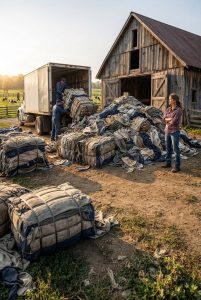
It backed across the muddy lane without permission, lifted its bed beside her red barn, and dumped nearly two tons of cotton scraps where her father’s old tractor used to sit.
When Hannah called the mill, a man laughed and told her the same thing everyone in Bellweather, Georgia, had been telling the Mercers for years.
“Your family ought to be grateful we’re giving you something useful.”
Then he hung up.
Hannah stood beside the mountain of torn canvas, denim offcuts, faded ticking stripe, damaged duck cloth, and tangled cotton webbing while November rain gathered on the shoulders of her father’s brown work jacket.
She did not scream.
She did not call back.
She did not drive into town demanding justice.
She simply picked up one rectangular piece of blue canvas from the mud, rubbed it between her fingers, and noticed something the man at Holloway Cotton Works apparently had not.
The cloth was beautiful.
Not perfect.
But beautiful.
And Hannah Mercer had spent most of her thirty-six years learning the difference between something ruined and something merely discarded.
Her father had taught her that.
So had poverty.
So had grief.
So had every person in Bellweather who had looked at the Mercer farm and seen failure where Hannah still saw land.
The old place sat six miles outside town, forty-seven acres of rolling Georgia pasture, pecan trees, red clay, and fences repaired so many times they looked stitched together.
The house leaned slightly east.
The barn roof leaked over the north stall.
The tractor worked when it felt respected.
The checking account contained $1,842.
The mortgage payment was due in seventeen days.
And the cotton mill had just dumped enough fabric beside her barn to bury a pickup truck.
Hannah reached down and lifted another piece.
Then another.
A broad section of cream canvas.
A strip of rust-colored duck cloth.
A length of heavy black webbing.
A torn panel printed with tiny blue flowers.
She carried them inside.
That evening, while wind pushed rain against the kitchen windows, Hannah unfolded her mother’s old Singer sewing machine from the cabinet in the spare room.
She had not used it since she was seventeen.
Her mother, June Mercer, had taught her to sew grocery sacks, quilts, aprons, curtains, and school costumes.
June had possessed the strange ability to make ordinary cloth seem important.
“Fabric remembers hands,” she used to tell Hannah.
As a child, Hannah thought that was nonsense.
At thirty-six, sitting alone in a nearly empty farmhouse with her father buried beneath a new stone on Mercer Hill and unpaid bills spread across the kitchen table, she understood.
Her hands remembered.
The machine remembered.
And somehow the scraps seemed to remember too.
Hannah made one bag that night.
Nothing fancy.
A rectangular market tote.
Cream canvas body.
Blue reinforced bottom.
Black handles.
Three interior pockets because her father hated losing his reading glasses.
She finished at 2:13 in the morning.
The seams were crooked.
One handle was a quarter inch longer than the other.
The lining had a crease she could not press out.
But when Hannah set the bag upright on the kitchen table, it stood there with a kind of stubborn dignity.
She stared at it for a long time.
Then she laughed.
It was the first sound resembling happiness that had come out of her since the funeral.
The next morning, Hannah carried the tote into town.
She needed coffee, feed, and thirty dollars’ worth of groceries she planned to stretch into ten days.
Bellweather had one main street, one courthouse, two churches large enough to influence elections, a pharmacy with a soda counter, a diner named Ruby’s, and Holloway Cotton Works sitting beyond the railroad tracks like a brick kingdom.
The mill employed almost four hundred people.
Which meant it employed somebody from nearly every family in town.
Which meant criticizing Holloway Cotton Works was considered roughly equivalent to criticizing oxygen.
Hannah walked into Ruby’s carrying the bag.
Ruby Callahan, who had known Hannah since kindergarten, noticed it immediately.
“Where’d you buy that?”
“I made it.”
Ruby stopped pouring coffee.
“You made that?”
“Last night.”
“Turn around.”
Hannah did.
Ruby came from behind the counter, inspected the stitching, touched the canvas, opened the pockets, and looked at Hannah differently.
Not with pity.
People had been looking at Hannah with pity for months.
This was something else.
Interest.
“How much?”
Hannah blinked.
“For what?”
“The bag.”
“It’s not for sale.”
“Everything’s for sale if somebody needs mortgage money badly enough.”
Hannah stared at her.
Ruby raised one eyebrow.
Bellweather was small.
Privacy was theoretical.
Hannah looked at the bag.
“How much would you pay?”
Ruby examined it again.
“Thirty-five.”
Hannah nearly laughed.
The fabric had cost nothing.
The thread had been in her mother’s sewing box.
The buckle on the inside key strap had come off an old horse halter.
“Thirty-five dollars?”
Ruby pulled two twenties from the register.
“I’ll give you forty if you leave before I change my mind.”
Hannah sold her the bag.
That should have been the end of it.
Instead, three days later, a teacher from Bellweather Elementary stopped Hannah outside the feed store.
“You’re the lady who made Ruby’s tote.”
Hannah hesitated.
“I suppose.”
“Can you make one with longer handles?”
“Yes.”
“Pockets?”
“Yes.”
“Something I can carry papers in without the bottom folding?”
“Yes.”
“How much?”
Hannah thought of Ruby’s forty dollars.
“Forty-five.”
The teacher nodded.
“Make two.”
That night Hannah made two bags.
By Sunday she had orders for seven.
By Thanksgiving she had made twenty-three.
By Christmas she had made sixty-one.
And every Thursday morning, as if the universe had developed a cruel sense of humor, another Holloway truck came down Mercer Lane.
Sometimes it dumped five hundred pounds.
Sometimes a ton.
Sometimes more.
The mill sent stained canvas.
Misdyed cotton.
Odd-shaped remnants.
Rejected straps.
End rolls.
Sample fabric.
Damaged upholstery cloth.
Even heavy woven material used in work aprons and industrial covers.
Hannah called again after the fourth delivery.
This time she reached Clyde Brennan, the mill’s operations manager.
“I need the dumping stopped.”
“Your daddy allowed it.”
“My father is gone.”
There was a pause.
“Sorry for your loss.”
His voice contained no sorrow.
“I’m asking you to stop.”
“Disposal arrangement’s been in place a long time.”
“I never agreed to it.”
“Well, Mrs. Mercer, we’ve got paperwork.”
“Send me a copy.”
Another pause.
Then Clyde chuckled softly.
“You planning to sue the largest employer in the county over cotton scraps?”
“I asked for paperwork.”
“You people always were difficult.”
Hannah’s grip tightened around the kitchen phone.
“You people?”
“The Mercers.”
“My father worked at Holloway for twenty-eight years.”
“And spent half of those years complaining.”
“He lost three fingers in your carding room.”
“Ancient history.”
Hannah became very still.
Her father had never spoken much about the accident.
Only that a machine guard had been removed to speed production.
Only that supervisors knew.
Only that Holloway’s lawyers made certain nothing meaningful happened afterward.
Hannah lowered her voice.
“Send the paperwork.”
Clyde stopped sounding amused.
“We’ll look into it.”
Nothing arrived.
The trucks kept coming.
Hannah kept sewing.
She worked at the county library three days a week for health insurance and spent every evening in the barn, where she cleared one horse stall and built a cutting table from her father’s old workbench.
Her daughter, thirteen-year-old Lucy, sat nearby doing homework.
Lucy had inherited June Mercer’s hands.
Quick hands.
Patient hands.
Hands that noticed small things.
One January evening she held up a rust-red strip of canvas.
“Mom, this looks better on the bottom than the blue.”
“You think?”
“Blue shows dirt.”
“That’s practical.”
Lucy shrugged.
“People with kids like practical.”
Hannah smiled.
“Since when are you an expert on customers?”
“Since Mrs. Talbot bought four bags and told everybody at school.”
They called the first design the Mercer Market Bag.
Then came the Farmstand Tote.
The Railway Weekender.
The Pecan Grove Crossbody.
The June Bag, named quietly for Hannah’s mother.
Hannah stamped a tiny letter M onto a square of salvaged leather and stitched it near the interior pocket.
Nothing flashy.
Nothing expensive.
Just a mark.
Mercer.
The name that Bellweather associated with patched roofs, old trucks, and the family who lived beyond the creek.
Hannah put it inside rather than outside.
Lucy asked why.
“Because the person carrying it should know who made it. Everybody else doesn’t need to.”
That was Hannah then.
She did not want attention.
She wanted the mortgage paid.
She wanted groceries without calculating every item before reaching the register.
She wanted Lucy to stop pretending not to notice when school field trips cost money.
She wanted one full night of sleep.
She wanted to keep the farm.
She wanted to keep the farm when the bank sent notices.
She wanted to keep the farm when the furnace failed.
She wanted to keep the farm when the truck transmission started slipping.
She wanted to keep the farm when people advised her to sell.
She wanted to keep the farm because three generations of Mercers had been told that losing was inevitable.
And Hannah had finally become tired of believing them.
By spring, Ruby cleared a shelf beside the register for Hannah’s bags.
They sold faster than Hannah could make them.
A woman from Atlanta bought one while visiting her sister.
Two weeks later she called Ruby and ordered six more.
Then a boutique owner from Athens drove to Bellweather.
She ordered twenty-four.
Hannah nearly refused.
“I can’t make twenty-four in a week.”
The woman smiled.
“I didn’t ask for them in a week.”
“Then when?”
“Three weeks.”
Hannah calculated.
Eight bags a week.
Possible.
Barely.
“What do you pay wholesale?”
Hannah stared at her.
“Wholesale?”
The woman laughed gently.
“You really haven’t done this before.”
“No.”
“Good.”
“Why is that good?”
“Because people who’ve done this before usually think they know everything.”
Her name was Melanie Hart.
She owned three stores and carried small American-made brands.
She turned Hannah’s Railway Weekender upside down, tested the seams, pulled the zipper, and examined the lining.
“This is better made than half the bags I buy from companies with trade-show booths and fancy catalogs.”
“They’re scraps.”
“No,” Melanie said. “They were scraps.”
That sentence stayed with Hannah.
They were scraps.
Past tense.
The difference mattered.
Melanie ordered thirty bags.
Not twenty-four.
Thirty.
The invoice came to $1,470.
Hannah sat in her truck after Melanie left and stared at the number until the ink blurred.
It was more money than she made in nearly a month at the library.
She called Lucy.
“Baby, I think we have a problem.”
“What?”
“I sold thirty bags.”
“That’s good.”
“I have to make thirty bags.”
“Oh.”
“Exactly.”
Lucy was quiet.
Then she said, “Mrs. Holloway has two industrial sewing machines in her basement.”
Hannah stiffened.
“Which Mrs. Holloway?”
“Not those Holloways. Mrs. Holloway from church. The widow who alters choir robes.”
Bellweather had too many Holloways.
By evening, seventy-four-year-old Betty Holloway had agreed to sell Hannah one industrial machine for $300.
“You can pay me when the bags sell.”
“I don’t want charity.”
Betty looked offended.
“Neither do I. I want four percent interest.”
Hannah laughed despite herself.
“Three.”
“Three and a half.”
“Deal.”
The first wholesale order shipped on time.
Melanie reordered.
Then reordered again.
By the end of that year, Hannah had sold $18,700 worth of bags.
It felt impossible.
The following year she sold $42,000.
Then $79,000.
The mill still dumped scraps.
Hannah still complained.
Nobody cared.
In fact, the deliveries increased.
Sometimes she suspected Clyde Brennan was doing it deliberately.
The trucks began arriving before sunrise.
Drivers dumped material too close to the barn doors.
Once they blocked the livestock gate.
Another time they buried a drainage ditch and Hannah spent half a Saturday pulling cloth out before a storm.
She photographed every load.
She wrote down truck numbers.
Dates.
Approximate weights.
Names when drivers gave them.
She kept everything in a three-ring binder labeled HOLLOWAY.
Lucy watched her one night.
“If you hate the deliveries so much, why do you keep using the fabric?”
“Because wasting something twice doesn’t make the first waste better.”
Lucy nodded as though storing the sentence away.
Hannah never imagined how important that binder would become.
For the next decade, her life changed in inches.
Not miracles.
Inches.
She left the library.
She hired Betty Holloway part-time.
Then a single mother named Shonda Reese.
Then two sisters, Carla and Jeanette Briggs, who had both lost jobs when the mill automated one weaving line.
Hannah converted the entire barn.
Horse stalls became workstations.
The tack room became inventory.
The hayloft became photography and storage.
Her father’s tool wall became a shipping station.
Lucy painted the faded barn doors white.
They launched a simple website.
Then a better one.
Hannah bought a used cutting machine.
A wholesale buyer in Nashville picked up the Railway Weekender.
A hotel gift shop in Savannah stocked the Pecan Grove Tote.
A magazine mentioned Mercer Made in a small article about Southern upcycling businesses.
Orders doubled in eight days.
Hannah nearly drowned in cardboard boxes.
She rented the empty hardware store downtown.
People who once referred to her work as “those scrap bags” began saying “Mercer Made” as if they had believed in it from the beginning.
Hannah noticed.
She never commented.
By year seven, annual sales crossed $300,000.
By year nine, $510,000.
In year eleven, Mercer Made was on track for $650,000.
The number appeared on a spreadsheet one Tuesday morning.
Hannah stared at it.
Lucy, now twenty-four and home after earning a degree in industrial design, stood beside her.
“You should smile.”
“I am smiling.”
“No. Your mouth is doing accounting.”
Hannah laughed.
Lucy turned the laptop toward herself.
“Six hundred fifty thousand.”
“Revenue.”
“I know.”
“Not profit.”
“I know.”
“Payroll comes out of that.”
“I know.”
“Materials.”
“Most of those are free.”
“Zippers aren’t.”
“Mom.”
“Taxes.”
“Mom.”
“Shipping.”
“MOM.”
Hannah finally stopped.
Lucy grinned.
“We built something.”
Hannah looked through the office glass.
Twenty-one people worked on the floor.
Most were women.
Seven had once worked at Holloway Cotton Works.
Two were widows.
Three were mothers raising children alone.
One was a former teacher.
One was Betty Holloway’s granddaughter.
Shonda Reese now supervised production and earned more than she had during twelve years at the mill.
Boxes stamped MERCER MADE were stacked near the loading door, headed for Georgia, Tennessee, Texas, Colorado, Vermont, California, and Oregon.
Hannah pressed her fingertips to the glass.
“We did.”
The moment lasted maybe twelve seconds.
Then the front door opened.
Wade Holloway walked in.
Hannah had seen him many times.
Everyone in Bellweather had.
Wade was fifty-one, broad-shouldered, silver at the temples, always dressed as if cameras might appear unexpectedly.
His grandfather founded Holloway Cotton Works.
His father expanded it.
Wade inherited it.
The Holloways sponsored football fields, hospital wings, charity auctions, courthouse renovations, political campaigns, and anything else that allowed their surname to appear on brass plaques.
Hannah had never had a private conversation with him.
Until that morning.
He walked past the display tables.
Ran his hand over a Railway Weekender.
Checked the tag.
Then looked at Hannah.
“Impressive.”
Hannah did not smile.
“Can I help you?”
“You already have.”
Lucy came out of the office.
Wade’s eyes shifted toward her.
“You must be Lucy.”
Lucy looked at her mother.
Hannah felt something cold move through her chest.
“Why are you here, Wade?”
He smiled.
“Straight to business. I respect that.”
“I have orders to fill.”
“So do I.”
He placed a cream envelope on the counter.
Hannah did not touch it.
“What is that?”
“A formal notice.”
“For?”
“Unauthorized commercial use of Holloway Cotton Works property.”
The room seemed to change temperature.
Behind Hannah, sewing machines continued running.
Shonda glanced up.
Wade tapped the envelope.
“The fabric.”
Hannah almost laughed because the alternative was something uglier.
“You dumped it on my farm.”
“Waste disposal isn’t transfer of intellectual property.”
“It was trash.”
“Industrial remnants.”
“You threw it into mud beside my barn.”
“Under an existing disposal arrangement.”
“An arrangement I asked you to end repeatedly.”
“That’s not really relevant.”
Hannah studied him.
Eleven years.
For eleven years the mill had treated the Mercer property like an unwanted extension of its loading dock.
For eleven years Hannah had photographed trucks.
For eleven years nobody returned calls.
For eleven years people at Holloway joked about the scraps.
And now that those scraps had become valuable, the owner had discovered they were property.
“What do you want?”
Wade folded his hands.
“Fifteen percent of gross historical revenue derived from Holloway materials.”
Lucy made a sound of disbelief.
Hannah remained still.
“And?”
“Going forward, we would enter a licensing arrangement.”
“There is no licensing arrangement.”
“There will need to be.”
“No.”
Wade’s expression barely changed.
“You should read the letter.”
“I can read it after you leave.”
“Hannah, I came personally as a courtesy.”
“You came personally because sending a lawyer would make you look like what you are.”
For the first time, the smile disappeared.
Workers nearby had gone quiet.
Hannah stepped closer.
“You dumped material on my property for eleven years. You ignored written requests to stop. You blocked gates, drainage, and access. You refused to provide the agreement you claimed existed. I cleaned it, sorted it, stored it, designed products from it, paid people to sew it, built customers, built systems, built a reputation, and now you walk in after eleven years and say you own part of what I made?”
Wade’s eyes hardened.
“I’m saying my company has rights.”
“Then enforce them.”
Lucy looked sharply at her mother.
Wade did too.
Hannah slid the envelope back across the counter without opening it.
“File whatever you plan to file.”
“You’re sure?”
“No.”
That answer surprised him.
Hannah continued.
“I’m terrified. I have twenty-one employees, a daughter who gave up opportunities to come home, contracts I’ve spent years earning, and a company carrying my family name. I’m terrified of losing all of it.”
Wade said nothing.
“But being afraid of you doesn’t mean I belong to you.”
Silence filled the shop.
Wade picked up the envelope.
Then placed it down again.
“Ten business days.”
“For what?”
“To reconsider.”
Hannah looked directly at him.
“You should use them.”
Wade’s jaw tightened.
Then he left.
The bell above the door rang once.
Nobody moved.
Finally Shonda said, “Well.”
Betty’s granddaughter whispered, “Can he do that?”
Hannah turned around.
Twenty-one faces waited.
Fear traveled fast in a small company.
Hannah knew that.
She also knew panic traveled faster.
So she did what her father used to do when storms came.
She gave people jobs.
“Shonda, finish the Nashville order.”
Shonda blinked.
“Hannah—”
“Carla, check zipper inventory.”
“Hannah.”
“Jeanette, I need freight estimates by two.”
Lucy stepped forward.
“Mom.”
Hannah turned toward her.
“Office.”
They closed the door.
Lucy spoke first.
“We need a lawyer.”
“Yes.”
“We need to stop using their fabric immediately.”
“Yes.”
“We need to figure out whether he has any claim.”
“Yes.”
“And we need to figure out why he waited eleven years.”
Hannah looked at her daughter.
That was the right question.
Not whether Wade wanted money.
Money explained the timing partially.
But Mercer Made had been visible for years.
Local papers wrote about them.
The chamber of commerce gave Hannah an award.
Wade’s wife owned two Mercer Made bags.
If Holloway Cotton Works had believed it possessed legal rights, why wait?
Why now?
Hannah opened the bottom drawer of her desk.
She removed the old three-ring binder.
Lucy stared.
“You kept all that?”
“Every delivery.”
They spent the afternoon reading.
Thursday, March 11.
Truck 17.
Approximately 1,100 pounds.
Thursday, March 18.
Truck 22.
Approximately 800 pounds.
Thursday, April 1.
Truck 17.
Approximately 1,600 pounds.
Photographs.
Notes.
Copies of certified letters.
Emails.
A printout of a message from Clyde Brennan calling the material “mill waste.”
Another referring to it as “scrap disposal.”
Another saying, “Use it, burn it, bury it, doesn’t matter to us.”
Lucy held that page up.
“Mom.”
“I know.”
“He’s in trouble.”
“Maybe.”
“No. This is explicit.”
“It’s explicit to us. Courts cost money.”