
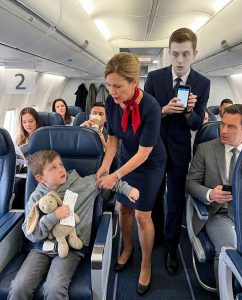
Linda backed into the aisle, but the people around Row 2 had already watched a veteran flight attendant put her hand on a six-year-old whose boarding pass had been correct from the beginning.
Noah Parker was still curled toward the window in Seat 2A, clutching his crooked-eared stuffed rabbit and the wrinkled piece of paper that had somehow become something he felt he needed to defend.
I was standing beside him with his passenger record open, and there was nothing complicated about what it showed.
Noah Parker.
Flight 271.
Seattle to New York.
Seat 2A.
He belonged exactly where he was sitting.
The uncomfortable part was that Noah had been saying that all along.
My name is Ryan Carter, and by then I had been working as a flight attendant for almost eight years.
Eight years in the cabin teaches you how quickly a minor disagreement can become the center of an airplane.
A passenger believes someone stole an overhead bin.
Someone reclines a seat at the wrong moment.
A connection is tight, a delay gets longer, a bag has to be checked, or somebody decides the person beside them is taking too much of the armrest.
Most conflicts have a pattern.
You listen, verify the facts, explain the rule, and try to keep frustration from spreading from one row to the next.
That was why what happened on Flight 271 bothered me so much.
The easiest part of this situation should have been verification.
Instead, verification came after a child had already been told he did not belong.
We were boarding in Seattle for New York, and the forward cabin had the usual end-of-boarding energy.
Wet coats carried in the smell of the weather outside, paper coffee cups were tucked into seat pockets or held between knees, and suitcase wheels rattled across the threshold while passengers searched for the last available bin space.
The open forward door let in a strip of cold metallic air from the jet bridge.
People were settling fast because everyone could tell boarding was almost finished.
That was when I first noticed Noah in 2A.
He looked small in the first-class seat, but not lost.
There is a difference.
A child who has wandered somewhere by mistake usually looks around for direction, for a parent, for an employee, for somebody to tell him what comes next.
Noah was doing none of that.
He was sitting beside the window with both hands around his boarding pass, a gray hoodie hanging loosely from his shoulders, faded jeans covering his knees, and worn sneakers planted beneath him.
A stuffed rabbit rested in his lap.
One ear had been sewn back on by hand, crooked enough that you could see the repair immediately.
Nothing about Noah suggested he was trying to attract attention.
If anything, he seemed determined to take up as little space as possible.
Around him were polished leather seats, hard-shell carry-ons, expensive watches, and the quiet signals of passengers who were used to occupying the front of an airplane.
Noah did not look impressed by any of it.
He looked focused on one thing: staying in 2A.
His boarding pass already showed why.
The paper had been squeezed enough that the edges were soft and creased, but the important information was still visible.
Then Linda Mercer stopped beside him.
Linda had worked for the airline for nearly twenty-five years.
She knew service procedures, emergency language, cabin routines, and the familiar excuses people sometimes used when they wanted a seat they had not purchased.
Experience can be valuable in an airplane because hesitation at the wrong moment can create real problems.
But experience can also become dangerous when confidence arrives before the facts.
Linda looked down at Noah and told him she thought he was sitting in the wrong section.
Noah looked up quickly.
“My ticket says this seat,” he told her.
That should have been enough to trigger a check.
Not a conclusion.
A check.
Linda instead told him first class was reserved for premium passengers.
Noah’s expression changed from caution to confusion.
“But my dad bought it for me.”
There was no attitude in his answer.
No attempt to challenge her authority.
He was six years old and explaining the simplest thing he knew: his father had purchased the seat, and the ticket in his hands said he was supposed to be there.
Passengers nearby began noticing.
A couple across the aisle turned their attention toward the exchange.
A man who had been using his phone stopped tapping at the screen.
Near the galley, a woman lowered her magazine enough to watch over the top of it.
That is how cabin tension spreads.
It rarely begins with everybody staring.
One person notices, then another realizes the first person is watching something, and within seconds an argument that started between two people has an audience.
Linda’s voice became firmer.
She told Noah to gather his things and move toward the back before boarding finished.
Noah barely shook his head.
“My dad told me to stay right here and wait for him.”
There was something important in that answer that had nothing to do with class of service.
Noah had been given a clear instruction by the adult he trusted: stay in this seat.
Now another adult in a uniform was telling him to disobey it.
For a six-year-old, that is not a routine seating dispute.
That is two different versions of safety colliding in front of him.
I stepped out of the forward galley and offered to check the passenger record.
It was the most ordinary solution available.
Name, flight, seat.
Three pieces of information could settle the issue.
Linda did not accept the offer.
“I know what I’m looking at, Ryan.”
That sentence changed the temperature of the interaction for me.
Not because Linda was senior to me or because crew members never disagree.
We do.
But there is a point where certainty stops being efficiency and becomes resistance to evidence.
Noah tightened both hands around the rabbit.
The fabric bunched beneath his fingers.
His lower lip trembled once, but he did not cry.
He kept trying to stay where his father had told him to stay.
Linda bent toward him.
I saw her hand moving toward his arm.
My stomach tightened before I had time to think through why.
“Linda.”
Noah pressed himself closer to the window, pulling the rabbit and boarding pass against his chest.
By then the nearest passengers were not pretending they had missed the exchange.
A suitcase remained halfway inside an overhead bin.
Someone held a coffee cup without drinking from it.
The man across the aisle leaned forward slightly.
“Ma’am,” I said, sharper now, “don’t grab him.”
Her fingers closed around the sleeve of Noah’s gray hoodie anyway.
That was the moment the situation stopped being a disagreement about a seat number.
A child who had shown his ticket, explained where he had been told to sit, and remained quietly in place was now being physically moved before anybody had verified whether he was wrong.
I stepped beside the seat before Linda could pull him into the aisle.
“Let me check it.”
This time I did not wait for agreement.
The boarding pass was still visible against Noah’s rabbit.
I used the information in front of me and checked the passenger record.
Noah Parker.
Flight 271.
Seattle to New York.
Seat 2A.
I looked at it twice.
Not because the system was unclear.
Because the result was so simple that for a second I wondered whether I had somehow entered something incorrectly.
I had not.
The six-year-old Linda was trying to remove from first class was assigned to the exact seat he occupied.
I felt the blood leave my face.
That reaction was not about discovering some mysterious status hidden in the record.
There was no need for a dramatic secret.
The truth was more uncomfortable because it was ordinary.
His name matched.
His flight matched.
His seat matched.
The document in Noah’s hands had been telling the truth the entire time.
Across the aisle, the man with the phone leaned farther forward.
The woman with the magazine stopped pretending to read.
Noah looked from Linda to me while pressing the crooked-eared rabbit against his chest.
Linda’s fingers were still around his sleeve.
“Let him go,” I said.
She looked at the passenger information in my hand.
Her hand came away.
For a second, the soft fabric of Noah’s hoodie still showed where her fingers had been holding it.
Noah immediately pulled his arm against his body.
Then he wrapped both hands around the rabbit again.
I kept the passenger record open because I wanted the fact to remain visible.
“His name matches. His flight matches. His seat matches. He’s in 2A.”
There are moments when a long explanation makes a situation weaker.
This was one of them.
Four short sentences contained everything that should have been checked before anyone told Noah to move.
Linda looked from the record to the boarding pass he had been holding since the beginning.
The passengers around us did the same thing in their own way.
Nobody needed a complicated theory to understand what they had witnessed.
Noah had answered the question.
His ticket had supported his answer.
I had offered to verify it.
Only after all of that had he been grabbed.
The couple across the aisle had seen the sequence from the start.