The day Michael Blake was told to let his daughter go, the most expensive room in the hospital felt cheaper than a bus station.
There were flowers everywhere, but none of them smelled alive.
White roses leaned over silver vases.
Orchids drooped against cards signed by senators, developers, investors, and people who had used the word prayers because it cost less than showing up.
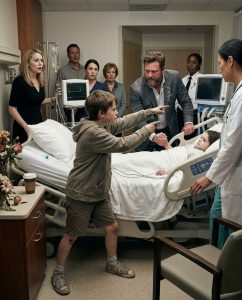
Emma Blake lay in the center of it all, eight years old, swallowed by white sheets and quiet machines.
Michael sat beside her with her hand in his.
Outside that room, people knew him as a man who could get permits moved, roads widened, hotels financed, and lawsuits softened before lunch.
Inside that room, he was just a father staring at a child who would not open her eyes.
The doctor stood near the ventilator with the careful posture of someone carrying bad news in both hands.
He had already said the words once.
There was no meaningful response.
The neurological signs were not improving.
The family needed to make a decision.
Michael had heard every sentence as if it were being spoken through glass.
At the foot of the bed stood Sarah, his older sister.
Her black dress was perfect.
Her makeup had not moved.
Her grief looked arranged.
She had cried in hallways when people were watching, then dried too quickly when they turned away.
During the five days Emma had been in that bed, Sarah had asked more questions about signatures than symptoms.
She wanted to know who had signed the intake forms.
She wanted to know whether Michael’s estate documents had been updated since his divorce.
She wanted to know whether Emma, as his only child, was still the direct heir to the trust.
Each question came wrapped in concern.
Each answer made her quieter.
Near the back wall stood Noah.
He was nine, skinny, and trying to disappear inside a borrowed hoodie.
His father, David, kept the grounds at the Blake estate.
David trimmed hedges, cleaned gutters, fixed sprinklers, and made sure the pool looked blue enough for guests who never learned his name.
Noah had grown up in the edges of that property.
He knew which gate squeaked.
He knew where the gardeners kept spare gloves.
He knew the service fence could be climbed if you did not mind scraping both knees on the way down.
That was how he had reached the hospital that morning.
Security had already been told the family wanted privacy.
Noah had not come for privacy.
He had come for Emma.
To everyone else, Emma was Michael Blake’s daughter.
To Noah, she was the girl who shared sandwiches behind the garage.
She was the girl who said ants were stronger than grown men because ants carried what mattered without bragging about it.
She was the girl who promised that when summer came, she would teach him to swim in the big pool.
The pool he was not allowed to use.
The pool his father cleaned every Friday.
Children notice unfairness before they have the language for it.
Emma had noticed.
That was why she loved Noah.
That was why he stood in a room full of adults who wished he would leave.
The doctor stepped closer to the ventilator.
Michael bent over Emma’s hand.
Sarah exhaled, almost relieved.
Turn it off, she said.
Michael looked at her.
Sarah’s eyes did not soften.
Dead heirs do not need machines, she murmured.
The sentence landed so coldly that Michael did not react at first.
There are moments when cruelty is too clean to understand.
It does not arrive shouting.
It arrives wearing black and speaking softly at the foot of a child’s bed.
The doctor reached for the control.
Noah’s voice cracked across the room.
No. Wait.
Everyone turned.
Sarah’s face tightened first.
She asked what that boy was doing in there, and the way she said that boy made David’s son sound like something tracked in on a shoe.
A security guard stepped forward.
The nurse looked embarrassed for him.
The doctor sighed.
Noah did not move.
His knees were shaking.
His cheeks were wet.
But his eyes stayed locked on the monitor.
She moved, he said.
The doctor told him that machines could jump.
Noah shook his head.
He said the line had moved before the doctor touched anything.
Sarah snapped at him to stop making things up.
She said her niece was gone.
She said he was playing with his boss’s pain.
That word told Michael everything.
Boss.
Not father.
Not friend.
Not the man whose child had shared half her childhood with the boy Sarah wanted removed.
Noah wiped his face with the back of his sleeve.
Then he said Emma had squeezed his hand the day before.
He said it had happened when nobody was looking.
He said he had written it down.
Friday, 6:38 p.m.
The nurse lifted her head.
The doctor’s hand stopped in the air.
Sarah went pale in a way grief had never made her pale.
A small jump rose on the green line.
Then another.
Noah pointed with both hands.
There, he cried.
The monitor beeped once.
Emma’s fingers moved inside Michael’s hand.
It was the smallest movement in the world.
It broke the room in half.
Michael made a sound that did not belong to the man people feared in boardrooms.
It belonged to a father who had been underwater for five days and had just found air.
The doctor pulled away from the ventilator and began giving orders.
Cancel the withdrawal.
Call neurology back.
Repeat the response tests.
Check the hand movement.
Check the pupils.
Get another scan.
The nurse moved quickly now, all softness gone, her training sharper than anyone’s grief.
Noah stood frozen, as if he had shouted from a cliff and only now realized the whole valley had heard him.
Michael reached for him without letting go of Emma.
Stay, he said.
The security guard stopped.
Sarah sank into the visitor chair.
Her hand slipped on the armrest.
For the first time since the accident, she looked genuinely afraid.
Not sad.
Afraid.
The charge nurse noticed.
So did Michael.
When the room filled with doctors again, Sarah tried to leave.
Michael told the guard she was not to go anywhere until he said so.
His voice did not rise.
That made it worse.
Noah reached into his hoodie pocket and pulled out a folded page from a school notebook.
The paper was soft from being handled too many times.
Across it, in uneven handwriting, he had written times and tiny notes.
Friday, 6:38 p.m. – squeezed my hand.
Saturday, 9:14 a.m. – finger moved.
Sunday, 2:02 p.m. – Aunt Sarah told nurse not to tell Mr. Blake.
The nurse stared at the last line.
Sarah stood up too fast.
She said Noah was a liar.
The problem with powerful people is that they often mistake quiet people for empty ones.
Noah had been quiet.
He had not been empty.
He had watched because nobody watched him.
He had listened because adults forgot children could hear.
And because he loved Emma with the plain loyalty grown-ups spend fortunes trying to imitate, he had written down what everyone else missed.
The doctor repeated the neurological exam.
This time, Emma responded.
Not fully.
Not like a child waking from a nap.
But enough.
Enough to stop the decision.
Enough to move her into a different category.
Enough to turn a farewell into a fight.
Michael stayed beside her through the night.
Noah stayed too, curled in a chair with a blanket the nurse brought him after Michael quietly told everyone that the boy was family as far as that room was concerned.
David arrived near midnight, breathless and frightened that his son had caused trouble.
He found Noah asleep near Emma’s bed and Michael standing beside him.
David began to apologize.
Michael stopped him.
He said David’s son had saved his daughter’s life.
David covered his mouth with one hand.
Men who work with their hands often learn to keep emotion behind their teeth.
That night, he could not.
By morning, Emma’s responses were stronger.
Her fingers curled again when Noah spoke.
Her eyelids trembled when Michael told her he was there.
The doctors warned them not to expect too much too quickly.
Michael did not argue.
He had learned in that room that money was not the same as power.
Power had been a poor boy with scraped knees saying wait when every rich adult had already surrendered.
Two days later, Emma breathed without the ventilator for short stretches.
On the fourth day, she opened her eyes.
The first person she clearly focused on was her father.
The second was Noah.
He stood at the side of her bed in clean clothes the nurse had found from pediatric donations, twisting the hem of his shirt like he still expected someone to tell him he did not belong.
Emma moved her lips.
Noah leaned closer.
She whispered that he was late for swim lessons.
Michael laughed and cried at the same time.
Sarah was not in the room.
By then, Michael had removed her access to the hospital suite, the house, the trust offices, and every family document she had been circling like a locked door with a keyhole.
He had also asked the hospital for every visitor log, every note, and every conversation that had been documented during Emma’s stay.
What he found did not prove Sarah had caused the accident.
It proved something colder.
She had known Emma was not as still as everyone believed.
A nurse remembered Sarah asking whether small movements should be reported if the family had already accepted the prognosis.
Another remembered Sarah correcting her when she said Emma might have squeezed in response to touch.
Sarah had called it reflex.
Sarah had called it noise.
Sarah had called it cruel to tell Michael.
All while asking whether the estate paperwork was current.
The final twist was not that a wicked aunt had made one dramatic move in the dark.
The final twist was worse because it was quieter.
Sarah had not needed to pull a plug herself.
She only needed everyone else to stop seeing a child as alive.
Noah saw her.
That was the miracle.
Months later, Emma did learn to swim again.
Not at a country club.
Not for an audience.
In the Blake pool, on a hot Saturday morning, with Michael sitting nearby and David pretending not to cry behind his sunglasses.
Noah stood in the shallow end first, nervous and proud.
Emma held the pool rail and told him the rule.
No one learns alone.
Then she took one careful step into the water.
Noah stayed beside her.
Michael had the service fence removed that same week.
He also changed the employment contracts for every worker on the estate, raised wages, added medical coverage, and made sure David never again had to ask permission for his son to stand where Emma wanted him.
When Sarah’s lawyers sent letters, Michael did not answer personally.
He let the silence do what grief had not.
It closed the door.
At the next family gathering, there were fewer important people in the room.
There were more honest ones.
Emma sat beside Noah at the kitchen table, eating peanut butter sandwiches cut into triangles.
Someone had placed fresh flowers on the counter.
No cards from politicians.
No silver vases.
Just daisies in a glass jar, bright and ordinary and alive.
Michael watched his daughter laugh at something Noah whispered.
For the first time since the hospital, the sound did not hurt.
It filled the space her silence had left behind.
And whenever people later called Emma’s recovery a miracle of medicine, Michael corrected them.
Medicine helped.
Machines helped.
Doctors helped.
But the first person to bring Emma back was a child no one thought belonged in the room.
Sometimes love does not arrive with a title, a fortune, or a last name that opens doors.
Sometimes it climbs a fence with scraped knees, stands in the corner, watches when adults look away, and says the one word that saves a life.
Wait.