
Just enough.
I had seen that look before, though never directed at me.
It was the expression he wore when a business meeting suddenly stopped going according to plan.
He gathered the divorce papers from my blanket more carefully than he had dropped them.
“Claire,” he said, lowering his voice, “why have you never mentioned this?”
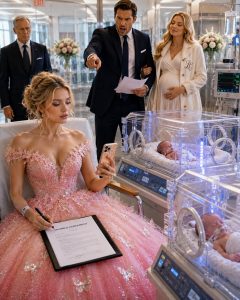
There it was.
Not Are you all right?
Not Why did you hide your family from me?
Not even How are the babies?
His first question was why I had failed to disclose the value of the people connected to me.
I rested my head against the hospital pillow.
“Because I wanted to know whether someone could love me without knowing.”
Ryan flinched.
Vanessa looked between us.
Something in her expression changed then—not guilt exactly, but uncertainty.
The nurse who had been standing nearby approached my bed.
“Mrs. Mercer, would you like me to ask your visitors to step outside?”
Ryan opened his mouth.
I answered first.
“Yes, please.”
His jaw tightened.
“Claire, we need to talk.”
“We did.”
“That wasn’t a conversation.”
“No,” I said quietly. “It was paperwork.”
The nurse gave him the professionally pleasant look of someone who had escorted difficult relatives out of hospital rooms before.
“Mr. Mercer, Ms. Hale, this way.”
Vanessa hesitated.
Her fingers tightened around the front of my coat.
For a strange moment, I thought she might say something to me.
Instead, she followed Ryan into the corridor.
The doors closed behind them.
And suddenly I was alone.
Not completely alone.
My babies were twenty feet away.
Two tiny lives behind glass.
But for the first time since the emergency delivery, there was no doctor asking questions, no nurse checking medication, no Ryan filling the room with certainty about what would happen next.
There was only me.
And when the quiet finally arrived, my hands began to shake.
A nurse named Marisol noticed.
She had been working the night Ethan and Emma were born. I remembered her voice more clearly than her face because she had been the one telling me to keep breathing when the room became a blur of lights.
She pulled a chair beside my bed.
“You don’t have to be brave every minute,” she said.
I swallowed.
“I’m not trying to be.”
Marisol gave me a look that suggested she knew better.
“Would you like me to call someone else?”
I almost laughed.
That question had followed me most of my adult life.
Emergency contact?
Next of kin?
Family nearby?
For twelve years, my answers had been short.
No.
No.
Not really.
Now my grandfather was somewhere across the city, coming toward me.
“I already did,” I whispered.
Marisol rested her hand lightly over mine.
“Good.”
I turned my face toward the incubators.
Ethan moved one tiny arm beneath his blanket.
Emma’s chest rose and fell beneath the careful watch of the monitor.
“Can I sit with them?”
Marisol smiled.
“That is exactly where you should be.”
She helped me into a wheelchair.
My body still felt borrowed—weak, sore, unfamiliar—but when she rolled me between the two incubators, the rest of the room faded.
I placed one hand through the opening beside Ethan.
The nurse guided my finger toward his palm.
His fingers closed around it.
So small.
So certain.
My throat tightened.
“Hi,” I whispered.
I looked toward Emma.
“And hi to you too.”
I wanted to tell them I was sorry.
Sorry that their first days had been filled with machines instead of arms.
Sorry that their father had stood nearby speaking about bank accounts and condos.
Sorry that I had not understood sooner what kind of marriage I was living inside.
But Marisol had told me earlier that premature babies learned voices quickly.
So instead, I told them something better.
“I’m here.”
Ethan’s fingers remained wrapped around mine.
“And I’m staying.”
My grandfather arrived forty-three minutes later.
I knew because I had spent most of those minutes watching the clock.
When the NICU doors opened, I expected security guards, lawyers, assistants, perhaps even the kind of entourage Ryan probably imagined accompanied billionaires everywhere.
Instead, Arthur Bennett walked in alone.
He was seventy-eight years old, tall despite the slight stoop that had appeared since I last saw him, wearing a charcoal overcoat over a simple gray sweater.
His hair had become almost completely white.
His face had more lines than I remembered.
But his eyes were exactly the same.
Brown.
Steady.
Observant.
The eyes that had taught me chess.
The eyes that had watched me leave home twelve years earlier without trying to stop me.
For one second, neither of us moved.
Then he looked past me.
At Ethan.
At Emma.
His mouth trembled.
I had never seen that happen before.
Not when my grandmother died.
Not when my mother left.
Not even when I told him, at twenty-one years old, that I no longer wanted anything to do with the Bennett family.
He removed his glasses.
“Those are my great-grandchildren?”
My eyes filled before I could stop them.
“Yes.”
Arthur came closer.
He stood between the incubators and looked at them with such wonder that something inside me cracked open.
“They’re beautiful.”
“They’re very small.”
“So were you.”
I blinked.
“What?”
“You were five pounds, eleven ounces. Your mother complained that the hospital hats were all too large for you.”
The memory came out of him so naturally that I forgot how angry I was supposed to be.
He reached toward the incubator, then stopped.
“May I?”
Marisol showed him how to place his hand through the side opening without disturbing the tubes.
Emma’s fingers brushed against his knuckle.
Arthur lowered his head.
For several seconds, he said nothing.
When he finally turned to me, his eyes were wet.
“You should have called me before today.”
The old defensiveness rose automatically.
“You could have called me too.”
“I did.”
“Three times in twelve years.”
“Forty-seven.”
I stared at him.
He gave a tired smile.
“You changed your number twice.”
I looked away.
That was true.
“And,” he continued, “you asked the family office not to contact you.”
“I asked them not to follow me.”
“Yes.”
The smile disappeared.
“And I decided respecting your boundary mattered more than making myself feel better by breaking it.”
That answer unsettled me more than an argument would have.
I had spent years telling myself Arthur Bennett had let me disappear.
It had become one of the foundations of my independence.
If no one came looking, I did not need anyone.
But now I wondered how much of that story I had built because it was easier than admitting I had been the one who walked away.
Arthur pulled the visitor’s chair beside me.
“Tell me what happened.”
I did.
Not everything.
I did not have the strength for everything.
I told him about Ryan and Vanessa.
The pregnancy.
The accounts.
The divorce papers.
The coat.
Arthur listened without interrupting.
That was another thing I had forgotten about him.
He rarely reacted before he understood.
When I finished, he looked toward the corridor.
“Where is Ryan now?”
“I don’t know.”
“Good.”
I almost smiled.
“You said you were bringing security.”
“I did.”
“Where are they?”
“Outside.”
His voice remained calm.
“They were instructed to ensure that anyone you do not wish to see is not allowed into this unit. Nothing more.”
I studied him.
“You’re not going to have Ryan dragged out of the building?”
“No.”
He raised an eyebrow.
“Do you want me to?”
Despite everything, a small laugh escaped me.
It hurt my incision.
I winced.
Arthur immediately leaned forward.
“Are you all right?”
“I’m fine.”
“You just had major surgery.”
“I said I’m fine.”
He sat back.
That familiar look passed over his face.
Not annoyance.
Recognition.
“You still do that.”
“Do what?”
“Say you are fine in exactly the tone your grandmother used when she was absolutely not fine.”
I looked at my children.
For the first time all morning, the room felt almost warm.
Ryan did not return that afternoon.
Neither did Vanessa.
A hospital administrator came by instead.
Not because Arthur demanded it, he assured me, but because there had been a concern about access to the NICU and patient privacy.
Arthur said almost nothing during the meeting.
He let me answer questions.
Who was permitted to visit?
Who could receive medical updates?
Who could make decisions if I became unable to?
Ryan was still legally my husband, and until the divorce was finalized, that complicated certain matters.
The administrator suggested I speak with an attorney.
Arthur finally spoke.
“I know one.”
I gave him a look.
He corrected himself.
“I know several. You may choose whether you want any of them.”
That distinction mattered.
More than he probably knew.
“I’ll speak with someone tomorrow.”
“Good.”
The administrator left.
Arthur remained.
By evening, I became tired enough that words felt heavy.
He noticed before I said anything.
“I booked a room nearby.”
“You don’t have to stay.”
“I know.”
“I mean it.”
“So do I.”
He rose.
Before leaving, he placed something on the small table beside my bed.
An old silver key.
I recognized it immediately.
It belonged to the lake house.
The Bennett family retreat sat three hours north of the city, surrounded by pine trees and cold blue water.
I had spent summers there as a child.
My grandmother had taught me to bake bread in the kitchen.
My mother had taught me to swim from the dock.
And Arthur had taught me to drive an ancient green pickup truck along the gravel road when I was fourteen.
“Why are you giving me this?”
“The house is empty.”
“I don’t need a house.”
“No.”
He put his glasses back on.
“But when Ethan and Emma are discharged, you may want somewhere quiet while you decide what happens next.”
I ran my thumb across the worn edge of the key.
“You kept it?”
“It was always yours.”
“No. It belonged to Grandma.”
“She left it to you.”
I looked up sharply.
Arthur paused.
“You didn’t know.”
It was not a question.
“No.”
For the first time since arriving, my grandfather looked genuinely troubled.
“She left you the lake house in her will.”
“My mother told me everything went to the family trust.”
Arthur’s expression changed.
A small crease appeared between his eyebrows.
“When did she tell you that?”
“After the funeral.”
He took a slow breath.
“That was not true.”
I stared at the key.
Another memory surfaced.
My mother standing in my bedroom.
Her black funeral dress still on.
Telling me there was no reason to keep pretending we belonged in that house.
Telling me Arthur controlled everything.
Telling me we should leave before he decided what we were allowed to have.
I had believed her.
I had been seventeen.
“Why would she lie?”
Arthur’s answer came slowly.
“I don’t know.”
But I knew his face.
He knew more than he was saying.
“You do know.”
“I know there were disagreements after your grandmother died.”
“What kind of disagreements?”
He glanced toward the incubators.
“Not today.”
I felt anger spark.
“Don’t do that.”
“Do what?”
“Decide what I can handle.”
His eyes softened.
“You’re right.”
He sat again.
“Your mother wanted to sell the lake house. Your grandmother’s will prevented her from doing so because the property had been left directly to you.”
“Why would Mom want to sell it?”
“She needed money.”
“For what?”
Arthur hesitated.
That hesitation told me the next answer mattered.
“I never learned the full reason.”
I folded my arms carefully over the blanket.
“You expect me to believe that?”
“No.”
His voice was quiet.
“I expect you to decide what you believe after you have all the information.”
That sounded like Arthur.
Infuriatingly measured.
Infuriatingly patient.
“Then give me all the information.”
“I will.”
“When?”
“When you’re stronger.”
I opened my mouth.
He held up one hand.
“That is not me deciding for you. That is me recognizing that you have been awake for twelve hours after emergency surgery.”
I hated that he was right.
Mostly because he knew I hated it.
“I’ll come back tomorrow morning,” he said.
I looked down at the key.
“Grandpa.”
He stopped.
It was the first time I had called him that in more than a decade.
His face changed almost imperceptibly.
“Yes?”
“Thank you for coming.”
He nodded once.
“There was nowhere else I was going to be.”
The next morning brought two pieces of good news.
Ethan had gained twenty grams.
Emma had tolerated her feeding better overnight.
To anyone outside the NICU, those details might have sounded microscopic.
Inside it, they felt enormous.
I wrote both numbers in the small notebook Marisol had given me.
Ethan: +20 g.
Emma: finished feeding.
Then beneath them I wrote:
Day 3.
It felt important to record something that belonged only to us.
Not Ryan.
Not divorce papers.
Not money.
Just progress.
Around nine, my phone buzzed.
Ryan.
I stared at his name.
Then I answered.
“Hello.”
His voice sounded different.
Less polished.
“Can we talk?”
“We’re talking.”
“Not like this.”
“What do you want, Ryan?”
There was silence.
“I want to explain.”
I looked through the glass toward Emma.
“Explain what?”
“Everything.”
“You already explained enough.”
“No, I didn’t.”
He exhaled.
“Claire, I handled yesterday badly.”
I almost laughed.
“Badly?”
“I panicked.”
“You walked into the NICU with your pregnant girlfriend.”
“I know.”
“You told me you emptied our accounts.”
“I know.”
“And you told me our children were my problem.”
Another silence.
Longer this time.
“I should never have said that.”
“No.”
“You’re right.”
That startled me.
Ryan rarely said those words.
Not because he was cruel.
That would have been easier to understand.
Ryan simply believed most problems could be organized until he was correct.
He treated disagreements like spreadsheets.
One column for facts.
One column for emotions.
And emotions always received less weight.
“Why did you call?” I asked.
“I want to see the babies.”
My first instinct was no.
Immediate.
Protective.
But then I looked at Ethan.
And I remembered something Arthur had told me years earlier while teaching me chess.
Never make your next move only because you dislike your opponent’s last one.
I hated that the advice still applied.
“They are your children,” I said.
“Yes.”
“But the NICU needs calm.”
“I understand.”
“No Vanessa.”
Ryan was quiet.
“All right.”
“No discussion about the divorce.”
“All right.”
“You come for them. Not for me.”
Another pause.
“All right.”
I gave him a time.
Then ended the call.
My hands trembled again.
But this time it was not helplessness.
It was the realization that boundaries felt different from walls.
Walls kept everyone out.
Boundaries required me to decide who could enter, how far, and under what conditions.
I had spent years confusing the two.
Ryan arrived at eleven.
No suit.
No tie.
He wore jeans and a dark sweater.
For a second, he looked like the man I had met six years earlier in a bookstore café when he asked whether the empty chair across from me was free.
The man who had made me laugh over terrible coffee.
The man who proposed on a rainy Tuesday because, he said, waiting for perfect weather seemed inefficient.