Evelyn had sent it to Natalie earlier that day.
It said, “Once Claire realizes we are serious, she will come back willing to follow our rules.”
That sentence removed the last plausible misunderstanding.
The lock had not been changed unexpectedly because it broke.
Lily had not accidentally been left outside because everyone thought someone else would let her in.
The exclusion was part of the pressure.
My mother expected my daughter being unable to enter the house to force me into compliance.
That was different.
Very different.
I contacted the attorney who had managed my father’s estate and explained what had happened.
I did not give him a speech about how cruel my mother had been. I gave him the sequence.
The changed lock.
Lily’s arrival.
The unanswered calls.
Mrs. Dalton’s account.
My mother’s words on the porch.
The message to Natalie.
The trust language.
He reviewed the material.
The written record now matched what Lily had experienced: this had not been a child arriving at the wrong time during a household misunderstanding. The change in access had been intentional, and my mother’s own message showed the purpose behind it.
By the next morning, the notice had been prepared.
I read it carefully.
There was no screaming in it.
No insult.
No revenge speech.
It simply addressed the trust and the authority my mother had assumed she possessed.
The first page notified Evelyn that her actions had violated the terms governing the family trust.
The next explained that her authority over the property had been suspended.
Another portion informed the adult residents that their continued housing would now depend on my approval under the trust arrangement.
The language was formal because the point was formal.
For years, Evelyn had treated family hierarchy as if it were property law.
Now the actual document controlled the question.
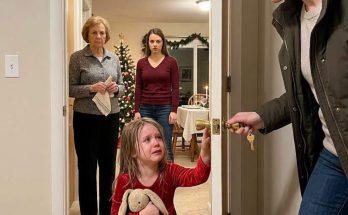
Three days after Lily stood beneath that porch light trying a key that no longer worked, a courier walked up to the same front door carrying a thick certified envelope.
There was something almost painfully ordinary about that image.
No dramatic crowd.
No family meeting.
No shouting across the driveway.
Just paperwork arriving at a house where a child had recently been told she no longer belonged.
Inside the envelope was the consequence of a decision my mother had believed was entirely hers to make.
She had assumed residency meant ownership.
She had assumed age meant authority.
She had assumed that because I had tolerated her rules for years, I would tolerate anything attached to them.
Most of all, she had assumed Lily’s access to the house was hers to take away.
The trust said otherwise.
What happened on the porch had never really been about a brass key.
The key was only the object Lily could see.
The real issue was whether my mother could place an eleven-year-old child in the middle of an adult power struggle and use the child’s fear to control her parent.
That was the part I could not overlook.
I kept thinking about Lily sitting at Mrs. Dalton’s house with both hands around that warm drink.
I kept hearing her say, “I’m sorry, Mom.”
Children notice far more than adults sometimes want to admit. Lily knew there had been tension in the family, but she should never have been made responsible for resolving it.
She should not have had to wonder whether she had earned the right to come inside.
She should not have had to stand beneath a porch roof while adults waited for her mother to surrender.
That was why my answer at the door had been so short.
“Understood.”
I was not agreeing with Evelyn.
I was telling myself that I finally understood the situation clearly enough to stop arguing about it.
The old argument had always taken place on my mother’s terms. She would announce a rule, I would challenge it, she would accuse me of disrespect, and eventually the actual issue disappeared beneath a debate over gratitude and family loyalty.
This time, I refused that pattern.
The question was not whether Evelyn felt disrespected.
The question was whether she had the authority to do what she had done.
She didn’t.
The evidence was uncomplicated because so much of it had come from ordinary things: a lock, a wet backpack, missed calls, a neighbor who stayed, a written message, and a trust agreement my mother apparently had never bothered to read completely.
None of those objects looked powerful by themselves.
Together, they formed a timeline.
Lily arrived.
Her key failed.
She called for help.
She waited.
The adults inside eventually appeared.
My mother told her directly that she could no longer live there.
And Evelyn’s earlier message showed that my reaction had been part of the plan from the beginning.
That was what the certified letter answered.
Not an insult.
Not a personality conflict.
A decision.
My mother’s decision had been to use the house as leverage.
My decision was to use the authority my father had actually placed in the trust to stop that leverage from being used against Lily again.

I did not feel victorious sitting in that hotel room.
Mostly, I felt tired.
There was still soup on the table. Lily’s damp backpack was drying nearby. Her school things were inside it, the same ordinary notebooks and supplies she had carried home believing she was walking into another normal afternoon.
That mattered more to me than whether Evelyn was embarrassed by the envelope.
The trust could define property rights.
It could identify beneficiaries.
It could establish authority.
But it could not erase those hours on the porch.
It could not make Lily forget hearing her grandmother say she was no longer welcome.
That part would require something far less dramatic than legal paperwork: consistency, safety, and adults who did not make her earn a place in their lives by obeying rules she had never broken.
So when I thought about the certified envelope reaching Evelyn’s door, I did not picture some grand moment of revenge.
I pictured a boundary finally becoming visible.
For years, my mother had said that living in the house was a privilege she controlled.
Three days after she changed Lily’s lock, the documents reminded her of the arrangement my father had actually created.
Evelyn had a right to live there.
Lily had rights too.
And when the final page identified the person responsible for enforcing those terms, the authority did not belong to the woman who had changed the lock.
It belonged to me.