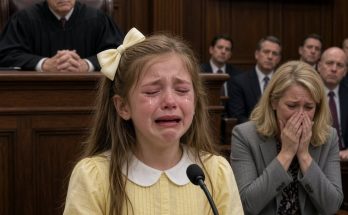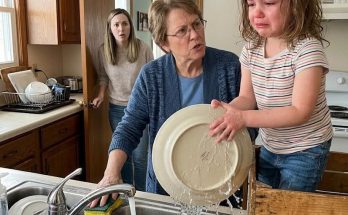
My sister left her five-year-old daughter with me for three days, and I thought I’d only have to put on cartoons, warm up dinner, and keep her occupied until Paula came back.
That was all it was supposed to be.
Three days.
A small suitcase by the door.
Cartoons in the living room.
Mac and cheese if she got picky.
Instead, by the end of the first night, I was standing in my kitchen with a bowl of beef stew between us while my niece asked whether she was allowed to eat.
My name is Robert.
At the time, I lived alone in a small house in Austin, Texas, the kind with a front porch just wide enough for two chairs, a mailbox that squeaked in the wind, and an old family SUV parked in the driveway because I kept telling myself I would trade it in and never did.
The afternoon Paula dropped Ruby off, the house was quiet except for the air conditioner humming over the hallway vents.
Cartoon voices came from the TV before Ruby ever sat down to watch them.
The stew was already on the stove, thick with potatoes and carrots, because I had figured comfort food was safer than asking a five-year-old what she wanted.
Paula arrived with Ruby’s suitcase in one hand and her phone in the other.
She looked rushed, but not the normal kind of rushed.
Not late-to-work rushed.
Not running-errands rushed.
She looked like someone who had made a decision and was terrified she might change her mind if she stood still too long.
“Just three days,” she said.
I looked past her at Ruby.
Ruby was holding Paula’s leg so tightly her small fingers had wrinkled the denim.
“Light dinner,” Paula added. “No sweets. And don’t let her throw tantrums.”
Ruby did not look like a child who threw tantrums.
She looked like a child who had already learned tantrums did not work.
Paula bent down and kissed the top of her head fast.
“Be a good girl,” she whispered. “Don’t make your mother look bad.”
Then she left.
The door clicked shut, and Ruby stared at it.
I waited for crying.
I waited for a question.
I waited for the normal little kid protest of wanting her mom back.
Nothing came.
She just stood there in the entryway with her suitcase beside her, one hand gripping the strap of her backpack, eyes fixed on the door like she was memorizing the place where Paula had disappeared.
“Want to watch cartoons?” I asked.
She nodded.
Then she looked at the couch.
“Am I allowed to sit there?”
I almost laughed, because I thought she was being overly polite.
Then I saw her face.
She meant it.
“Of course,” I said. “Sit anywhere you want.”
She walked to the couch and sat on the edge.
Not back into the cushions.
Not curled up like kids do.
On the edge, hands flat on her knees, shoes together, body stiff.
I gave her coloring pencils.
She asked if she could use the red one.
Then she asked if she could use the blue one.
Then she asked what would happen if she made a mistake.
“We erase it,” I told her.
She looked at me as if I had said something impossible.
That should have been the first moment I called Paula and demanded an explanation.
Instead, I did what adults do when the truth is inconvenient.
I softened it in my own head.
I told myself Ruby was shy.
I told myself Paula had been under pressure.
I told myself Sergio, Paula’s boyfriend, had changed their household routines, and maybe Ruby just needed time.
By 5:42 p.m., I had counted eight separate things Ruby asked permission to do.
Drink water.
Use the bathroom.
Touch a throw pillow.
Laugh at a cartoon.
Stand near the window.
Run once across the living room.
Breathe hard after running.
Ask me where the trash can was.
People tell you to mind your business until a child’s body starts telling the truth for them.
Dinner was supposed to make things easier.
I had made beef stew the way my mother used to make it, with carrots soft enough to break under a spoon and potatoes that thickened the broth.
The whole kitchen smelled like bay leaves, steam, and home.
I put a small bowl in front of Ruby.
Steam curled off the meat.
Her spoon sat beside her hand.
She did not touch it.
“It’s hot,” I said gently. “Blow on it first.”
Her shoulders rose toward her ears.
“Ruby,” I asked, “are you hungry?”
She pressed her fingers into her thighs until her knuckles turned pale.
Then she asked me the question that changed everything.
“Uncle… am I allowed to eat today?”
The kitchen went so quiet that I could hear the refrigerator click on.
I remember the sound because my brain grabbed on to it.
Sometimes when something horrible happens, your mind records the smallest useless detail because the real thing is too much.
“What do you mean, allowed?” I asked.
Ruby stared at the bowl.
“I don’t know if it’s my turn today.”
My first feeling was rage.
My second was fear, because rage has weight, and a frightened child can feel it even when it is not aimed at her.
So I smiled.
It felt like forcing my face through wet cement.
“Sweetheart,” I said, “you are always allowed to eat here. Always.”
That was when she broke.
Not whining.
Not begging.
She covered her mouth with both hands and cried like she was trying to keep the sound inside.
“I’m sorry,” she whispered. “I’ll stop crying. I’ll stop.”
I crouched beside the chair but did not touch her.
“You did nothing wrong.”
“Yes, I did.”
“What did you do?”
She swallowed.
“I was hungry.”
I had to grip the edge of the table.
If I had stood up too fast, I might have thrown the chair.
For one ugly second, I pictured Sergio’s face and my fist meeting it.
Then I looked at Ruby’s hands and stopped myself.
She did not need my anger first.
She needed safety.
“Who told you being hungry was wrong?” I asked.
Ruby looked at my phone on the table.
Not at me.
At the phone.
Like it might be listening.
“Mom says obedient girls don’t ask for things.”
“And if you ask?”
Her eyes filled again.
“Then it’s my water day.”
The stew kept steaming between us.
Outside, a truck rolled past the mailbox.
The world kept doing ordinary things while my kitchen split in half.
“Just water?”
She nodded.
“Sometimes bread,” she said. “If I didn’t make anyone mad.”
“Anyone?”
Her voice dropped.
“Sergio.”
Sergio had been around Paula for only a few months, but he had already mastered the performance.
He smiled too easily at family cookouts.
He brought flowers to my mother’s birthday.
He carried grocery bags without being asked.
He said he loved Ruby like his own, loudly enough for the room to admire him.
Cruel people love an audience before they love control.
It gives them cover.
“Does Sergio punish you by taking food away?” I asked.
Ruby panicked.
Her little face changed so fast I regretted the question as soon as I asked it.
“Please don’t tell Mom,” she said. “She says he supports us.”
I pushed the bowl closer.
“Eat, baby,” I said. “Nobody is taking food away from you in this house.”
She picked up the spoon.
Her hands trembled so badly broth spilled over the side.
She looked at me one more time for permission.
I nodded.
She ate one bite.
Then another.
Then too fast.
She cried into the bowl and kept swallowing like the food might vanish if she slowed down.
When she finished, she looked up at me.
“Are you going to let me eat tomorrow, too?”
That was the moment I stopped being confused.
Confusion is what you get to feel before the evidence becomes unbearable.
After that, you either act or you help hide it.
At 8:16 p.m., I put Ruby in clean pajamas.
I left the guest room door open.
I turned on the nightlight.
She looked relieved for half a second.
Then she asked, “You’re not going to put the chair there?”
Cold moved through me.
“What chair?”
She pulled the blanket to her chin.
“Nothing.”
I wanted to ask more.
I did not.
A child who has been trained to fear questions will not tell the truth faster because an adult is desperate.
She fell asleep with the doll pressed under one arm.
At 12:03 a.m., I called Paula.
No answer.
I texted her: We need to talk about Ruby. It’s an emergency.
Then I checked Ruby’s backpack.
I did it carefully.
I hated doing it.
But Ruby had arrived with a suitcase that felt too light for three days, and by then every strange detail mattered.
Inside the backpack were one spare T-shirt, socks, a toothbrush, and a coloring book.
Tucked inside the coloring book was a folded sheet of paper.
The handwriting was adult.
Monday: No dinner.
Tuesday: Water only.
Wednesday: Bread if she obeys.
Thursday: No speaking.
Friday: Lockdown.
Under it, in purple crayon, Ruby had written: I really do want to be good.
I sat on the kitchen floor.
Not discipline.
Not stress.
Not a parent having a bad week.
A system.
At 12:19 a.m., my phone buzzed.
Paula.
I answered before the first ring finished.
“What did you two do to Ruby?”
For three seconds, I heard only her breathing.
Then my sister whispered, “Robert, do not let her come back to this house.”
The words made the room tilt.
“What the hell is going on?”
“Sergio doesn’t know I left her with you,” Paula said. “I told him she was staying with a neighbor.”
“Why?”
She broke then.
Not loud.
Worse.
Quiet.
“Because last night, I found a camera hidden in her bedroom.”
My stomach dropped.
“In Ruby’s bedroom?”
“Yes.”
“Why didn’t you go straight to the police?”
Paula sobbed once.
“Because the camera wasn’t even the worst part.”
Before I could ask what that meant, the guest room door creaked upstairs.
Ruby appeared at the top of the stairs barefoot, clutching her doll so tightly its plastic face pressed into her chest.
Her skin looked white under the hallway light.
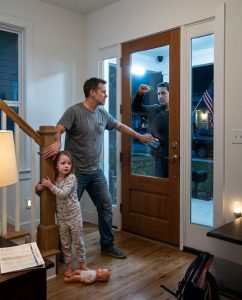
“Uncle,” she whispered. “He’s already here.”
Then came the knock.
Three slow thuds against my front door.
Paula screamed through the phone, “Don’t open it!”
From the porch, Sergio’s voice stayed calm.
“Robert, I know Ruby is in there with you. I just came to collect my little girl.”
Ruby shrank behind me.
She was shaking so hard I could feel it through my jeans.
I looked toward the door, then toward the porch light through the glass.
That was when I noticed the tiny black dot above the fixture.
A camera lens.
Not inside my house.
Outside it.
Pointed straight at my front door.
I pulled Ruby behind me and lowered my voice.
“Paula,” I said, “there’s a camera on my porch.”
Her crying stopped.
That scared me more than the crying had.
“Robert,” she whispered, “listen to me. Don’t talk through the door. Don’t say her name. And don’t let him see you call anyone.”
Sergio knocked again.
Softer.
Patient.
Like he knew patience would make him sound reasonable later.
“Ruby,” he called, “don’t make this harder than it has to be.”
Ruby’s doll slipped from her hands and hit the stair tread with a plastic crack.
I picked up her backpack.
A second folded paper slid out from behind the coloring book.
This one had Paula’s handwriting.
At the top was a date from two nights earlier.
Three words were circled so hard the pen had torn the paper: hidden camera found.
“You found it,” Paula breathed.
“What is this?”
“Proof,” she said. “Not enough. But proof.”
Outside, Sergio’s voice changed.
Only a little.
Enough.
“Robert,” he said, “I’m not leaving without what belongs in my house.”
That was the first time Ruby made a sound.
Not a word.
A small broken inhale.
My sister made a sound too, like her knees had given out wherever she was.
Ruby looked up at me.
“Uncle… does he know about the paper?”
Before I could answer, my phone lit up with an incoming call from a number I did not recognize.
I looked at it.
Then I looked at the door.
Sergio knocked a third time.
“Robert,” he said, “open the door.”
I did not.
I answered the call.
A woman’s voice said, “This is the emergency dispatcher. Are you able to speak freely?”
I closed my eyes for half a second.
Paula had called.
Somehow, in the middle of her panic, she had called.
“No,” I said.
The dispatcher understood.
“Is the person you’re concerned about at your location?”
“Yes.”
“Is the person outside your door the danger?”
I looked through the glass.
Sergio had stepped back just enough for me to see his face.
He was not angry.
That was the worst part.
He was smiling.
“Yes,” I said.
The dispatcher asked if there were weapons.
I said I did not know.
She asked how many people were inside.
“Two,” I said. “Me and a child.”
Ruby looked at me when I said child.
For a second, something in her face shifted.
Not relief exactly.
Recognition.
As if hearing an adult call her a child, not a problem, not a burden, not someone’s property, loosened one knot inside her.
The dispatcher told me officers were on the way.
She told me not to engage.
She told me to move away from the door if I could.
I guided Ruby toward the hallway wall where we could not be seen through the glass.
Sergio heard the movement.
His voice sharpened.
“Robert.”
I said nothing.
“I know you’re there.”
Still nothing.
He tried the doorknob.
Ruby clamped both hands over her mouth.
The knob moved once.
Twice.
Then stopped.
A porch camera watched everything.
For the first time, I was grateful for it.
At 12:31 a.m., red and blue light washed across my front window.
Sergio stepped away from the door so fast his shoulder hit the porch post.
The dispatcher stayed on the line.
I heard a car door close.
Then another.
A firm voice outside ordered Sergio to keep his hands visible.
He laughed.
He actually laughed.
“This is a family misunderstanding,” he said.
Nobody answered with the softness he expected.
Ruby pressed her forehead against my side.
“Do I have to go with him?” she whispered.
“No,” I said.
I had never been more certain of anything.
When an officer knocked and identified himself, I opened the door with Ruby behind me.
Sergio was on the walkway, hands visible, still trying to talk.
He looked past the officers at me.
His smile was gone.
The officer asked if Ruby was safe inside.
I said yes.
Then Ruby said, in a tiny voice, “He has the chair.”
Everyone went still.
The officer crouched enough to lower his height but did not move close.
“What chair, sweetheart?”
Ruby looked at me first.
I nodded.
“The one for the door,” she said. “So I can’t come out.”
Sergio’s face changed.
For one second, the good-guy version disappeared.
It was quick.
But not quick enough.
The porch light caught it.
The officers saw it.
The camera above the light saw it.
Paula arrived twenty minutes later in sweatpants, with her hair pulled back wrong and her face swollen from crying.
She parked crooked in the driveway and ran toward Ruby.
Ruby did not move at first.
That hurt Paula more than any scream could have.
She stopped two steps away.
“Baby,” she said. “I’m sorry.”
Ruby looked at me again.
I said, “You decide.”
Only then did Ruby step forward.
Paula dropped to her knees and wrapped her arms around her daughter.
Not tight.
Not claiming.
Careful.
Like she understood she had no right to demand trust just because she was sorry.
The officers took statements.
I handed over the food schedule.
I handed over Paula’s note.
I pointed to the porch camera.
Paula told them where she had found the bedroom camera.
She told them she had panicked because Sergio had access to her phone, her passwords, and her apartment.
She told them she had left Ruby with me because she thought my house was the one place he would not check first.
She had been wrong about that.
But she had been right about one thing.
I would not let Ruby go.
By 2:08 a.m., my kitchen table looked like a police report before anyone printed one.
Notes.
Phone numbers.
A photograph of the folded food schedule.
The dispatcher’s call log.
The officer’s incident number written on the back of an envelope because I could not find a clean notepad.
Ruby slept on the couch with Paula sitting on the floor beside her.
Paula did not sleep.
Neither did I.
At dawn, the house smelled like cold stew and burnt coffee.
Ruby woke up just after 6:30.
The first thing she did was look toward the kitchen.
The second thing she did was ask, “Is it my breakfast day?”
Paula covered her mouth.
I could see her break all over again.
I got up and made pancakes.
Not because pancakes fix anything.
They do not.
But a child who has been taught to ask permission for hunger needs ordinary things repeated until they become believable.
Plate.
Fork.
Butter melting.
Syrup in a small cup.
“Every day is your breakfast day,” I told her.
Ruby stared at the plate for a long time.
Then she ate slowly.
That felt like a victory.
Not a big one.
A real one.
Over the next few days, everything became process.
Reports.
Follow-up calls.
Questions.
Photographs.
Screenshots.
Paula changed passwords.
I bought a new deadbolt.
The porch camera came down and went into an evidence bag.
A caseworker spoke to Ruby in a room with toys and soft chairs.
Paula gave another statement.
I gave mine twice.
Sergio tried to call Paula from three different numbers.
She did not answer.
The first week was ugly.
The second was quieter.
Quiet did not mean healed.
Quiet meant Ruby stopped flinching every time a car slowed near the house.
Quiet meant she asked for seconds once, then apologized, then cried when nobody punished her.
Quiet meant Paula sat at my kitchen table and admitted, piece by piece, how control had entered her life dressed as help.
He had paid one bill.
Then he wanted to see all of them.
He had offered to watch Ruby.
Then he decided Ruby needed discipline.
He had said Paula was too emotional.
Then he made every fear sound like proof she was unstable.
That is how some people take over a home.
Not all at once.
Room by room.
Rule by rule.
Meal by meal.
Ruby stayed with me longer than three days.
Nobody called it permanent at first.
Adults love soft words when the hard ones would force decisions.
But her toothbrush stayed in the bathroom cup.
Her shoes stayed by the door.
Her drawings filled the refrigerator.
One of them showed three people at a table.
Me.
Paula.
Ruby.
There were bowls in front of all of us.
Above Ruby’s head, in purple crayon, she wrote: I am allowed.
I kept that drawing.
I still have it.
The full legal part took longer than anyone wants to admit.
There were interviews, temporary orders, more reports, more waiting rooms, and a family court hallway where Paula stood with both hands around a paper coffee cup she never drank from.
Ruby held my hand that day.
Then she held Paula’s.
That mattered.
Not because everything was fixed.
Because trust had stopped being demanded and started being earned.
Months later, Ruby asked me why I cried the first time she finished a whole bowl of stew without asking.
I told her the truth, but only the part a child could carry.
“Because I was happy you felt safe.”
She thought about that.
Then she pushed the bowl toward me.
“Can I have more?”
I laughed.
Paula cried.
Ruby rolled her eyes at both of us like we were embarrassing.
That was the sound I had been waiting for.
Not gratitude.
Not apology.
A child annoyed by adults loving her too obviously.
Normal.
Blessedly normal.
The night she asked whether she was allowed to eat did not end with one heroic speech or one perfect rescue.
It ended with police lights in the window, cold stew on the stove, a little girl asleep on my couch, and a family finally admitting what fear had taught everyone to ignore.
An entire house had taught Ruby to wonder if hunger made her bad.
So we taught her again.
Every morning.
Every plate.
Every ordinary meal.
You are allowed.
You are safe.
You do not have to be good to deserve dinner.