Lily came awake all at once and clamped her icy fingers around my wrist.
The movement was so sudden that for half a second I simply stared at her.
Then training took over again.
“Lily. I’m here.”
Her eyes were open, but they were unfocused at first, trying to make sense of the warm room after the white violence outside. Melted snow darkened the hair around her temples. Her breathing was shallow but steady enough that I could count each rise of the blankets over her chest.
I kept my voice low.
“You’re safe.”
Her fingers did not loosen.
Across the living room, Mara was still tending to the two babies Lily had dragged through the storm. They remained wrapped tightly, protected from the cold that had followed us through the doorway on our clothes and boots.
Three children.
No Sarah.
That fact sat in the room heavier than anything else.
I wanted to ask Lily where my sister was. I wanted to ask what she meant by monsters. I wanted to know how a seven-year-old girl had ended up outside my locked gates on Easter Sunday with two freezing babies on a sled.
But I was a doctor before I was allowed to be an aunt with questions.
Warm them gradually.
Watch breathing.
Watch circulation.
Keep panic out of the room.
So I did.
Only hours earlier, I had thought the storm itself was the emergency.
The weather alerts had been relentless all afternoon. The worst snowstorm of the year had swallowed the mountain road leading to my house, burying the driveway and bending the trees beneath the wind. Every warning carried the same message: stay inside unless there was no other choice.
Emergency vehicles could be delayed for hours in isolated areas.
I understood what that meant better than most people.
I had spent years in trauma surgery watching minutes turn into outcomes. A delayed ambulance was not an inconvenience. A blocked road was not merely bad weather. When someone was injured, sick, freezing, or bleeding, distance could become part of the diagnosis.
That afternoon, though, I was home.
Safe, I thought.
I was standing in my kitchen when movement crossed one of the security monitors.
At first I assumed it was an animal.
The image was distorted by blowing snow, and the figure beyond the gates seemed too small to be a person willingly moving through weather like that.
Then the shape rose again.
A child.
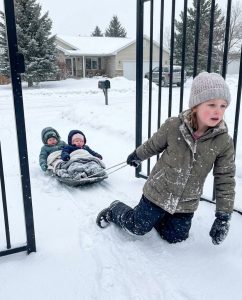
She was leaning forward into the wind with both hands around a rope.
Something followed behind her.
A sled.
My body reacted before my mind caught up.
I ran.
I did not stop for the right coat. I did not stand there studying the monitor. I shoved through the door, and the cold struck my lungs hard enough to make breathing hurt.
Still, the girl kept coming.
Still, she pulled.
Still, she refused to let go.
That was what stayed with me most.
Her hair had frozen stiff around her face. Snow clung to her eyelashes. Her lips had turned blue, and her knees kept giving little warning dips as if her body were trying to shut down one piece at a time.
Yet both hands remained fixed around the rope.
“Help…”
I almost lost the word in the wind.
I pushed through the gate toward her.
She lifted her face.
Recognition hit harder than the cold.
“Lily?”
My niece.
Sarah’s daughter.
I had never seen her standing in front of me before, but I knew exactly who she was.
Seven years can change almost everything about a family. It cannot always erase recognition.
Sarah and I had not spoken since the fight that ended our relationship.
She had married Marcus Kane despite every warning I gave her.
I had not objected because I disliked his personality or because I thought no man was good enough for my sister. I had looked into him because things around him did not add up.
There were lawsuits.
There were questionable business deals.
There were missing financial records.
There were former employees whose stories changed after meetings with his lawyers.
None of those facts, individually, gave me the right to run Sarah’s life.
I knew that.
But together they frightened me.
I told her Marcus was dangerous.
Sarah heard something different.
She heard judgment.
She heard control.
She heard an older sister who believed a medical degree gave her authority over everyone else’s decisions.
Maybe I gave her reasons to hear it that way.
Our last argument became the kind siblings think they can repair later.
Voices rose.
Old resentments found new words.
Pride did the rest.
“Then leave,” she told me.
“And don’t come back.”
I left.
For seven years, I replayed it.
Sometimes I believed giving her space had been the only respectful choice.
Sometimes I believed I had abandoned her when she needed someone stubborn enough to stay.
There was no medical chart for that question. No scan. No lab value. No clean answer that could be circled in black ink.
Then Lily appeared in my driveway.
Seven years vanished in one look.
When I reached her, her mouth trembled.
“Mommy said you wouldn’t let the monsters come inside.”
I had no chance to ask what she meant.
Her legs collapsed.
I caught her against me.
Even then, her hands stayed around the rope.
That detail frightened me more than the fall.
A child who feels safe lets go.
Lily did not.
I looked beyond her and finally saw what she had been protecting.
Two bundled babies were lying on the sled.
For one impossible moment, the entire scene seemed to separate into details the way emergencies sometimes do: Lily’s blue lips, the frozen rope, the buried driveway, the babies under their coverings, the gate disappearing beneath snow.
Then Mara came running from the house carrying blankets.
“Get them inside,” I shouted.
There was no discussion.
No questions yet.
No Sarah yet.
Mara moved to the sled while I lifted Lily.
The girl felt frighteningly cold through her soaked clothing.
Mara had to work the rope from Lily’s rigid fingers. Even unconscious against me, my niece seemed determined to keep holding it.
Finally Mara wrapped the rope around her own hand.
Then she pulled.
She pulled the babies across the threshold while I carried Lily ahead of her.
The door closed against the storm.
Inside, everything changed.
Not emotionally.
Practically.
The house became a treatment space because it had to.
Wet layers had to come off. Dry blankets had to go on. Breathing and circulation mattered more than the questions burning through me.
Medicine can tell you how cold a child is; it cannot tell you what frightened her enough to keep walking.
I lowered Lily onto the couch.
Her cheeks looked painfully pale beneath the cold. Her eyelashes were still crusted with melting snow, leaving tiny drops along her skin as the warmth of the room slowly reached her.
I kept my fingers against her wrist.
There.
A pulse.
I watched her chest.
There.
Breathing.
I checked her hands next.