My name is Grace, and for four years I learned how to hear danger before anyone else in the room noticed it.
I learned the difference between a tired breath and a bad breath.
I learned what it meant when my daughter’s lips lost color around the edges.
I learned to keep one ear tuned to the soft hum of an oxygen machine the way other mothers listen for a baby monitor.
My daughter Lily was born at twenty-eight weeks, so small the first time I saw her that I was scared my own breathing might hurt her.
The hospital bassinet looked too big for her.
The tubes looked bigger than her hands.
The nurses spoke gently, and the doctors chose their words carefully because they knew I was already standing at the edge of a cliff.
They told me about underdeveloped lungs.
They told me about oxygen support.
They told me about bronchopulmonary dysplasia and infection risk and emergency signs I needed to memorize before I even understood what kind of mother I was going to have to become.
So I became that mother.
I learned how to clean tubing.
I learned how to read saturation numbers.
I learned which cough meant watch her and which cough meant pack a bag.
I learned how quickly a normal afternoon could become a hospital waiting room with vending machine coffee and a registration bracelet around my wrist.
Lily survived her first year.
Then she survived her second.
Then her third.
By four, she had wild brown curls, serious eyes, and a laugh that sounded like she was surprised joy existed.
She loved purple crayons, plastic dinosaurs, fairy-tale castles, and asking questions at the exact moment I thought I had run out of answers.
She also still needed oxygen.
Sometimes it was a nasal cannula.
Sometimes it was a mask.
Sometimes it was just at night or during illness.
Sometimes, when her lungs were tired, it was nearly constant.
Her oxygen was not a prop.
It was not clutter.
It was not something she used for attention.
It was the reason my daughter could stay alive long enough to draw dinosaurs wearing princess crowns.
Her father, Jake, left before she was old enough to remember his face.
He said the appointments were too much.
He said the bills were too much.
He said the fear was too much.
Then he packed two duffel bags, put them in his car, and drove out of our apartment complex like he was escaping a weather system instead of abandoning a child.
He never learned which alarm meant danger.
He never sat up at 3:00 a.m. whispering, “Please keep breathing,” over a crib.
That became my job.
Every job became my job.
I worked, I filled forms, I made calls, I kept folders, I washed tiny clothes with gentle detergent, and I slept with one hand near Lily’s blanket because feeling her chest rise was the only way I could rest.
We did not have much.
We had thrift-store coats, library story time, payday meals, and a kitchen table that wobbled if you leaned too hard on one side.
But we had peace.
Most days, peace was enough.
Then there was my family.
My mother, Dorothy, had always loved appearances more than people.
Her house was never simply a house.
It was a stage.
The floors had to shine.
The curtains had to hang correctly.
The couch pillows had to look untouched, as if no tired person had ever sat down with a cup of coffee and a headache.
My father, Kenneth, did not argue with her.
He had perfected a cold silence that made his approval feel like a locked door.
If my mother decided something mattered, my father enforced it.
If she decided someone did not matter, he looked away.
My older sister Vanessa mattered.
Vanessa married a lawyer, lived in a nice house, drove a clean family SUV, and had three healthy children who looked perfect in holiday photos.
My parents celebrated every soccer goal, spelling test, piano recital, and missing tooth like it was proof the family had done something right.
Lily took her first steps at three after months of therapy.
She trembled on weak little legs, gripping my fingers so tightly her nails pressed half-moons into my skin.
My mother glanced up from her phone and said, “That’s nice. Anyway, Vanessa is thinking about remodeling her kitchen.”
That was the family map.
Vanessa’s children were milestones.
Lily was inconvenience.
My mother called the oxygen equipment ugly.
My father called me overprotective.
Once, when Lily missed a family dinner because of a respiratory infection, Dorothy sighed and said, “There’s always something with that child.”
I should have left that house behind the first time she said it.
I know that now.
But wanting family can make you stupid in quiet ways.
I wanted Lily to have grandparents.
I wanted her to have cousins.
I wanted her to belong somewhere bigger than our apartment, our clinic appointments, and the hospital hallways where the vending machines glowed all night.
So I kept showing up.
I kept explaining.
I kept giving my parents chances they had not earned.
Then Christmas weekend came.
Vanessa called to say she, her husband, and the kids were coming to my parents’ house for the holiday.
My mother reacted like royalty had accepted an invitation.
She made lists.
She bought new hand towels.
She washed guest bedding twice.
She called me three times before 9:00 a.m. on the day Vanessa was due to arrive.
The first voicemail said she needed help.
The second said family helped family.
The third said I always made things difficult.
By then, Lily was already curled against me on the couch, breathing harder than usual.
It was not quite hospital-level.
I had checked her numbers at 7:42 a.m., then again at 8:05.
I wrote both readings in the spiral notebook I kept tucked inside her supply bag.
The oxygen delivery slip was still folded in the front pocket.
Her emergency instruction page was in the folder behind it.
That was how I lived.
I documented what other people dismissed.
Lily looked up at me and whispered, “Mommy, can I bring my dinosaur book?”
I almost said we were staying home.
Then my phone buzzed again with my mother’s name.
I let it ring.
I knew what the message would say before I heard it.
So I packed Lily’s oxygen supplies, her monitor, the folder, the spiral notebook, two backup masks, wipes, snacks, crayons, and the dinosaur coloring book.
I buckled her into the car and drove across town with my stomach tight enough to hurt.
The neighborhood looked harmless when we pulled in.
Suburban houses.
Bare winter lawns.
A small American flag near my parents’ porch, snapping lightly in the cold.
Vanessa’s family had not arrived yet.
My mother’s house smelled like lemon cleaner, cinnamon candles, and stress.
She was moving through the rooms like a storm in a cardigan, snapping at my father about streaks on the windows and muttering about dust no one else could see.
Lily sat on the living room rug by the coffee table.
Her oxygen machine hummed beside her.
Her mask fogged faintly with each breath.
She colored a dinosaur green with tiny, careful strokes.
She was not making a mess.
She was not asking for attention.
She was not in anybody’s way.
She was just breathing.
My mother came into the room holding folded towels and stopped.
Her eyes dropped to the tubing before they found my daughter’s face.
“Why is she just sitting there?” she asked.
I was wiping the side table.
“She’s having a rough breathing day,” I said. “She needs to rest.”
“She can dust,” Dorothy said. “She has hands.”
I looked at her, waiting for the joke that did not come.
“No,” I said. “She can’t. Not today.”
The room changed around that one word.
My mother’s mouth tightened.
Some families hear no and understand a line has been drawn.
Mine heard it as disrespect.
“She’s four, Grace,” Dorothy said. “You’re teaching her to be helpless.”
“I’m teaching her to stay alive.”
Dorothy crossed the room.
I remember the basket thudding against the couch.
I remember Lily looking up because adults moving fast around her always made her nervous.
I remember my mother bending down.
Then she grabbed the oxygen mask and tubing and pulled it away from Lily’s face.
The sound Lily made was not loud.
It was a small, broken gasp.
That was worse.
Her purple crayon rolled under the coffee table.
Her hand flew to her face.
Her eyes widened with the kind of panic no child should understand.
Dorothy stood over her, holding the mask just out of reach.
“Enough sitting around,” she snapped. “Start cleaning now. Your cousins will be here soon.”
I moved before I had a thought.
“Give it back,” I said. “Now.”
“She can breathe fine when she wants something.”
“She can’t breathe without it.”
“Stop exaggerating.”
I saw Lily’s chest working too fast.
I saw the color around her mouth fading.
I saw the living room disappear and every hospital room return.
The beep of monitors.
The smell of sanitizer.
The nurse’s hand on my shoulder when Lily was eight months old and struggling through an infection.
Fear has muscle memory.
Mine knew exactly where to go.
“Mom,” I said, and my voice broke despite every effort not to let it, “give me the mask. She could pass out. She could die.”
That was when my father walked in.
He did not look at Lily first.
He looked at my mother.
Then he looked at me.
“What is going on?” he demanded.
“She took Lily’s oxygen,” I said. “Dad, please. Look at her.”
He glanced at my daughter for less than a second.
His expression did not become afraid.
It became irritated.
“Your sister is arriving any minute,” he said. “This is not the time for drama.”
I stared at him.
“Drama? She can’t breathe.”
Dorothy made a disgusted sound.
“Grace has always exaggerated everything.”
I pointed at Lily.
“Look at her mouth. Look at her chest. She needs it back right now.”
My father stepped closer.
“Lower your voice.”
“No,” I said. “Not while my daughter is turning blue.”
The slap came so fast I did not see his arm move.
My head snapped to the side.
Pain burst across my cheek, then turned into numb heat.
I stumbled into the coffee table, and the crayons rattled across the wood.
I tasted blood where my teeth had cut the inside of my mouth.
For one second, the room held still.
The oxygen machine hummed uselessly beside my child.
My mother looked almost relieved.
My father’s voice landed flat and hard.
“Stand down.”
There are moments when anger arrives like fire.
This was not fire.
This was ice.
Something inside me went quiet.
Not forgiveness.
Not calm.
A decision.
I stepped around my father and reached for the tubing in Dorothy’s hand.
She tried to yank it away.
I gripped harder.
My fingers shook, but my voice did not.
“Let go.”
For the first time that morning, she looked unsure.
I took the mask from her, dropped to my knees, and pressed it gently back over Lily’s face.
Lily grabbed my sleeve with both hands.
She dragged in air in thin, frightened pulls.
“I’m here,” I whispered. “Breathe, baby. Just breathe.”
Behind me, my father said, “You are not going to make a scene.”
Then the front door opened.
Vanessa’s voice came through bright and cheerful.
“We’re here!”
Her children came in first, laughing, boots thumping against the entryway floor.
Then all the laughter stopped.
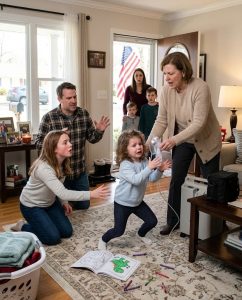
The living room froze.
Dorothy still had one hand near the oxygen tubing.
Kenneth stood over me with his jaw tight.
I was kneeling on the rug with a bleeding mouth, holding Lily while her little body trembled behind the mask.
Vanessa looked from my face to Lily.
Then to our mother.
Then to our father.
For the first time in my life, my sister looked at that room without the family filter.
Before anyone could lie, Lily lifted one shaking finger toward Dorothy.
Through the mask, barely louder than a breath, she whispered, “Grandma took my air.”
Vanessa’s smile dropped.
Then she looked at our father and said, “What did you do?”
Nobody answered.
My father tried to recover first.
“This is family business,” he said. “Take the kids to the kitchen.”
Vanessa did not move.
Her husband stood behind her with an overnight bag still in his hand.
Her oldest child stared at Lily like the world had changed shape.
My mother tried to put the tubing down slowly, like slow movement could erase what everyone had seen.
It did not.
“Grace,” Vanessa said, and her voice had gone low. “Tell me exactly what happened.”
I opened my mouth, but Dorothy cut in.
“She needed to learn she can’t use that machine to get out of helping.”
There it was.
No misunderstanding.
No accident.
No panicked mistake in a crowded room.
A belief.
A grown woman had looked at my daughter’s medical equipment and decided discipline mattered more than oxygen.
Vanessa went pale.
Her husband set the overnight bag down carefully.
Then he pulled out his phone.
“I’m recording this,” he said.
My father turned on him.
“Put that away.”
He did not.
“Say again what you just said,” Vanessa’s husband told Dorothy.
My mother looked offended, as if being recorded was the violation.
My father took one step toward him.
Vanessa stepped in front of her husband.
“No,” she said.
It was one small word.
In that house, it sounded like furniture breaking.
Lily’s monitor started beeping from the supply bag on the coffee table.
I had not clipped it back on after rushing to replace the mask, but the last reading still flashed low enough to make my stomach drop.
Vanessa saw the number before I could close the bag.
“What is that?” she asked.
“Her oxygen,” I said.
My voice sounded far away.
“That’s from when the mask was off.”
Her youngest child started crying.
Her oldest whispered, “Mom, is Lily going to die?”
My mother finally looked at Lily like the child on the rug was real.
Not clutter.
Not an embarrassment.
Not a problem sitting in the wrong place before company arrived.
Real.
I reached for the medical folder with shaking hands.
The folder was wrinkled at the corners because I carried it everywhere.
Inside were appointment summaries, oxygen instructions, emergency contacts, and the typed page from Lily’s clinic that said removal of oxygen support during respiratory distress required immediate intervention.
I opened to that page.
My father tried to step between me and Vanessa.
This time, Vanessa blocked him.
“Move,” she said.
He stared at her like he had never heard her use that voice.
I read the first line out loud.
Dorothy’s hand flew to her throat.
Kenneth’s face hardened.
Vanessa’s husband kept recording.
When I finished the second line, Vanessa turned to our mother and asked, “Did you know this?”
Dorothy said nothing.
That silence told the truth better than any confession could have.
Vanessa covered her mouth.
She had spent years as the golden child in that house, but even she could not decorate this into something acceptable.
The pretty towels were still folded on the couch.
The cinnamon candle was still burning.
The windows were clean.
The house looked ready for family.
And in the middle of it, my daughter had been taught that some people cared more about appearances than air.
I stood slowly with Lily in my arms.
My cheek throbbed.
My knees hurt from the rug.
Lily’s fingers stayed locked in my sweater.
“We’re leaving,” I said.
My father’s answer was immediate.
“You are not walking out after causing this scene.”
Vanessa turned on him.
“She didn’t cause it.”
Dorothy found her voice then.
“Oh, please. You all know how Grace is. Everything is an emergency. Everything is about Lily.”
“Yes,” Vanessa said. “Because Lily is four.”
My mother flinched as if the sentence had struck her.
Vanessa’s husband moved toward the door and opened it wider.
Cold daylight spilled into the entryway.
The small flag on the porch snapped in the wind.
For once, my parents did not look powerful.
They looked exposed.
I carried Lily toward the door.
Dorothy reached out, not for Lily, but toward the folder in my hand.
I pulled it back.
“No,” I said.
It was the second time I had said that word that day.
This time, nobody slapped me.
Vanessa grabbed Lily’s supply bag.
Her husband picked up the oxygen machine.
Her children stood pressed against the wall, quiet and scared, watching adults become something they could not unsee.
At the doorway, Lily turned her head against my shoulder.
“Mommy,” she whispered, “did I do bad?”
The question almost broke me.
I kissed her hair.
“No, baby. You did nothing wrong.”
Behind us, my mother started crying.
Not for Lily.
Not for me.
For herself.
“Now everyone thinks I’m a monster,” she said.
Vanessa looked back at her.
“No,” she said quietly. “Now everyone knows what happened.”
I drove straight to urgent care because I trusted documentation more than family explanations.
The nurse took one look at Lily’s breathing and brought us back.
The intake form asked what happened.
For the first time in my life, I wrote it plainly.
Oxygen mask removed by family member during respiratory distress.
Mother struck while trying to return oxygen.
Witnesses present.
The nurse read it, looked at my cheek, and asked if I wanted the incident noted in the chart.
I said yes.
That yes changed everything.
A social worker came in.
Then a police officer came to take a report.
Vanessa arrived twenty minutes later with her husband, the recording, Lily’s supply bag, and the coloring book Dorothy had tried to forget on the rug.
The green dinosaur in the princess crown was half finished.
The page was bent where Lily’s hand had crushed it.
Vanessa cried when she saw it.
“I should have seen it sooner,” she said.
I was too tired to comfort her.
For years, I had been the difficult daughter because I asked people to treat my child’s medical needs as real.
For years, my parents had called that drama.
The thing about a family lie is that it only works when everyone agrees not to write it down.
That day, it was written in a chart.
It was recorded on a phone.
It was listed in a police report.
And it was witnessed by the daughter my parents had spent years believing would always take their side.
Lily was okay by that evening.
Shaken, exhausted, clingy, but okay.
Her oxygen numbers stabilized.
The doctor told me I had done the right thing bringing her in.
I cried in the bathroom after that.
Not loud.
Not dramatically.
Just one hand over my mouth, trying not to scare Lily while the fear finally left my body all at once.
Vanessa waited in the hallway with a paper coffee cup she had bought from the vending area.
When I came out, she handed it to me and said, “I’m sorry.”
Two words were not enough.
She knew that.
I knew that.
But they were the first honest words my family had given me in a long time.
In the weeks that followed, everything changed.
My parents called and called.
I did not answer.
My father left messages about respect.
My mother left messages about forgiveness.
Neither of them left one message asking how Lily was breathing.
That told me what I needed to know.
Vanessa sent the recording when the officer requested it.
Her husband gave his statement.
The urgent care chart matched my report.
The oxygen readings in my spiral notebook showed Lily had already been struggling that morning.
The same notebook my mother once mocked as obsessive became one of the things that proved I had been paying attention while everyone else looked away.
There was no dramatic courtroom speech.
No perfect movie ending.
Life rarely hands mothers clean justice wrapped in a bow.
But there were consequences.
There were reports.
There were boundaries.
There was a written warning attached to my parents having any contact with Lily.
And there was me, finally understanding that family is not proved by blood or holidays or matching photos on a mantel.
Family is proved by who protects your child when the room gets uncomfortable.
Vanessa and I are not magically healed.
We are careful with each other now.
She visits Lily at my apartment sometimes, bringing groceries and sticker books, and she has learned to ask before touching any tube, mask, or machine.
Her children are gentle around Lily in a way that makes my throat ache.
They bring her crayons.
They sit on the floor with her.
They let her explain dinosaurs in a voice.
They sit on the floor with her.
They let her explain dinosaurs that gets stronger every month.
Lily still has hard breathing days.
I still wake at night and listen for her.
I still keep the folder by the door.
But we have peace again.
Real peace this time.
Not the kind that depends on keeping cruel people comfortable.
Sometimes Lily asks about Grandma.
I tell her the truth in words a four-year-old can carry.
“Grandma made an unsafe choice, and Mommy’s job is to keep you safe.”
She accepts that more easily than I expected.
Children understand safety faster than adults understand accountability.
Last week, Lily finished another dinosaur drawing.
This one had wings, a crown, and a purple oxygen mask.
She taped it to our refrigerator herself.
Then she stood back, smiled, and said, “This one can breathe.”
I looked at that picture for a long time after she went to bed.
I thought about my mother’s spotless house, the polished windows, the cinnamon candle, the folded towels, the way everyone had once acted like silence was the polite response.
And I thought about my daughter on that rug, reaching for air while grown adults worried about company arriving.
Some families teach children they must shrink to be loved.
Mine tried to teach my daughter that breathing was negotiable.
They failed.
Because Lily is still here.
She is still coloring.
She is still asking questions I do not always know how to answer.
And every time I hear that oxygen machine hum, I do not hear weakness anymore.
I hear proof.
My daughter was not the problem in that living room.
She was the only honest thing in it.