HOA Destroyed My Dock and Sank My Yacht—Then a Coast Guard Investigator Asked Who Authorized the Demolition
The first thing I saw when I turned onto Harbor Pine Lane was my yacht’s mast sticking out of the lake at a forty-five-degree angle.
The second thing I saw was my dock floating upside down beside it.
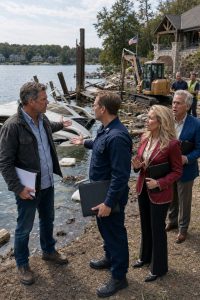
And the third thing was Cynthia Vale, president of the Harbor Ridge Homeowners Association, standing on my shoreline in white slacks and a navy blazer, holding a clipboard like she had just won a war.
I stopped my truck in the middle of the gravel drive.
I didn’t slam the brakes.
I didn’t jump out.
I didn’t shout.
I just sat there with both hands on the steering wheel and watched a yellow excavator crush the last twelve feet of my private pier into a pile of treated lumber.
A worker in an orange vest lifted the bucket.
Boards snapped.
Steel brackets twisted.
One of my dock lights shattered against a concrete piling.
Behind the excavator, my fifty-two-foot Grand Banks motor yacht, Resolute, sat partially submerged in twelve feet of water.
Only the flybridge, radar arch, and upper windows remained above the surface.
Diesel sheen glimmered faintly around the stern.
That was the detail that finally made me move.
Not the yacht.
Not the dock.
The fuel.
I put my truck in park, grabbed my phone, and stepped out.
Cynthia noticed me immediately.
Her smile widened.
That told me almost everything I needed to know.
“Daniel,” she called. “I was wondering when you’d get back.”
I ignored her.
I walked down the slope toward the water, filming the entire scene.
The excavator operator stopped when he saw me.
A younger man wearing a contractor shirt looked from me to Cynthia.
“Is that the owner?” he asked.
Cynthia answered before I could.
“He’s been notified.”
I kept recording.
“Turn the excavator off.”
The operator did.
Cynthia’s smile disappeared.
“You don’t have authority to direct my contractors.”
“They’re standing on my property.”
“This shoreline falls within the Harbor Ridge architectural control district.”
“No, it doesn’t.”
She raised her clipboard.
“We’ve been through this.”
“No,” I said. “You’ve sent letters. That isn’t the same thing.”
Her face tightened.
Around us, three HOA board members stood near a black SUV.
Greg Fallon, the treasurer.
Elaine Mercer, who chaired the architectural committee.
And Todd Reese, Cynthia’s favorite volunteer enforcer, who had somehow turned owning a golf cart and a reflective vest into a personality.
Todd folded his arms.
“You ignored seven notices.”
I looked at him.
“Did you sink my boat?”
Nobody answered.
That silence mattered.
I walked closer to the shoreline.
The Resolute had been tied at my dock when I left for Annapolis four days earlier.
She was built like an old bank vault.
Fiberglass hull.
Twin diesels.
Watertight bulkheads.
Automatic bilge systems.
Two independent battery banks.
She did not simply sink because somebody bumped her.
The aft quarter was much lower than the bow.
One stern line remained attached to a mangled cleat.
Another line had been cut clean.
Not torn.
Cut.
I zoomed in with my phone.
Cynthia stepped beside me.
“Your illegal structure created an obstruction.”
I turned the camera toward her.
“Say that again.”
She hesitated.
Good.
People become surprisingly careful when they notice they’re being recorded.
Cynthia adjusted her sunglasses.
“The association determined your dock violated current community standards. Our attorney confirmed we had the right to abate the violation after sufficient notice.”
“And my yacht?”
“That was unfortunate.”
“Unfortunate.”
“It was moored to the structure during removal.”
I looked at the water.
Then back at her.
“You demolished a dock while a fifty-two-foot vessel was attached to it?”
“Our contractor was instructed to secure the vessel.”
“By whom?”
She stared at me.
“Daniel, this doesn’t need to become dramatic.”
That almost made me laugh.
Instead, I dialed 911.
Her mouth opened.
I raised one finger.
“Emergency services. What’s the location of your emergency?”
I gave the dispatcher my address.
Then I said, “A vessel has been sunk at my private dock during an unauthorized demolition. There is a visible petroleum discharge in the water. I also need law enforcement because property has been destroyed and I believe evidence may have been altered.”
Cynthia’s expression changed.
Not much.
Just enough.
The smugness slipped.
Todd stepped forward.
“There’s no need to involve police.”
I looked at him.
“There’s fuel in the lake.”
“It’s barely anything.”
“Then you won’t mind explaining that to the fire department.”
Greg Fallon muttered something under his breath.
Cynthia walked several yards away and pulled out her phone.
I knew who she was calling.
The association attorney.
Good.
I wanted him there too.
Because six months earlier, when Harbor Ridge first tried to claim my shoreline, I had learned something important about Cynthia Vale.
She believed paperwork was power.
And usually, she was right.
She had spent eleven years running Harbor Ridge like a private municipality.
She issued fines.
Placed liens.
Threatened foreclosure.
Approved fences.
Rejected paint colors.
Sent tow trucks.
Filed nuisance complaints.
She once forced an elderly couple to remove a wheelchair ramp because the railing didn’t match the approved cedar stain.
That decision lasted exactly three days after their daughter contacted a disability attorney.
But Cynthia hadn’t learned humility from that.
She had learned to use lawyers earlier.
My problem with her began the previous fall, when Harbor Ridge Development Group purchased seventy acres north of my property.
The original subdivision contained eighty-four lakefront homes.
The new expansion would add sixty-two more.
Luxury homes.
Private clubhouse.
Shared marina.
And, according to glossy marketing brochures that began appearing online, “exclusive deep-water lake access.”
There was only one problem.
Harbor Ridge did not own deep-water access.
I did.
My property was seventeen acres of old shoreline that had belonged to my grandfather since 1968.
It sat in a narrow bend where the lake dropped sharply to twenty feet.
The HOA-controlled shoreline, meanwhile, was shallow.
Too shallow for the marina their developer wanted without extensive dredging.
My grandfather had installed the original dock decades before the subdivision existed.
My deed predated every HOA covenant around us.
I wasn’t a member.
Never had been.
Cynthia knew that.
The developer knew it.
Their attorney definitely knew it.
But apparently they hoped enough letters would eventually change geography.
The first envelope arrived in November.
NOTICE OF NONCOMPLIANT MARINE STRUCTURE.
I put it in a drawer.
The second demanded an architectural review fee.
I mailed it back with a copy of my deed.
The third threatened a $250-per-day penalty.
I had my attorney, Rachel Kim, respond.
Her letter was three pages long.
Mine would have been two words.
Rachel preferred professionalism.
For a while, the HOA backed off.
Then survey stakes appeared near my property line.
I removed none of them.
I photographed them.
Then I hired an independent surveyor.
The stakes weren’t marking the actual boundary.
They were marking a proposed pedestrian easement running along my shoreline.
An easement that did not exist.
Two weeks later, a Harbor Ridge planning document appeared on the county website.
The new development rendering showed a boardwalk connecting the HOA clubhouse to a marina.
That boardwalk crossed my land.
The marina occupied the exact location of my private dock.
That was when I understood.
The letters had never really been about my dock.
The dock was standing where someone wanted to build something bigger.
And now it was lying upside down in the water.
Sirens echoed beyond the trees.
Cynthia ended her phone call.
“Our counsel is on the way.”
“Excellent.”
“You’re making a serious mistake.”
I looked at the half-sunken Resolute.
“So far, Cynthia, I’m having trouble finding one that belongs to me.”
The county sheriff’s deputy arrived first.
Deputy Mason Cole.
Mid-forties.
Quiet.
The kind of man who listened long enough to make dishonest people nervous.
He walked toward the shoreline, saw the excavator, saw the yacht, then looked at me.
“Who owns the vessel?”
“I do.”
“Who owns the dock?”
“I do.”
“Who authorized demolition?”
Cynthia stepped forward.
“The Harbor Ridge HOA, under its covenant enforcement authority.”
Mason looked at her.
“Is this property inside the HOA?”
Cynthia’s pause lasted half a second.
“No, but—”
Mason turned to me.
“Do you have identification?”
I handed it over.
“And documentation for the property?”
“In my truck.”
“Boat registration?”
“Documentation certificate is onboard.”
Cynthia seized on that.
“So you can’t produce it.”
I ignored her again.
Mason raised a hand.
“Ma’am, give me a minute.”
The fire department pulled in next.
Then environmental response.
Within fifteen minutes, what Cynthia had treated like a landscaping project became a controlled incident scene.
Absorbent booms went into the water.
The contractor crew suddenly became very interested in leaving.
Mason stopped them.
“Nobody drives equipment off this property until I have names and company information.”
The contractor supervisor pointed toward Cynthia.
“We were hired by Harbor Ridge.”
Cynthia’s attorney finally arrived in a silver Mercedes.
His name was Victor Hale.
Expensive suit.
Perfect hair.
Smile like polished marble.
He walked straight toward Cynthia, spoke quietly for thirty seconds, then approached Mason.
“I represent Harbor Ridge Homeowners Association. I believe there’s been a misunderstanding involving authorized covenant enforcement.”
Mason looked at the upside-down dock.
Then the yacht.
“Pretty expensive misunderstanding.”
Victor glanced toward me.
“Mr. Mercer has a documented history of refusing to comply with community standards.”
“I’m not in your community,” I said.
Victor gave me the patient expression attorneys use when they want witnesses to think the other person is emotional.
“Your property is geographically integrated into Harbor Ridge.”
“It’s geographically integrated into North Carolina too. Raleigh doesn’t get to choose my patio furniture.”
One firefighter coughed to hide a laugh.
Victor’s smile tightened.
“An easement exists along this shoreline.”
“Show me.”
Cynthia looked toward Victor.
Victor opened his leather folio.
He pulled out a photocopy.
“This easement was recorded in connection with the lake access agreement.”
I took the paper.
I didn’t need long.
I had seen versions of it before.
The legal description ended twenty-six feet north of my parcel.
“This doesn’t cross my land.”
Victor pointed.
“The association’s interpretation—”
“Land descriptions aren’t interpretive dance.”
Mason held out his hand.
“Let me see that.”
Victor passed him the document.
I walked to my truck and retrieved the folder Rachel had told me to keep behind the seat.
Deed.
Survey.
Title opinion.
County GIS printout.
Old plats.
And one certified document that was about to make everyone’s day considerably worse.
When I returned, Mason had Cynthia separated from the contractor supervisor.
Good police work.
Keep stories from blending.
I handed Mason my deed and survey.
He studied them.
Then looked at Victor’s easement.
“Different parcel.”
Victor spoke carefully.
“There are overlapping rights.”
“No,” I said. “There aren’t.”
Cynthia snapped.
“You cannot expect an entire neighborhood to redesign a multimillion-dollar waterfront improvement because of one obsolete dock.”
There it was.
The first honest sentence she had spoken.
Mason looked at her.
“This demolition was part of the new marina project?”
Victor interrupted immediately.
“My client did not say that.”
Cynthia realized her mistake.
I said nothing.
That was the easiest part of dealing with people like Cynthia.
Give them enough silence and eventually they argue against themselves.
I had learned that in the Coast Guard.
Not as an admiral.
Not as some heroic rescue swimmer.
Nothing cinematic.
I spent sixteen years in marine engineering and incident response before leaving active duty and starting a commercial marine systems company.
Most emergencies were not dramatic.
They were procedures.
Containment.
Documentation.
Sequence.
You didn’t scream at a failing system.
You isolated it.
You recorded it.
You stopped one failure from turning into five.
That afternoon, Cynthia Vale was a failing system.
And I had no intention of interrupting her.
I handed Mason the certified survey.
He compared the lines.
“According to this, the dock is entirely inside Mr. Mercer’s parcel.”
“It projects into community waters,” Cynthia said.
I looked at her.
“No such thing.”
“The lake is shared.”
“The lake is state-controlled water. Your HOA doesn’t own it.”
Victor stepped in.
“We should refrain from making legal conclusions roadside.”
Mason nodded.
“Agreed. Which is why nobody is touching anything else.”
Then he looked at me.
“You said the vessel documentation was onboard?”
“Yes.”
“Can you access it safely?”
“No. But I have the documentation number.”
I gave it to him.
Victor glanced at Cynthia.
She didn’t notice.
I did.
Mason typed into his patrol tablet.
A few seconds later, his brow changed.
Not dramatic.
Just focus.
“Your vessel is federally documented.”
“Yes.”
Cynthia gave a dismissive laugh.
“Every large yacht has paperwork.”
I looked at her.
“Not exactly.”
Mason kept reading.
“What does ‘official service notation’ mean?”
That was the moment Cynthia’s attorney stopped smiling.
I answered.
“The Resolute isn’t just documented through the Coast Guard’s National Vessel Documentation Center. She’s enrolled under a federal research-support agreement.”
Cynthia stared at me.
“A what?”
I pointed toward the yacht.
“The vessel supports Coast Guard and university navigation testing several times a year. Sensor calibration. AIS studies. Emergency communications trials.”
Victor spoke very slowly.
“Is the vessel currently operating under federal assignment?”
“She finished a navigation equipment trial nine days ago.”
He looked at the water.
“Was federal equipment onboard?”
“Yes.”
That answer landed differently.
Even Mason looked at me again.
“What kind of equipment?”
“Prototype communications hardware. Two sealed navigation modules. A data recorder. Government property tags on all three.”
Cynthia’s face lost color.
Todd Reese laughed once.
It was nervous.
“Come on. You expect us to believe the Coast Guard left secret equipment on your pleasure boat?”
“I didn’t say secret.”
I looked at him.
“I said federal.”
That distinction mattered.
Todd didn’t understand why.
Victor did.
“Daniel,” he said, suddenly using my first name, “perhaps we can handle the recovery cost privately.”
I almost admired the speed of the pivot.
Five minutes earlier, I was a delinquent homeowner who needed to obey.
Now we were discussing private resolution.
I shook my head.
“This stopped being private when fuel entered navigable water.”
The fire chief walked over.
“We’ve contained what we can see. We’re calling state environmental.”
“Understood.”
Then I added, “You may also want Coast Guard Sector North Carolina notified.”
Cynthia crossed her arms.
“This is ridiculous. We’re eighty miles inland.”
“Federal documentation doesn’t disappear because you don’t like the ZIP code.”
Victor turned to her.
“Don’t say anything else.”
She stared at him.
That was probably the first time in years anyone had given Cynthia Vale an order she couldn’t ignore.
I wish I could say I enjoyed it.
I didn’t.
Not yet.
Because the Resolute was sinking deeper.
And boats don’t care about revenge.
Every minute she sat underwater, systems died.
Wiring.
Panels.
Engines.
Generators.
Woodwork.
Electronics.
My grandfather had taught me to run a boat when I was eleven.
He had never owned anything as big as the Resolute, but he had wanted one.
After he died, I found an old Grand Banks brochure in his desk.
Three circles in blue ink marked the model he liked.
I bought one seven years later.
Not the same year.
Not the exact design.
But close enough.
The teak wheel still had a tiny brass plate beneath it with his initials.
RWM.
That plate was underwater now.
That hurt more than I let anyone see.
I walked down to the shoreline.
The sun had begun lowering behind the pines.
Booms floated around the stern.
One fireman watched the fuel sheen.
The lake beyond everything remained perfectly calm.
That was the strange thing about disasters.
The world rarely adjusts its lighting.
Birds keep flying.
Water keeps moving.
Somebody three houses away keeps grilling hamburgers.
Your life can split open while the sky looks beautiful.
I stood there and thought about the past six months.
I had ignored the insults.
I had answered the letters.
I had paid for the surveys.
I had refused the fines.
I had refused their meetings.
I had refused their pressure.
I had refused to sell.
I had refused to be frightened.
I had refused to mistake confidence for authority.
And now, looking at my yacht underwater, I understood something Cynthia had apparently failed to understand about me.
Calm was not surrender.
Calm was what came before action.
By six that evening, two additional patrol cars had arrived.
The contractor’s insurance company was calling everyone.
Rachel Kim was driving in from Raleigh.
And Victor Hale had moved Cynthia and the HOA board members beside their SUV, where they spoke in whispers.
I sat on my tailgate and created a timeline.
9:14 a.m. — first security camera loses signal.
9:17 — driveway motion sensor records excavator arrival.
9:21 — contractor crew enters shoreline area.
9:28 — second camera goes offline.
10:03 — neighbor’s camera catches excavator boom above trees.
Unknown — dock demolition begins.
Unknown — yacht compromised.
2:46 p.m. — I arrive.
My cameras mattered.
But the missing footage mattered more.
Two cameras had not simply failed.
Both were hardwired into the same network.
Both had battery backup.
Someone had cut the exterior fiber line at the junction box.
I found the box behind the boathouse.
The cover screws were sitting neatly on the ground.
The cable inside had been clipped.
That wasn’t demolition damage.
That was preparation.
I photographed it without touching anything.
Then called Mason.
He came over.
“Interesting.”
“Very.”
“Who knew you had cameras?”
“Anyone who walked onto the property.”
A small sign near the drive said VIDEO SURVEILLANCE.
Todd had complained about it once.
Cynthia had called the cameras “hostile neighborhood aesthetics.”
Mason photographed the junction box.
“Don’t touch it.”
“Wasn’t planning to.”
Rachel arrived twenty minutes later.
Five-foot-four.
Gray pantsuit.
Black hair in a low ponytail.
She stepped out of her car carrying two legal pads and the expression of a woman who had just discovered someone had volunteered to fund her next vacation.
She looked toward the lake.
“Oh.”
That was all she said.
Then she looked at me.
“Are you okay?”
“Yes.”
“Boat insured?”
“Yes.”
“Dock?”
“Yes.”
“Cameras?”
“Cut.”
Her eyes sharpened.
“Cut cut?”
“Cleanly.”
She looked toward Cynthia.
“Oh.”
Different kind of oh.
Rachel met with Mason first.
Then the fire chief.
Then she asked me for the full sequence.
I gave it once.
She wrote everything down.
Halfway through, headlights appeared at the top of the drive.
A dark government SUV stopped behind the patrol cars.
Two people got out.
A broad-shouldered man in khakis and a dark blue Coast Guard polo.
And a woman carrying a hard case.
The man showed identification to Mason.
Then walked directly toward me.
“Daniel Mercer?”
“Yes.”
“Chief Warrant Officer Lucas Grant. Marine Safety.”
We shook hands.
He nodded toward the water.
“This Resolute?”
“Yes.”
“Anybody board after the casualty?”
“No.”
“Any attempt to raise her?”
“No.”
“Good.”
Cynthia whispered something to Victor.
Grant heard it.
He turned.
“Who authorized the dock demolition?”
Nobody answered.
Mason pointed gently.
“Mrs. Vale is HOA president. Contractor says the association hired them.”
Grant walked toward Cynthia.
“I need the work order.”
Victor stepped between them.
“I represent the association.”
Grant looked at him.
“Congratulations. I need the work order.”
Rachel lowered her head to hide a smile.
Victor handed over a document.
Grant read it.
“Remove fixed pier. Remove associated pilings. Relocate moored vessel as required.”
He looked up.
“Who decided how to relocate the vessel?”
The contractor supervisor raised a hand reluctantly.
“We were told it had already been cleared.”
“By whom?”
He pointed toward Todd.
Every face turned.
Todd looked genuinely surprised.
“What?”
The contractor supervisor reached into his pocket and pulled out his phone.
“You.”
Todd shook his head.
“No. I told you the boat wasn’t supposed to be there.”
“You told us the owner had abandoned it.”
“That’s not the same thing.”
“You said cut it loose if we needed room.”
Cynthia said, “Todd.”
One word.
Quiet.
Warning.
Todd looked at her.
Then at Victor.
Then at the deputy.
“I was speaking generally.”
Grant held out his hand toward the contractor supervisor.
“Can I see the messages?”
Victor immediately said, “That correspondence may be privileged.”
Grant stared at him.
“Was your law firm in the group text?”
Victor said nothing.
“Then probably not.”
The supervisor handed over his phone.
Grant read.
His expression didn’t change until the fourth or fifth message.
Then he looked at Todd.
“Did you write, ‘Don’t baby the boat, just get it out of the footprint before Mercer gets back’?”
Todd’s mouth opened.
Cynthia closed her eyes.
The supervisor pointed toward the yacht.
“We pushed it away with the excavator bucket. It swung back.”
I felt something tighten in my chest.
“You pushed my yacht with an excavator?”
He looked ashamed now.
“Only the rub rail. We were told it was being scrapped.”
I turned toward Todd.
He didn’t meet my eyes.
Grant continued.
“What happened after it swung back?”
The supervisor swallowed.
“One piling caught the swim platform.”
“And?”
“Ripped part of it off.”
“And then?”
“We heard water.”
“And then?”
“We called Mrs. Vale.”
Cynthia’s head snapped up.
“No.”
The supervisor looked at her.
“You came down here.”
Everyone went quiet.
He kept going.
“You told us to finish the dock before he returned.”
Victor shut his folio.
That tiny sound felt louder than the excavator.
Cynthia stepped forward.
“That is absolutely not what I said.”
The supervisor pointed at one of his workers.
“Luis was standing right there.”
The young worker nodded.
Cynthia’s cheeks reddened.
Grant raised a hand.
“No more group discussion.”
He looked toward Mason.
“Can we separate everybody?”
“Already started.”
Within minutes, people were moved apart.
Cars.
Driveway.
Shoreline.
Patrol units.
Statements became individual.
And individual statements are where coordinated stories begin to crack.
Rachel and I stood beside my truck.
She didn’t smile.
“This is bigger than a property dispute now.”
“I know.”
“Do you?”
I looked at her.
She counted on her fingers.
“Unauthorized entry. Destruction of real property. Damage to federally documented vessel. Possible pollution violation. Potential destruction of federal equipment. Camera line intentionally cut. And possibly knowing continuation of demolition after the vessel started flooding.”
“Possibly.”