
The doctor walked back into the room holding the X-ray results, and the expression on her face made me sit straighter before she said a word.
Mrs. Chen was still beside me, one hand resting near my good shoulder as if she had decided I was not going to face this alone, and for once I was not trying to explain away what had happened.
Three hours earlier, I had been setting out my mother’s good china for Sunday dinner.
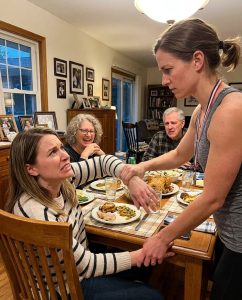
My sister Sarah had walked into the dining room carrying her gym bag like she owned the house, dropped it onto the chair I had just polished, and acted as though the whole evening belonged to her.
That part was normal.
Sarah had always carried herself like someone who believed strength made her untouchable.
She was thirty, trained for competitions, wore her medals proudly, and could enter our parents’ house without knocking on the emotional door either.
I was twenty-eight, trying to keep dinner from getting cold while everyone talked around me.
Then Sarah looked at my arm.
She smiled.
And she grabbed it.
She called it a family joke.
She said we were finally settling things with an arm-wrestling match, as if the whole thing were harmless and familiar.
I laughed because laughing had become my reflex around Sarah.
That was how I survived her.
I smiled when she mocked me.
I changed the subject when she pushed too far.
I pretended old injuries were accidents because that was easier than admitting the person hurting me was my own sister.
So when she pulled me into the chair, I told her I needed to finish serving dinner.
She ignored me.
She pinned my hand against the table.
At first, she pushed like it was actually a game.
Then her grip changed.
Her fingers locked around my wrist instead of my hand, and she started twisting.
Pain shot up my arm so fast that my breath disappeared before my voice came back.
I told her to stop.
I told her I was serious.
I told her it hurt.
She kept going.
Sarah leaned closer and told me everything hurt with me.
She said I needed to toughen up.
She said the real world would not coddle me.
Then my bone cracked.
The sound was small, but it changed everything inside my body.
My hand went weak immediately.
Heat ripped through my wrist and up toward my shoulder, and I screamed before I could stop myself.
Sarah did not release me right away.
For several seconds, she kept twisting while watching my face as though my pain were proof that she had won something.
When she finally let go, my arm dropped into my lap.
That should have been the moment somebody helped me.
Instead, Mom walked in from the kitchen, looked at my swelling wrist, and told me I was being dramatic.
Dad lowered his newspaper and immediately turned the conversation toward money.
He asked whether I understood how expensive an emergency room visit would be.
Sarah smiled.
Mom returned to the kitchen.
Dad lifted the newspaper again.
Then they told me to help serve dinner.
There was something almost unreal about hearing that request while my hand stopped looking like mine.
I tried moving my fingers.
Nothing happened.
Purple color was spreading beneath my skin, and my injured hand felt colder than the other one.
Everyone else was acting as though dinner mattered more than the fact that I might have seriously damaged my arm.
So I did the only thing I could think of.
I locked myself in the bathroom.
I wanted to get away from their voices, their laughter, and the strange normality they were forcing onto the room.
With my good hand, I searched for pain medicine.
A box of bandages shifted from a shelf and fell to the floor.
Medical papers scattered across the tile.
My name was printed on every page.
I stopped moving.
The first page described a fractured radius when I was sixteen.
Another documented cracked ribs.
Another listed severe bruising.
Beside each injury was an explanation that sounded familiar because I had heard the same explanations my whole life.
Fell downstairs.
Slipped in the shower.
Walked into a door.
Those phrases were family history in disguise.
I stared at the pages and realized I remembered something different.
I remembered Sarah’s martial arts phase.
I remembered her practicing chokeholds.
I remembered the pillowcase stuffed with books and swung like a weapon during one of her old games.
I remembered different years, different rooms, and different excuses.
The excuses changed.
The person did not.
My injured hand kept getting colder while I sat there with those pages spread across the bathroom floor.
For the first time, the past was not a collection of isolated accidents.
It was a pattern.
The bathroom door opened.
Sarah stood there looking at the records.
I expected embarrassment.
I expected anger.
I expected, at the very least, some recognition that she had crossed a line.
She laughed.
She called the records my “victim trophies.”
Then she told me nobody would believe the whiny sister over the successful athlete.
That sentence hurt almost as much as my wrist.
Because I knew exactly what she meant.
Sarah had built a version of herself that everyone trusted.
She had medals.
She trained hard.
She looked disciplined.
She knew how to speak with confidence.
I had spent years learning how to minimize myself around her.
That is what happens when a family keeps telling you the same story about yourself.
Eventually, you start repeating it for them.
My phone buzzed.
A friend had texted asking why I had disappeared.
I looked at the message, then at my family medical records on the tile.
For years, I had kept my explanations short.
I had protected my parents from uncomfortable questions.
I had protected Sarah’s reputation.
I had even protected myself from having to admit how badly I had been treated.
But that night, holding the phone awkwardly in my good hand, I typed two words I had never sent before.
“Need help.”
Then I slipped through the back door.
I did not make a plan.
I did not confront anyone.
I just left before someone could stop me.
I made it as far as the hedge before my knees nearly gave out.
That was when Mrs. Chen saw me.
She was seventy-two, our neighbor, and a retired nurse.
Her eyes went immediately to my swollen wrist.
I gave her the answer I had been giving people for years.
“I fell.”
She did not argue.
She did not ask me to prove it.
She looked at my arm and quietly told me she had watched me fall too many times.
Those words landed differently because she was not talking about one night.
She was talking about all the nights she had noticed something was wrong and all the times I had covered it up.
Mrs. Chen caught my good elbow and guided me toward her car.
She did not need a dramatic speech.
She did not need to convince me that my family was wrong.
She simply acted like my injury mattered.
Inside the car, she did not immediately pull away.
The engine stayed running while she looked at my face instead of my excuses.
For the first time in years, someone was not asking me why I was causing trouble.
Someone was asking what had happened.
I wanted to protect my family’s image.
I wanted to believe there was still a version of Sunday dinner where everyone would eventually admit what Sarah had done.
I wanted to believe one honest conversation could repair years of pretending.
But Mrs. Chen had already seen enough.