
Instead of responding to the nurse, Ethan turned toward his mother and held her gaze.
He was six years old.
He was exhausted, dehydrated, and wrapped in a hospital blanket after being gone for nearly eighteen hours.
Dark purple bands circled both wrists.
His hair, which had been normal when he left our house the previous morning, had been cut almost to his scalp.
And when the nurse asked whether anyone at home had known where he was supposed to be, Ethan did not point at me.
He looked at my wife.
That look landed harder than anything he had said since coming home.
Because only a few hours earlier, my wife had still been trying to explain away what had happened.
Maybe her mother had gone to the wrong entrance.
Maybe Ethan had fallen.
Maybe I was doing what she had accused me of doing for years whenever Gertrude was involved: turning an uncomfortable situation into a crisis.
But Ethan’s face was not an argument.
Neither were his wrists.
And none of it had begun in a hospital room.
It had begun in our kitchen with breakfast.
That morning, eggs hissed in butter on the stove while the vanilla candle my wife liked burned beside the sink.
Ethan sat at the table in his dinosaur hoodie, swinging his feet beneath the chair.
He looked exactly like what he was: a six-year-old boy who expected the adults around him to keep their promises.
Three weeks earlier, he had fallen off his bike.
Nothing about that morning was supposed to become a family emergency.
His pediatrician simply wanted orthopedics to take one last look before Ethan went back to normal recess activities.
The appointment information was still attached to the refrigerator beneath a small magnet.
2:00 p.m.
Hospital Orthopedics Desk.
Ethan Richardson.
It should have been routine.
Then my wife came into the kitchen carrying a paper coffee cup and told me the plan had changed.
Her mother was taking him.
I stopped cooking.
“Why?” I asked.
“She offered.”
Two words.
That was enough to make my stomach tighten.
Gertrude rarely pushed her way into our lives in an obvious way.
She offered.
She offered rides.
She offered opinions.
She offered help that somehow left everyone feeling indebted afterward.
Refusing her rarely stayed a simple refusal because Gertrude had a talent for making boundaries sound like personal attacks.
My wife had grown up with that rhythm.
I had married into it.
Over the years, we had learned the easiest way to keep peace was often to let a small thing go.
Then another.
Then another.
But this was Ethan’s medical appointment.
I told my wife I was uncomfortable with Gertrude taking him.
She reminded me I had a meeting.
She said her mother knew how to handle appointments.
Then came the familiar request.
“Please don’t make this a whole thing.”
That sentence mattered because it put me in a position I knew too well.
If I insisted, I became the difficult husband.
If I backed down, Gertrude got what she wanted.
That morning, I backed down.
At 10:00 a.m., a polished silver Mercedes pulled into our driveway.
Gertrude stepped out wearing a cream coat.
She barely acknowledged me before turning her attention to Ethan.
Her voice changed when she spoke to him.
“Ready, sweetheart?”
Ethan did something so ordinary I almost missed the meaning of it.
He looked at me first.
Not Gertrude.
Not the car.
Me.
Children do that when they are checking whether something is safe.
At six, Ethan still believed the world worked because the adults he trusted said it did.
I zipped his backpack.
I told Gertrude to take him straight to the appointment and call when they arrived.
She gave me a tight smile.
“We know.”
Then they left.
For a while, there was nothing dramatic to react to.
No alarming message.
No strange phone call.
No warning from Ethan.
Just an ordinary weekday continuing around a plan I thought another adult had agreed to follow.
At 2:15 p.m., I called the clinic.
The receptionist placed me on hold.
I remember the waiting music because I had nothing else to focus on while I stood there wondering why nobody had contacted me.
Then she came back on the line.
Her tone was different.
The clinic had no record of Ethan Richardson checking in that day.
I opened the patient portal immediately.
Same department.
Same confirmation number.
Same appointment time.
There was no scheduling mistake on my end.
I called Gertrude.
Voicemail.
I called again.
Voicemail.
By 4:00 p.m., the hospital scheduling office had confirmed what the first receptionist told me.
“He never checked in.”
That was the moment the missed appointment stopped feeling like an inconvenience.
I began saving everything.
The portal page.
The appointment reminder.
The call history.
Every unanswered attempt to reach Gertrude.
2:17.
2:41.
3:06.
3:39.
I was not thinking about revenge.
I was not trying to build some dramatic file against my mother-in-law.
I was trying to hold on to facts.
That distinction mattered because I knew what usually happened whenever Gertrude and I disagreed.
The disagreement became about my reaction instead of her behavior.
My wife came home carrying grocery bags.
I asked where Ethan was.
She assumed her mother had probably taken him for ice cream.
I told her he had missed the appointment.
She suggested the wrong hospital entrance.
I told her the hospital had confirmed he never checked in.
One of the grocery bags shifted when she put them on the counter.
An apple rolled onto the floor.
Neither of us picked it up.
That small thing stayed with me because our argument was happening around all the ordinary pieces of home life that were supposed to mean our child was safe.
Groceries on the counter.
A kitchen light.
A refrigerator with his appointment reminder still attached to it.
And no Ethan.
My wife became defensive.
“You always do this,” she said.
To her, my fear looked familiar because she had spent years hearing me complain about Gertrude’s interference.
To me, this was different because there was now a six-year-old boy whose location neither of us could confirm.
But the old language came back anyway.
Paranoid.
Dramatic.
Overreacting.
Those words had been used so often around Gertrude that they had almost become part of the furniture in our marriage.
If Gertrude crossed a boundary and I objected, the discussion somehow shifted toward whether my objection was excessive.
That afternoon, however, I had something I usually did not have.
Timestamps.
A missed medical appointment.
Unanswered calls.
A child who had not come home.
So I stayed awake.
The hours passed without Gertrude returning Ethan.
There was still no explanation that made the timeline make sense.
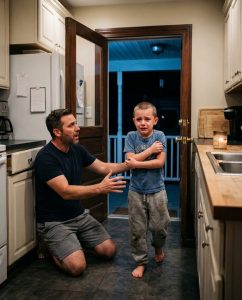
Then, at 3:47 a.m., our back door opened.
I heard the creak first.
Then small footsteps on the kitchen tile.
Slow.
Uneven.
Ethan appeared in the doorway alone.
The dinosaur hoodie was gone.
So were the clothes I had dressed him in that morning.
He wore sweatpants I had never seen and a faded T-shirt hanging crookedly from one shoulder.
His hair had been cut almost down to the scalp.
His lips were cracked.
His hands would not stop shaking.
“Daddy…”
I dropped to my knees so quickly that my shoulder hit the cabinet.
There are moments when a parent wants answers immediately.
This was not one of them.
Everything about Ethan told me that demanding information would have been for my benefit, not his.
So I tried to keep my voice level.
I asked where he had been.
His eyes filled.
Then he gave me the first direct piece of information about Gertrude since she had driven away.
“Grandma told me I’m not allowed to say where we went.”
That sentence changed the shape of the entire day.
Missing the appointment could potentially have had an innocent explanation.
Ignoring calls could have had one too.
Even returning late could have been explained badly but innocently.
Telling a six-year-old that he was forbidden to tell his parents where an adult had taken him was something else.
Still, I did not yell.
I did not start firing questions at Ethan.
I put my hands against the floor because they were shaking too.
He smelled different.
Not dirty.
Not like our laundry soap.
There was unfamiliar detergent on his clothes, mixed with cold night air and the unmistakable sour edge of fear.
Then Ethan pulled his sleeve down.
It was a tiny gesture.
He might have hoped I would not notice.
I noticed.
I reached carefully toward his arm and gave him time to move away if he wanted to.
When the sleeve shifted back, the first marks became visible.
Dark purple bands circled his wrist.
They were separated rather than blended together.
When I checked the other arm, there were similar marks there too.
My wife stepped closer.
“Maybe he fell.”
Ethan moved backward before she touched him.
That reaction did what my arguments had failed to do all afternoon.
My wife’s expression changed.
The important thing was not simply that Ethan had bruises.
It was that he recoiled from his mother at the exact moment she approached him after trying to explain those bruises away.
I wrapped him in the blanket from the couch.
Then I called for medical help.
I told the dispatcher only what I could verify.
Six years old.
Gone nearly eighteen hours.
Dehydrated.
Shaking.
Unexplained marks around both wrists.
Hair cut without either parent’s approval.
I did not fill the gaps with guesses.
I did not tell the dispatcher what I feared Gertrude might have done because I did not know.
I had spent the afternoon fighting to make facts matter inside my own house.
Now facts were the only thing I trusted myself to give anyone else.
While I was speaking, my wife’s phone began vibrating on the kitchen counter.