A cemetery worker placed both hands on the coffin lid, and every voice around the grave seemed to disappear.
I stood beside him with rain running down the back of my collar, mud packed around my shoes, and my seven-year-old son’s fingers wrapped tightly around my hand.
Ethan wasn’t crying anymore.
That frightened me more than the crying had.
For the last hour, almost everyone around us had treated his words as the desperate reaction of a little boy who had just watched his mother disappear beneath six feet of dirt.
Maybe they were right.
Maybe I was about to make the worst decision a grieving husband could make.
But standing over Laura’s coffin, I could no longer pretend that Ethan was the only one who had felt something was wrong.
Three days earlier, my wife had gone to sleep and never gotten back up.
Her name was Laura Walker.
She was my wife, Ethan’s mother, and the person who had somehow made the ordinary parts of our life feel permanent.
I was thirty-eight, a construction foreman, and the kind of man who usually trusted what could be measured, checked, repaired, or explained.
If a wall was crooked, there was a reason.
If a beam failed, there was a reason.
If something went wrong on a job site, you found the cause before anyone moved forward.
But grief didn’t work that way.
The doctors told me Laura had suffered cardiac arrest in her sleep.
That was the explanation I was given.
I repeated it to relatives because they kept asking what had happened.
I repeated it to myself when I walked past the side of the bed where she should have been.
I repeated it when Ethan asked why his mom had gone to sleep and never woke up.
There are questions a father wants to answer for his child.
That wasn’t one of them.
I had no answer that could make sense to a seven-year-old.
So I told him what adults tell children when adults don’t know what else to say.
I told him Mommy had died.
I told him we loved her.
I told him we would say goodbye together.
Ethan listened, but he never seemed convinced that goodbye was the right word.
The morning of the funeral was cold and gray, the kind of day when the clouds seemed close enough to touch.
By the time we reached the funeral home, Ethan had gone quiet.
He stayed near me while people came over, squeezed my shoulder, hugged him, and told us how sorry they were.
Most of those words blurred together.
I remember faces more than sentences.
I remember people lowering their voices when they approached us.
I remember Ethan holding my sleeve.
And I remember Laura’s hand.
Before the service ended, I walked to her one last time.
I had already seen her lying there, but I needed one private second that didn’t belong to relatives, funeral arrangements, doctors, paperwork, or condolences.
I touched her hand.
Then I stopped.
Her skin seemed warm.
Not alive-warm.
Not unmistakably warm.
Just warm enough to make me hesitate.
For a moment I stared at our hands together and wondered whether grief was playing some cruel trick on me.
I called the mortician over and told him what I had noticed.
He didn’t react the way I expected.
He didn’t look alarmed.
He explained that preparation could sometimes make the body feel different from what families expected.
He spoke calmly, and I wanted that calmness.
I needed someone else to make the moment ordinary.
So I accepted his explanation.
At least I told myself I did.
Then the coffin was closed.
That should have been the end of my doubt.
The burial happened later beneath a steady gray rain.
Umbrellas tilted in the wind while people gathered around the grave.
I kept one hand on Ethan’s shoulder as the final words were spoken.
He stood close enough that I could feel him trembling through his coat.
When the coffin began descending, his whole body stiffened.
At the time, I thought he was finally understanding that his mother was gone.
I pulled him closer.
He didn’t look at me.
His eyes stayed fixed on the grave.
The coffin went lower.
Ethan suddenly whispered something.
I couldn’t hear him clearly over the rain and the movement around us.
I bent toward him, but he shook his head and pressed closer to me.
The burial continued.
Dirt covered the coffin.
People began saying goodbye to us.
Some headed toward their cars while others stayed nearby, speaking quietly beneath umbrellas.
I was exhausted enough that I barely knew what I was doing.
I remember thinking only about getting Ethan home.
I wanted to take off the suit that felt too tight around my neck.
I wanted to make him something to eat, even if he refused it.
I wanted to get through one hour without somebody asking me what I planned to do next.
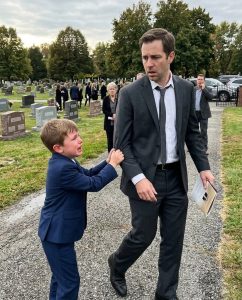
Then Ethan grabbed my sleeve.
Hard.
I turned toward him.
His face was wet from rain and tears, and his eyes were wider than I had ever seen them.
“Dad, we have to dig her up! Mom’s not dead! She’s calling me!”
The words were loud enough that the people closest to us heard them.
A few stopped walking.
Someone turned around.
I felt every muscle in my body tighten.
I crouched in front of Ethan and held his shoulders.
“Ethan, I know you miss Mommy. She’s gone now. She’s resting.”
He shook his head violently.
“No. She’s still calling me.”
There was something in his voice I couldn’t explain.
He wasn’t talking like a child asking for something impossible.
He wasn’t bargaining.
He wasn’t asking whether his mother could come back.
He was telling me that I was wrong.
“Daddy, I heard her,” he insisted. “She said my name when they were lowering her down.”
I wanted to tell him grief could make people hear things.
I wanted to tell him that after everything he had been through, his mind was trying to keep his mother close.
I wanted to be the reasonable adult in the cemetery.
Then I remembered Laura’s hand.
That tiny piece of doubt I had forced down that morning came back so fast it made my stomach turn.
Her skin seemed warm.
I had noticed it.
I had asked about it.
I had accepted the explanation because accepting it was easier than considering what the alternative might mean.
I looked toward the grave.
Fresh dirt covered the place where my wife had been lowered less than an hour earlier.
Then I looked at Ethan.
He was still gripping me.
“You’ll see, Daddy,” he said.
Something inside me shifted.
Maybe I was acting irrationally.
Maybe every person watching thought grief had finally broken me.
But I knew one thing with absolute clarity.
If I walked away without checking, I would spend the rest of my life wondering whether my son had been trying to tell me something and I had refused to listen.
I stood.
“Bring me the tools,” I said.
The cemetery caretaker stared at me as if he hadn’t heard correctly.
“Sir, we can’t just reopen a grave because of—”
“I don’t care.”
He tried again.
There were procedures.
There were reasons not to do this.
There were people still standing around us who had just watched the burial.
I understood all of that.
None of it mattered enough to make me leave.
“Get me the shovel.”
My voice carried farther than I intended.
People who had already started toward the parking area stopped.
Some came back.
Nobody seemed sure whether they were about to witness a grieving father’s breakdown or something none of us could explain.
Two workers eventually stood with me beside the grave.
I took a shovel.
The first scoop of wet dirt felt unreal.
I threw it aside and dug again.
Then again.
Soon mud covered the lower legs of my pants.
My hands began hurting long before I cared about the pain.
Rain softened the soil, but that didn’t make the work feel easier.
Every shovel full brought the same questions back.
What if Ethan had imagined everything?
What if I was reopening Laura’s grave only to prove to my son in the most brutal way possible that his mother really was gone?
What if I was turning the worst day of his life into something even worse?
I almost stopped.
Then Ethan spoke from beside the grave.
“You’ll see, Daddy.”
His voice was quieter now.
“I told you.”
I looked up at him.
He didn’t seem excited.
He didn’t seem confused.