Denise was still holding my phone when Mom’s new text appeared. The preview said she had instructed Vanessa to deal with Emma before I returned to the kitchen.
For several seconds, I could only look at the screen.
The wording changed everything.
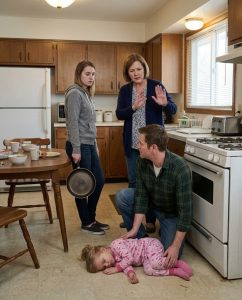
Until then, I had been trying to understand how a four-year-old sitting in the wrong chair had somehow ended with a hot skillet beside her head and my daughter being carried unconscious out of my parents’ house.
Now there was something from before I came downstairs.
Something deliberate.
Denise looked at me, then at the security officer standing near the door.
“Don’t delete anything,” she said.
“I won’t.”
My voice barely sounded like mine.
She asked whether my mother normally gave Vanessa instructions about Emma.
“No.”
“Had Emma been causing trouble this morning?”
“No.”
“Was she fighting with Lily?”
“No.”
“Was she told she couldn’t sit there?”
I shook my head.
“She was eating breakfast.”
That was the part my family kept trying to make complicated.
Emma had sat in Lily’s place by mistake. She was four. She saw food, saw a chair, climbed into it, and started eating.
That was all.
Denise asked me to walk through the morning again without guessing about anything I had not personally seen.
So I did.
I told her about the syrup on Emma’s yellow sweatshirt. I told her I had taken it upstairs to rinse it. I told her about the crash at 8:17 a.m., about running down the stairs, about the pan on the floor, the eggs stuck around its rim, and Emma beside Lily’s chair.
I told her Vanessa was standing near the stove.
I told her Lily was still at the table.
I told her my mother stepped between Vanessa and me after I picked up Emma.
Then I repeated what my mother had said.
Take her somewhere quiet.
Everyone was upset enough already.
Denise wrote without interrupting.
The security officer asked one question.
“When you found your daughter, did anyone call for medical help before you did?”
“No.”
That answer hurt in a different way.
Not Vanessa.
Not Mom.
Not Dad.
My father had picked up Emma’s pink cup and put it in the sink while I was kneeling beside her trying to make sure she was breathing.
I had been replaying that moment ever since the hospital doors closed behind her.
The cup in his hand.
The juice on the floor.
His refusal to look at Emma.
It was such an ordinary movement that it almost felt worse than shouting would have.
He had chosen cleanup.
My phone buzzed again.
Denise glanced down.
Mom.
Another message.
This one tried to soften the first without denying it. She said she had only wanted Vanessa to correct the seating problem before I returned. She said nobody had wanted Emma hurt.
I read it twice.
Then I remembered my mother standing between me and Vanessa while Emma hung limp against my chest.
Whatever Mom claimed she had intended before I came downstairs, I knew exactly what she had done afterward.
She had seen Emma.
She had seen the pan.
She had seen me holding a child who could not hold up her own head.
And her concern had been everyone else’s mood.
Denise didn’t tell me what conclusion to draw.
She didn’t need to.
She simply preserved the sequence of messages and asked whether I wanted any relatives allowed back if they arrived at the hospital.
“No.”
The answer came quickly.
Then I corrected myself.
“No one from that house.”
She nodded.
It was the first decision I had made all morning that didn’t feel like panic.
A nurse came in a few minutes later and told me Emma was still stable. They were continuing to monitor the concussion and treating the injury to her face. I could see her again soon, but she might remain sleepy and confused because of everything she had been through and the medication she had received.
I thanked her.
Then I asked the question I had been afraid to ask since 8:39 that morning.
“Is she going to know me?”
The nurse’s expression softened.
“She knew you were there earlier.”
That was enough to make my knees weak.
When they finally let me back beside her, Emma looked smaller than she had at breakfast.
Hospitals do that to children.
The bed was too wide. The blanket was too white. The monitor leads looked too large against her little body.
I sat beside her and put my hand near hers without touching anything the nurses had positioned.
Her fingers moved first.
Barely.
Then again.
“Mommy?”
“I’m here.”
Her eyes opened only partway.
She looked confused, then tired.
“I’m here, baby.”
She swallowed.
“Did I do bad?”
The question hit harder than anything Vanessa or my parents had said.
I leaned closer.
“No.”
Emma blinked slowly.
“You sat in a chair,” I said. “That’s all.”
“Lily’s chair.”
“Yes.”
Her mouth trembled.
“I’m sorry.”
“No.”
I had to stop because my voice cracked.
I tried again.
“You never have to apologize for somebody hurting you.”
She closed her eyes.
A few minutes later, she was asleep again.
I stayed beside her.
At some point, Denise returned my phone.
There were more notifications now, but I didn’t open most of them.
Dad had called twice.
Mom had sent several messages.
Vanessa had finally sent one too.
I stared at her name without touching the screen.
Denise noticed.
“You don’t have to answer anyone right now.”
“I know.”
That was new for me.
In my family, not answering was treated like aggression. Boundaries became insults. Leaving a conversation became disrespect. Saying no meant somebody would call somebody else until enough people were involved that you eventually gave in just to make the noise stop.
That morning, though, the noise had stopped mattering.
My daughter was lying in a hospital bed because the adults around her had cared more about a chair, a breakfast table, and keeping the peace than they had cared about her safety.
I opened Vanessa’s message.
It was short.
She said I had not seen what happened.
That was true.
And for the first time, I understood that I didn’t need to pretend otherwise.
I had not seen the pan leave her hand.
I had seen everything that came after.
I had seen where Emma was lying.
I had seen where the skillet landed.
I had seen Vanessa standing there.
I had heard her justify what happened by saying Emma had taken Lily’s seat.
I had watched my mother defend the atmosphere in the room instead of the injured child in my arms.
And now I had Mom’s message showing that Vanessa had been instructed to deal with Emma before I returned.
I didn’t need to exaggerate any of it.
The truth was bad enough.
I handed the phone back to Denise and asked her to make sure the new messages were added to what she had already reviewed.
She did.
Around lunchtime, Dad called again.
I let it ring until it stopped.
Then he left a voicemail.
He said he had Emma’s shoes.
For some reason, that broke something open in me.
Mom had walked onto the porch that morning holding my coat while I strapped Emma into the car.
She had brought my coat.
She had not brought Emma’s shoes.
Now Dad had them.
I imagined those tiny sneakers still sitting near the kitchen, probably beside the same table where everyone had been so worried about Lily’s seat.
I did not call him back.
A while later, the front desk contacted the room. My father had dropped off a bag and left.
Inside were Emma’s shoes, her pink cup, and the yellow sweatshirt I had rinsed upstairs.
The sweatshirt was still damp around one sleeve.
I held it for a long time.
That morning had started because I was trying to clean syrup from that shirt.
Less than ten minutes.
That was how long I had been upstairs.
I used to think life-changing moments announced themselves somehow.
They don’t.
Sometimes you are rinsing syrup out of a child’s sweatshirt, thinking about breakfast and whether you remembered to pack apple slices, and downstairs the people you trust are making choices you will never be able to forget.
I folded the sweatshirt and put it back in the bag.
The pink cup stayed on the windowsill beside me.
Dad sent one message after leaving.
He said he hoped I understood that the family was frightened too.
I stared at that word.
Family.
Emma was family when people wanted pictures of her.
She was family at birthdays.
She was family when my mother wanted both granddaughters dressed nicely at the same table.
But when Emma was hurt, suddenly Vanessa had Lily to think about. My parents had everyone’s mood to think about. Somehow every adult in that kitchen had been assigned a person to protect except me.
I had Emma.
That was enough.
I replied to Dad with one sentence.
From now on, anything about what happened needed to be in writing.
Then I muted the conversation again.
No speech.
No threat.
No argument.
Just a boundary.
Later that afternoon, Mom tried calling from Dad’s phone.
I recognized the pattern immediately because he almost never called twice in a row.
I didn’t answer.
She sent another message from her own number instead.
She insisted that telling Vanessa to correct Emma did not mean she had told her to hurt Emma.
Maybe that distinction mattered to her.
To me, another distinction mattered more.
After Emma was hurt, Mom still had choices.
She could have called for help.
She could have brought Emma’s shoes.
She could have come with me.
She could have asked whether her granddaughter was breathing normally.
She could have told Vanessa to step away.
Instead, she told me to take my injured child somewhere else because Emma was upsetting the room.
That part required no interpretation.
By early evening, Emma was awake for longer stretches.
She wanted water, then decided she didn’t. She asked where her shoes were. I showed her the bag Dad had brought.
“Pink cup too?” she whispered.
I lifted it from the windowsill.
Her eyes followed it.
“There it is.”
She gave the smallest smile.
It lasted about a second, but I held onto it.
The doctors wanted to keep watching her. I didn’t argue about time. I didn’t ask when we could leave every twenty minutes. I sat where I could see her face and let the hospital move at the pace Emma needed.
That night, Denise stopped by again before leaving.
She told me that the hospital documentation reflected what I had personally observed, what I had been told, Emma’s condition when she arrived, and the messages my family had sent afterward.
I appreciated the precision.